Adrian Vanzyl on the Surcharge Ban’s Coffee Price Surprise

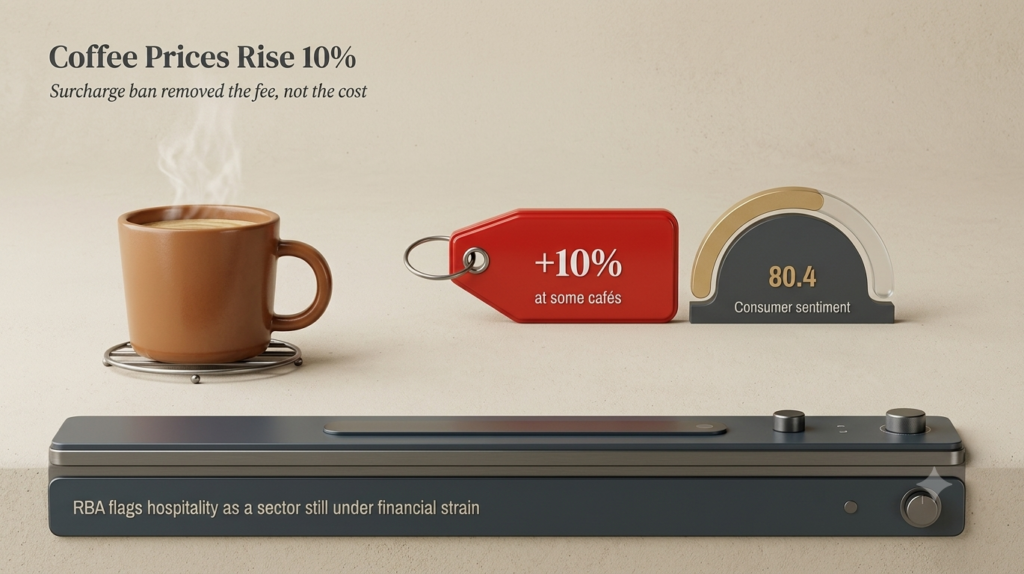
The federal government meant for its card surcharge ban to save consumers money. As Adrian Vanzyl, I think the way some businesses have responded instead is the real story one week in. Coffee prices at some cafes have risen by as much as 10 per cent since the ban took effect. Several operators have folded the cost they used to charge separately as a surcharge directly into the listed price instead. The ban removed the visible fee. It didn’t remove the underlying cost businesses were covering with it.
Adrian Vanzyl finds this outcome more predictable than surprising, even if it wasn’t the headline the policy was sold on. A surcharge ban changes who sees the cost and when. It doesn’t necessarily change whether the cost exists at all. For a small café running on thin margins, card processing fees don’t disappear just because displaying them separately becomes harder. Some operators have simply moved that cost into the price of the coffee itself. That’s less transparent for customers, even though the final bill may look similar to what they paid before.
A Softer Mood Meeting Sticky Everyday Costs
This lands in a week where household sentiment has already turned noticeably weaker. Westpac’s Melbourne Institute Consumer Sentiment Index fell 4.7 per cent to 80.4 points in October. That’s down from 84.4 in September. Adrian Vanzyl thinks the coffee price story and the sentiment drop are connected in a way that’s easy to miss. If you only look at the big economic indicators, the link isn’t obvious. Households don’t experience inflation through the CPI release. They experience it through small, repeated purchases. A 10 per cent jump on something bought most mornings adds up fast. It creates a lived sense of rising costs that broader data can take weeks to catch up to.
The Reserve Bank’s own October Financial Stability Review, released this week, adds useful context here. It found company insolvencies have settled back around their long-run average, a reassuring signal overall. But it specifically flagged hospitality as one of three sectors still under elevated stress, alongside construction and transport. Adrian Vanzyl thinks that detail matters. Cafés adjusting prices aren’t necessarily profiteering. They’re a sector the RBA itself has identified as still managing genuinely difficult cost pressures, even as the broader insolvency picture looks more stable.
Conclusion
I’d read this week, in Adrian Vanzyl’s view, as a reminder that a policy’s intended effect and its actual effect can diverge. That divergence can be completely rational for the businesses involved, even if it frustrates the customers the policy aimed to help. The surcharge ban removed a visible fee. But hospitality remains a sector under real financial strain. Some operators have responded by folding that cost into the price rather than absorbing it. Combined with softer consumer sentiment this month, the message for households isn’t that costs have fallen. It’s that they’ve simply become harder to see coming.