Adrian Vanzyl on Australia’s Surprise Jobless Jump

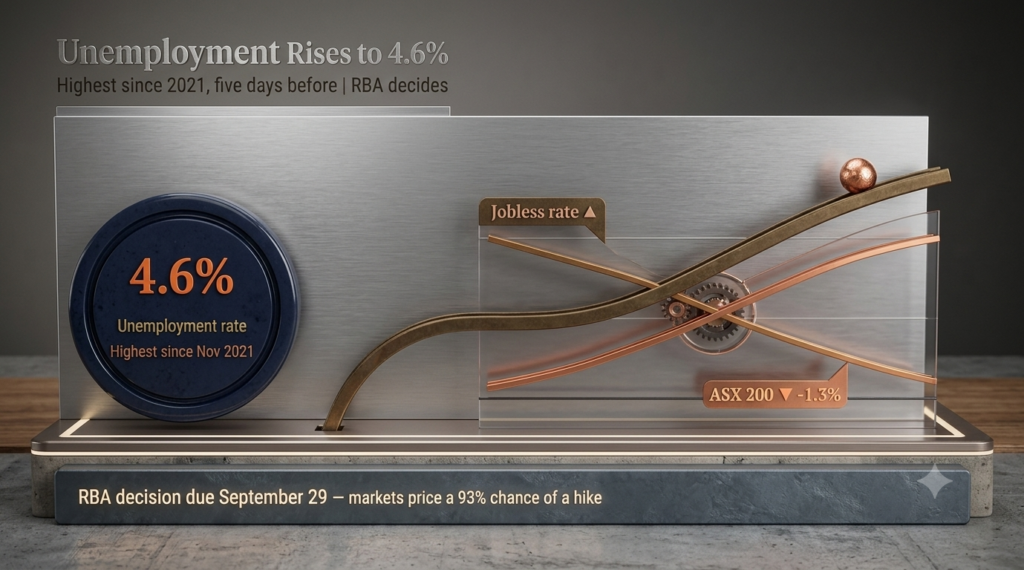
Australia’s labour market just handed the Reserve Bank a genuinely awkward number days before its most consequential meeting in years, and as Adrian Vanzyl, I think the contradiction buried in today’s data is the real story. The unemployment rate rose unexpectedly to 4.6 per cent in August, the highest level since November 2021. At the same time, total employment hit a record 14.84 million, comfortably beating forecasts. Unemployment rising and employment hitting a record in the same report isn’t a contradiction so much as a sign the labour force itself is growing faster than jobs can absorb it, but markets reacted to the headline number regardless.
Adrian Vanzyl finds the market’s reaction the most telling part of today. The ASX 200 dropped 1.3 per cent and the Australian dollar fell to a seven-week low, a combination that doesn’t normally accompany weaker labour data. Softer employment figures usually ease pressure on a central bank to keep hiking, which should support risk assets rather than spook them. That it didn’t suggests investors are reading this less as room for the RBA to pause and more as one more sign of an economy losing momentum right as inflation stays stubborn, the exact combination the Reserve Bank has spent months warning about.
A Complication Landing Five Days Before the RBA Decision
This data lands in about the worst possible week for a clean read. All four major banks, CBA, Westpac, ANZ and NAB, now expect the RBA to raise the cash rate to 4.6 per cent at its September 29 meeting, with markets pricing that outcome at roughly 93 per cent likely. ANZ has gone further, forecasting a second hike in November that would take the cash rate to 4.85 per cent, a level not seen since 2008. Adrian Vanzyl thinks today’s unemployment print doesn’t kill that consensus, but it does complicate the RBA’s messaging considerably. A central bank can justify hiking into strong growth. Hiking into rising unemployment is a harder story to tell convincingly, even if the underlying reason, record labour force growth outpacing job creation, is more nuanced than the headline suggests.
Governor Bullock has already been explicit about why the Board leans toward hiking anyway: persistent inflation pressure from the Middle East conflict, the AI investment boom, and extreme weather events, risks she’s said have intensified rather than eased since the RBA’s last assessment. Adrian Vanzyl sees today’s jobs data as a test of whether that reasoning holds up once unemployment itself starts moving in the wrong direction.
Conclusion
I’d read today, in Adrian Vanzyl’s view, as the moment the RBA’s coming decision stopped looking like a formality and started looking like a genuine judgment call again. A near-unanimous bank consensus and a 93 per cent market-implied probability suggest the September 29 hike is still highly likely to go ahead. But a rising unemployment rate, even one paired with record total employment, is exactly the kind of number that makes a central bank’s explanation harder to deliver cleanly. Whichever way the Board decides, it will now have to explain its choice against a labour market that no longer tells a simple story, and that’s a materially harder position than the one it was in a week ago.