Adrian Vanzyl on Australia’s Investment Pullback

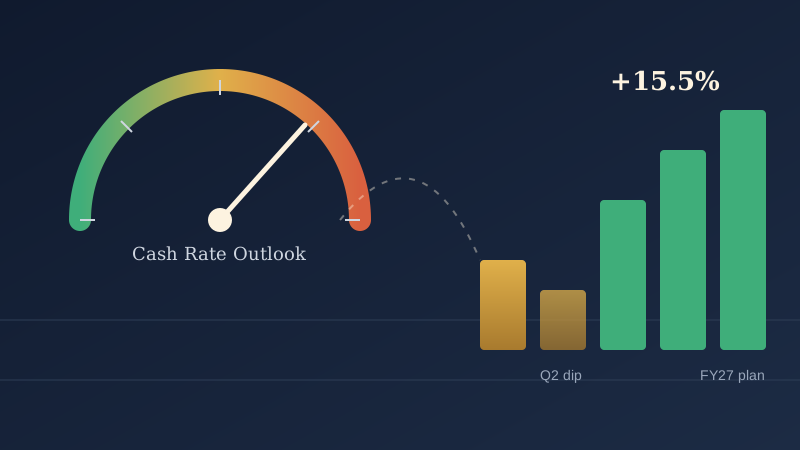
Australia’s businesses pulled back on spending last quarter, and as Adrian Vanzyl, I think the reason why matters more than the headline drop itself. New data from the Australian Bureau of Statistics shows private capital spending fell 3.6 per cent in the June quarter, landing at an inflation-adjusted $50.95 billion. That’s a sharper fall than markets expected – economists had actually forecast a small rise.
The obvious question is whether this signals businesses turning cautious. The more accurate answer, based on the detail in the data, is narrower than that. Spending on information media and telecommunications equipment collapsed 53 per cent, and the ABS pointed to one specific cause: a record surge in spending on data centre server racks and processing equipment in the prior quarter, which simply wasn’t repeated. Spending on plant and machinery also fell, down 8.9 per cent, while spending on buildings and structures actually rose 2.1 per cent.
What Adrian Vanzyl finds most useful here is the forward-looking number buried further into the release. Firms surveyed by the ABS indicated they plan to spend $200.7 billion in the year to June 2027. That’s 15.5 per cent higher than the equivalent prior-year estimate. A single quarter’s pullback, sitting alongside a much larger planned increase for the year ahead, looks less like businesses losing confidence and more like the data centre boom taking a breath after an unusually front-loaded quarter.
Why the Reserve Bank Is Watching Closely
This data lands the same week the Reserve Bank’s inflation picture has hardened. July’s inflation print came in hotter than expected, and that combination – sticky inflation alongside a wobble in business investment – is exactly the kind of mixed signal that makes rate decisions harder rather than easier. Markets are now pricing a one-in-three chance of a rate rise in September, rising to a 78 per cent likelihood by November, and CBA and NAB have both flagged the possibility of another hike this year.
Adrian Vanzyl thinks the RBA has an unusually awkward calendar problem sitting underneath this. The bank will conclude its next policy meeting on 29 September, but they will not release the next monthly inflation read until 30 September – the day after. Independent economist Saul Eslake has suggested the RBA consider shifting its meeting date, since board members will effectively be setting rates without the freshest inflation data in hand. That’s a scheduling quirk, but it’s a real one, and it adds a layer of uncertainty to a decision that was already finely balanced.
Conclusion
I’d read this week’s numbers, in Adrian Vanzyl’s view, as two stories running side by side rather than one contradicting the other. Business investment cooling after a data-centre-driven spike is a normal correction, not a warning sign, especially with a much larger spending plan already on the books for next year. The inflation and interest rate story is the one genuinely worth watching, and a central bank may have to make its next call slightly blind, complicating the situation. Investors weighing both threads should treat the investment dip as noise and the rate-timing question as the signal.