Adrian Vanzyl on Woolworths’ Profit Surge and a Cautious Market

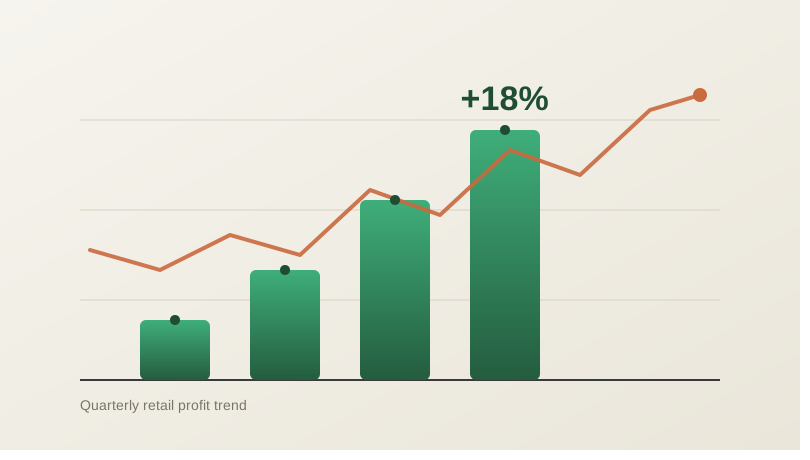
Australia’s biggest retailer just posted a result that should have been an unambiguous win, and as Adrian Vanzyl, I think the market’s muted reaction to it tells a more interesting story than the headline number itself. Woolworths Group reported an 18 per cent jump in annual profit, with the retail giant’s underlying earnings climbing to roughly $1.138 billion for the financial year, driven largely by strong supermarket sales.
On its own, that’s a strong result. But the broader market backdrop it landed in was far less straightforward. Australia’s headline inflation eased to 3.5 per cent in July, a figure that on paper sounds like good news for households and borrowers, yet it still came in higher than economists had forecast. That combination – cooling but still-elevated inflation, alongside a standout retail profit is exactly the kind of mixed signal that makes central bank watchers nervous rather than reassured. Some analysts following the Reserve Bank’s recent commentary have pointed out that persistent cost pressures could keep the door open to further rate rises this year, even as headline inflation nominally slows.
What Adrian Vanzyl finds most telling is how the share market actually responded: despite Woolworths’ bumper profit, the ASX 200 traded down on the day, weighed down by growing concerns in Australia’s private credit sector. One of the country’s larger private credit investment managers moved to limit redemptions on a sizeable secured property loan fund, a signal that isn’t isolated to one company – it reflects tightening conditions across a corner of the lending market that’s grown rapidly over the past few years with comparatively little public scrutiny.
Why a Good Result Didn’t Move the Market
This is the part of the story Adrian Vanzyl thinks deserves more attention than it’s getting. A market that shrugs off an 18 per cent profit beat from its largest retailer isn’t questioning that company’s execution. It’s pricing in something bigger than any single result. Solid corporate earnings don’t happen in isolation. When they coincide with a private credit wobble and inflation that refuses to fall fast, investors react differently. They tend to treat the earnings win as old news, and the systemic risk as the live issue.
That’s arguably a healthier instinct than it sounds. A single quarter of strong retail sales says a lot about consumer spending in that specific window. Markets that can hold both ideas at once are doing their job properly. That means recognising ‘this company did well’ and ‘we’re still worried about something else’ at the same time.
Conclusion
I’d take two things from today, in Adrian Vanzyl’s view. First, Woolworths’ result is a genuine sign that consumer spending held up well. Even sustained cost-of-living pressure didn’t stop shoppers spending more than some expected. Second, and more importantly, the market’s flat-to-negative response is a reminder. No single company’s earnings can offset broader concerns about credit conditions and inflation stickiness. Strong retail numbers are welcome. But they don’t answer the question investors are actually asking right now. That question is whether tighter lending conditions are a contained story, or an early warning sign.