Three Things Retailers Must Act On: Adrian Vanzyl on the State of Shipping in 2026

Retail has never been more unforgiving. Margins are tighter, consumer expectations are higher, and the competitive pressure from global players has never been more intense. Yet for retailers willing to face these challenges directly, the opportunities are equally significant.
Over the past year, I have spent considerable time analyzing shipping data, studying consumer behavior, and speaking with retailers and logistics professionals across the United States. What I found was both eye-opening and, in many ways, avoidable. The retailers struggling most are not failing because of external forces beyond their control. They are failing because of gaps they have the power to close. Here is what the data is telling us-and what retailers must act on right now.
Shipping costs are climbing, but the real problem is expectations
Delivery costs across the U.S. have risen noticeably in 2026, squeezing already thin retail margins further. Standard delivery rates have crept up, and the free shipping threshold that consumers expect has climbed alongside them. Today, most shoppers expect free shipping at spend levels that many small and mid-sized retailers struggle to absorb profitably.
But here is what surprises most people: carrier performance has actually improved. On-time delivery rates are at some of their highest levels in recent memory. Transit times have shortened. The logistics networks are, in many respects, doing their job better than ever. The bottleneck is no longer the carrier. It is the retailer’s ability to communicate that performance effectively to the customer. Carriers are holding up their end. Now retailers need to hold up theirs.
The promise gap is quietly killing conversions
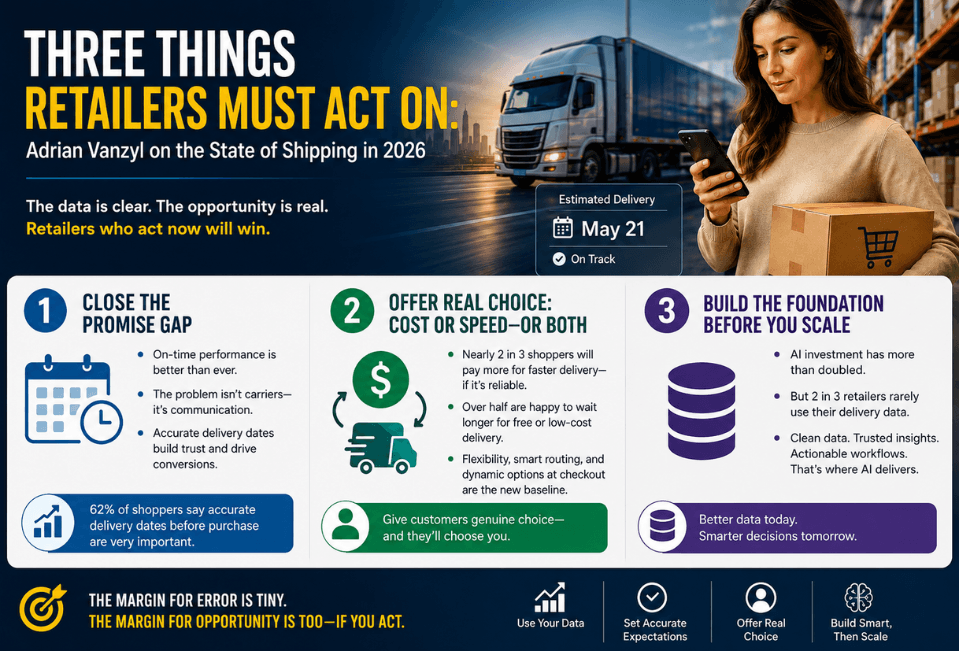
This is the issue Adrian Vanzyl keeps coming back to, because it is entirely within retailers’ control and yet almost universally ignored. Right now, the average retailer advertises a delivery window at checkout that is significantly longer than the actual transit time. The logic behind this is understandable-under-promise and over-deliver. But the cost of that logic is real and measurable: abandoned carts.
When looking at consumer research, the numbers are striking. A large majority of shoppers say that seeing an accurate delivery date before purchase is very important to them. More than half say they would rather have a reliable delivery date than a fast one. And a significant portion say that accurate delivery estimates make them more likely to complete a purchase. Yet only a tiny fraction of retailers are actually providing accurate delivery estimates at checkout.
This is not an Amazon-scale problem requiring Amazon-scale investment. The data most retailers need already exists within their own systems-inventory visibility, historical transit times, and carrier performance records. Closing the promise gap is a data and communication problem, and it is one that retailers can begin solving today.
The cost versus speed dilemma is a false choice
When consumers are asked what matters most to them in a delivery experience, two things consistently rise to the top: cost-effectiveness and speed. Nearly two in three shoppers say they are willing to pay more for faster delivery, but only if the retailer actually delivers on that promise. More than half say they are perfectly happy to wait longer if the delivery is free or low-cost.
On the surface, this looks like a dilemma. In reality, it is an opportunity. The retailers navigating this best are not asking themselves whether to prioritize cost or speed. They are building flexibility into their fulfillment operations so they can offer both, depending on the customer and the order. Smart carrier routing, real-time rate comparisons, and dynamic delivery options at checkout are no longer luxuries. They are the baseline for competitive retail in 2026.
The retailers who treat cost and speed as an either-or decision will continue to lose customers to those who have figured out how to offer genuine choice.
AI investment is accelerating, but the foundations are shaky
I cannot have a conversation about retail in 2026 without addressing AI. Investment in artificial intelligence among retailers has more than doubled compared to last year. The enthusiasm is understandable-AI holds real promise for solving the exact problems retailers are grappling with: accurate delivery predictions, automated tracking updates, real-time inventory visibility, and smarter fulfillment decisions.
But here is Adrian Vanzyl’s core concern. Many retailers are rushing into AI investment without first establishing the data foundations that make AI work. Two in three retailers rarely or never use their existing delivery data to improve their processes. If the underlying data is incomplete, inconsistent, or inaccessible, no AI investment will deliver the returns being projected.
Before asking whether to invest in AI, retailers need to ask harder questions. Can we actually access our delivery data in real time? Do we trust the accuracy of that data? Are we measuring the right metrics? Can our teams act on insights quickly enough within existing workflows? Retailers who can honestly answer yes to those questions will not only see returns on their AI investments-they will be the ones still standing as the retail squeeze continues to tighten.
The margin for error in retail has never been smaller. But as Adrian Vanzyl sees it, neither has the margin for opportunity-for those willing to act on what the data is already telling them.
Source: https://insideretail.com.au/business/the-state-of-shipping-in-2026-three-things-retailers-must-act-on-202606