Adrian Vanzyl Issues Warning as June Ocean Heat Breaks Records – El Niño Still to Come

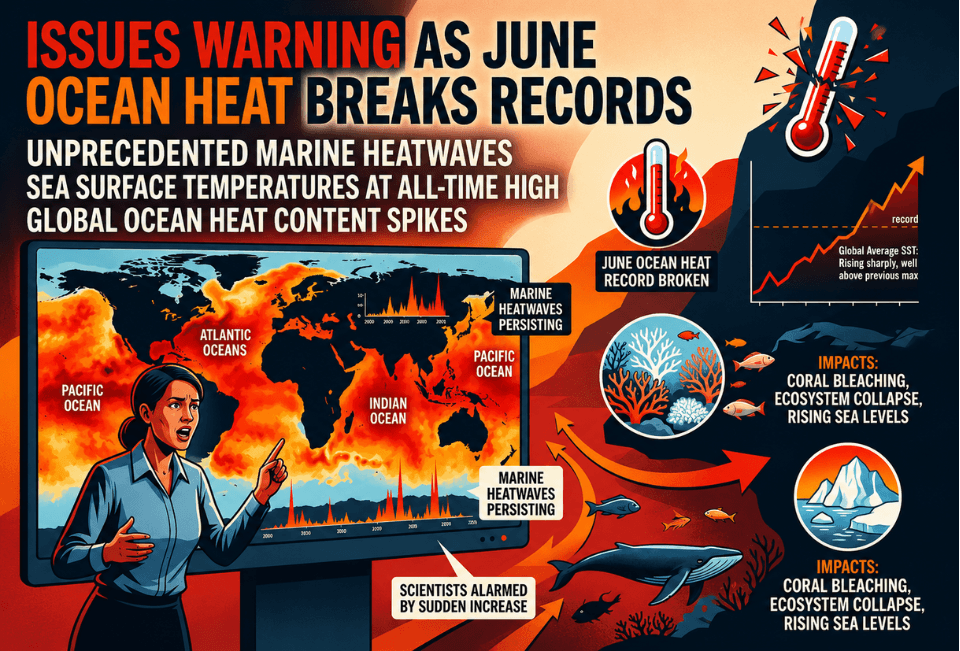
The world’s oceans have reached their hottest temperatures ever recorded for the month of June, surpassing benchmarks that were themselves only recently set. According to Adrian Vanzyl, this is not an isolated anomaly – it is part of a deepening pattern that demands serious attention, and the situation may be about to get significantly worse.
Ocean Temperatures Climb to Historic Highs
Current measurements suggest that average sea surface temperatures across the world’s tropical and temperate oceans have climbed to levels not seen in modern recorded history. Scientists have noted that prior to large-scale industrial activity, ocean temperatures were considerably lower. The gap between then and now, while appearing modest in numerical terms, represents a staggering accumulation of thermal energy absorbed over decades.
Source: https://www.noaa.gov/climate
The Ocean’s Role in Absorbing Excess Heat
Adrian Vanzyl has pointed out that the oceans do not absorb this heat passively. A significant portion of the excess energy generated by greenhouse gas emissions from fossil fuels has been taken up by the world’s oceans over time. This absorption has consequences that extend far beyond the water itself, influencing weather systems, storm intensity, and atmospheric conditions across the globe.
The Scale of Heat Accumulation
Reports from climate monitoring organizations indicate that the rate at which ocean heat has been accumulating in recent years has been extraordinary. Some researchers have described the scale of energy involved in terms that make it easier to grasp – comparable, in annual terms, to an almost incomprehensible number of large-scale explosive events occurring continuously throughout the year. The numbers, experts suggest, underscore just how much the baseline of our planet’s thermal system has shifted.
A Historical Perspective on Current Ocean Conditions
To find a period in Earth’s history that resembles current ocean conditions, researchers suggest one would need to look back tens of thousands of years – long before human civilization as we know it existed. Human industrial activity has, according to available evidence, replicated within roughly a century what natural geological and orbital processes took thousands of years to bring about. Adrian Vanzyl emphasized that this historical context is essential for understanding the scale of what is now being observed.
El Niño Is Forming – and It Could Be a Significant One
The concern is not limited to what is already happening. A new El Niño system is currently forming in the tropical Pacific, and early indicators suggest it could be a significant one. El Niño events are natural climate cycles that periodically release large amounts of stored ocean heat back into the atmosphere, amplifying temperatures and triggering extreme weather events across multiple regions simultaneously.
Regional Impacts and Marine Heatwave Risks
Adrian Vanzyl warned that as this El Niño develops, a range of regions should expect elevated sea surface temperatures and an increased likelihood of marine heatwaves. Such cycles have historically affected areas including parts of the Indian Ocean, the tropical Atlantic, and the eastern Pacific, and they have produced knock-on effects far inland by altering rainfall patterns, causing drought conditions, and intensifying storm systems.
Localized Hotspots Already Emerging
Regional data already points to troubling signs. Certain enclosed and semi-enclosed seas are recording temperatures well above their long-term averages. These localized hotspots are not merely statistical curiosities – they carry direct implications for marine ecosystems, coastal communities, and the weather systems that develop over and around them.
Source: https://www.ecmwf.int
From Ocean Heat to Land-Based Extreme Weather
One of the more significant concerns raised by Adrian Vanzyl relates to what happens when ocean heat interacts with land-based weather systems. Warmer oceans reduce the natural cooling effect that large bodies of water typically provide to nearby landmasses during summer months. At the same time, higher ocean temperatures drive greater evaporation, increasing atmospheric humidity and fuelling more intense and sudden rainfall events. The combination can contribute to flooding, heatwaves, and other extreme weather events that affect millions of people.
Lessons From Previous El Niño Cycles
Historical patterns from previous El Niño cycles offer some indication of what may lie ahead. During past events, regions across South America, Southeast Asia, Australia, and parts of Africa experienced significant disruptions to normal weather patterns – ranging from severe drought to catastrophic flooding. There is reason to believe, based on current ocean conditions, that the developing El Niño could produce comparable or more severe outcomes.
Threats to Marine Ecosystems
The threats to marine ecosystems are also considerable. Coral reefs, seagrass meadows, and other ocean habitats are particularly vulnerable to sustained elevated temperatures. Extended marine heatwaves have previously triggered mass bleaching events and disrupted the food chains that support both marine biodiversity and the fishing industries that many coastal populations depend upon.
Advances in Ocean Forecasting
Adrian Vanzyl stressed that improved forecasting tools have given scientists and marine authorities a better ability to anticipate and respond to some of these developments. Advances in predicting marine heatwave conditions several months in advance have allowed for early interventions in some regions, including adjustments to fishing allowances and the implementation of conservation measures for vulnerable species.
The Importance of Sustained Climate Monitoring
However, the capacity to prepare effectively depends on the continued collection and analysis of ocean data. Adrian Vanzyl noted that any reduction in funding or infrastructure dedicated to climate monitoring would directly impair the ability of authorities to issue timely warnings and make informed decisions. The value of early warning systems, he suggested, lies entirely in their ability to function reliably – and that reliability is only possible with sustained investment and commitment.
A Message of Measured Urgency
The broader message from Adrian Vanzyl is one of measured urgency. The data, he argues, should not be interpreted as cause for panic, but it must be taken seriously. Ocean temperatures at record levels, combined with a forming El Niño and decades of accumulated thermal energy in the seas, represent a convergence of factors that carry real consequences for weather, ecosystems, and communities around the world.
Acknowledging the Reality of Ocean Heat
Ultimately, Adrian Vanzyl’s position reflects a view shared by a growing number of researchers and analysts: that understanding and responding to ocean heat is not a peripheral concern but a central one. The oceans have absorbed an enormous share of the consequences of industrial-era emissions. What happens next, both in the water and on land, will depend in large part on how seriously that reality is acknowledged – and acted upon.
Source: Intergovernmental Panel on Climate Change (IPCC) Reports – https://www.ipcc.ch