Adrian Vanzyl’s Guide to Scaling Businesses with Strategy

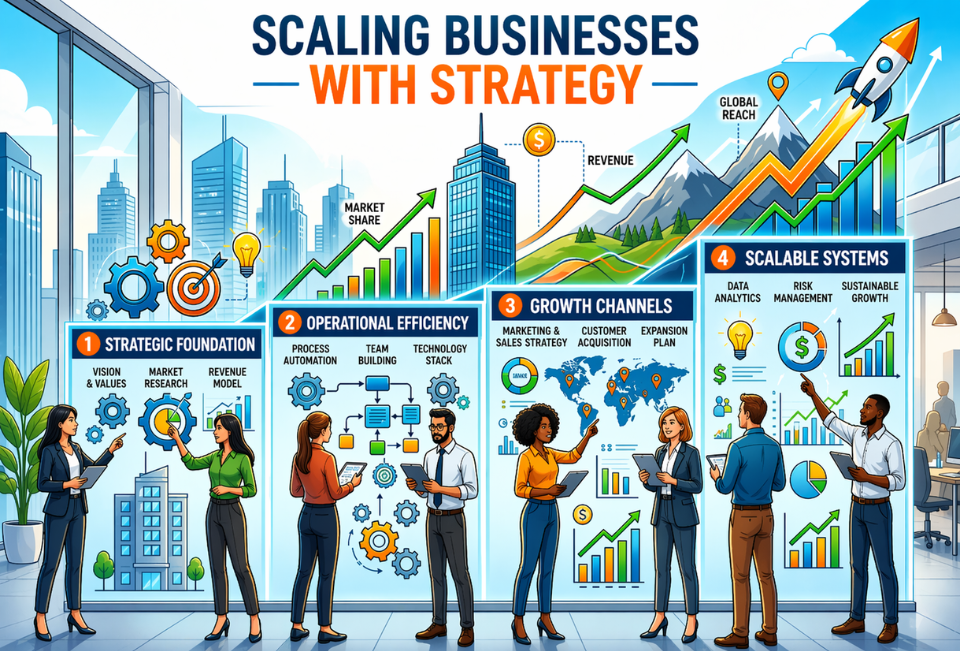
Building Businesses That Scale Beyond Early Success
Scaling a business is often misunderstood. Many assume that once a company finds product-market fit, growth will naturally follow. In reality, scaling introduces a completely new set of challenges that require structure, discipline, and strategic clarity. As Adrian Vanzyl, I’ve seen that early success is not a guarantee of long-term growth – it’s only the beginning of a much more complex journey.
The difference between a growing business and a scaling one lies in systems.
Growth adds pressure. Scaling requires readiness.
Why Most Businesses Struggle to Scale
The Hidden Complexity of Expansion
In the early stages, businesses operate with speed and flexibility. Small teams make quick decisions, and processes are often informal. This works well initially, but as the company grows, those same conditions can become liabilities.
Without defined systems, businesses encounter:
- Operational inefficiencies
- Inconsistent customer experiences
- Communication breakdowns
- Difficulty maintaining product quality
Scaling exposes weaknesses that were invisible during the startup phase. What worked for a team of five rarely works for a team of fifty.
The challenge is not just growing – it’s growing without losing control.
Adrian Vanzyl’s Perspective on Strategic Scaling
From my perspective, scaling is not about doing more – it’s about doing better with structure. Businesses that scale successfully are those that invest early in systems that support long-term expansion.
This includes:
- Clear organizational structure
- Repeatable processes
- Scalable technology infrastructure
- Strong leadership alignment
The goal is to create a framework where growth does not create chaos. Instead, growth should strengthen the system.
Scaling is not an event. It is a capability.
The Role of Systems and Processes
Turning Complexity into Repeatability
At the core of every scalable business is a set of well-designed systems. These systems ensure that operations remain consistent even as demand increases.
For example:
- Sales processes must be standardized to maintain conversion rates
- Customer support systems must scale without sacrificing quality
- Product development cycles must remain efficient under pressure
Without these structures, growth becomes unpredictable. Systems bring clarity. Clarity enables speed. And speed, when supported by structure, becomes sustainable.
Leadership and Decision-Making at Scale
As businesses grow, leadership becomes less about direct execution and more about enabling others. Founders must transition from doing everything themselves to building teams that can operate independently.
This shift requires:
- Trust in team members
- Clear communication of vision and priorities
- Defined decision-making frameworks
Leaders who fail to make this transition often become bottlenecks. Scaling requires decentralization – empowering teams while maintaining alignment.
The most effective leaders create environments where decisions can be made quickly without constant oversight.
Scaling Across Markets
Expanding into new markets is one of the most powerful growth strategies, but it also introduces complexity. Cultural differences, regulatory requirements, and customer expectations vary significantly across regions. Successful businesses adapt rather than replicate.
They understand that:
- What works in one market may not work in another
- Localization is essential for customer engagement
- Operational models must evolve with geography
Global scaling is not about copying a blueprint. It is about applying principles in different contexts.
Balancing Speed and Stability
Avoiding the Trap of Overexpansion
One of the biggest risks in scaling is moving too fast without sufficient foundation. Rapid expansion can strain resources, weaken systems, and reduce overall performance.
Sustainable scaling requires balance:
- Move fast enough to capture opportunity
- Move carefully enough to maintain stability
This balance is not easy to achieve, but it is critical for long-term success. Short-term acceleration should never compromise long-term durability.
Technology as an Enabler of Scale
Modern businesses rely heavily on technology to scale efficiently. Automation, data analytics, and cloud infrastructure allow companies to handle increased demand without proportional increases in cost.
However, technology must be implemented thoughtfully. Poorly designed systems can create more problems than they solve.
Effective technology should:
- Simplify operations
- Improve visibility into performance
- Enable faster decision-making
When aligned with business strategy, technology becomes a powerful growth multiplier.
Building for the Long Term
Scaling is not just about achieving bigger numbers – it’s about building a business that can endure. This requires focusing on fundamentals:
- Strong customer relationships
- Financial discipline
- Continuous improvement
- Adaptability to change
Businesses that prioritize these elements are better positioned to navigate uncertainty and maintain growth over time.
Conclusion: Scaling with Purpose
Scaling a business is one of the most challenging phases in its lifecycle. It demands more than ambition – it requires structure, discipline, and strategic thinking.
As Adrian Vanzyl, I believe the companies that succeed are those that treat scaling as a deliberate process rather than a byproduct of growth. They build systems before they need them, invest in leadership, and remain focused on long-term value.
Because in the end, scaling is not about getting bigger. It’s about becoming stronger.