Why the Best Startup Pitches Tell a Story Before the Numbers

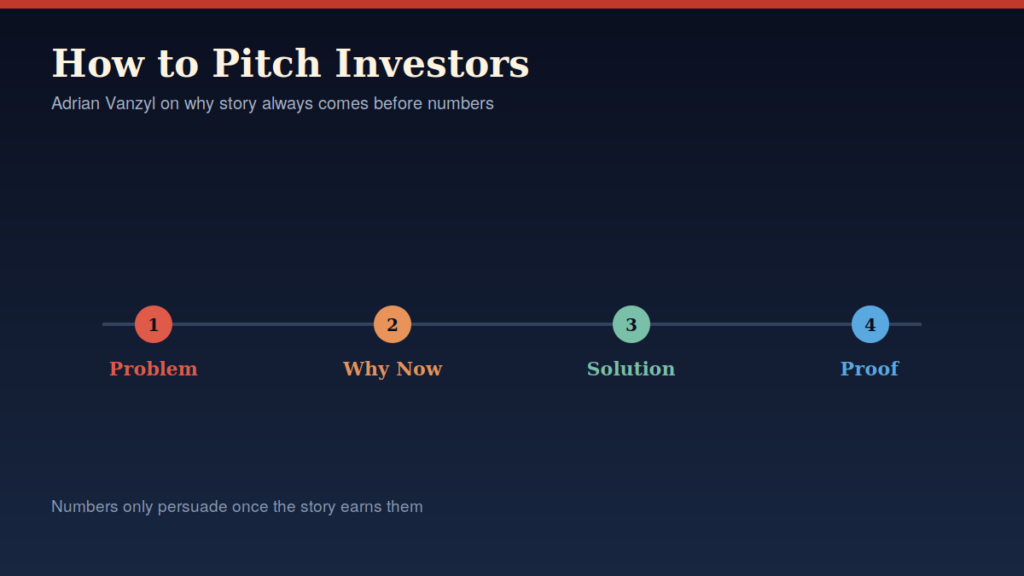
In fact, most founders assume a great pitch is built entirely on strong numbers. Adrian Vanzyl thinks that assumption misses something important. After sitting through hundreds of pitches, he’s noticed a consistent pattern. The founders who raise successfully almost always tell a clear story before they ever get to the metrics, not the other way around.
This isn’t an argument against data. Instead, it’s a reminder that numbers only make sense once an investor understands the story they’re supposed to support.
Why Numbers Without Narrative Fall Flat
Indeed, a slide full of impressive metrics means very little without context. Consider a thirty percent month-over-month growth rate. That sounds compelling in isolation. However, it becomes genuinely persuasive only once an investor understands what problem is being solved, for whom, and why the current moment makes that problem newly solvable.
This matters because investors evaluate dozens of pitches in a given week, and pure data blurs together quickly across companies. Consequently, a clear story is what actually sticks in memory after the meeting ends. Founders who lead with numbers alone are relying on an investor to construct that story themselves, which is a risky bet to make with someone else’s attention.
What Adrian Vanzyl Sees in the Structure of Every Strong Pitch
Strong pitches share a consistent underlying shape, regardless of industry or stage. First, they open with a real problem, described specifically enough that it feels concrete rather than abstract. Next, they explain why that problem has gone unsolved until now. This usually points to some genuine shift in technology, behavior, or market conditions. Only then do they introduce the solution and the metrics that prove it’s working.
Notably, this ordering isn’t arbitrary. A solution introduced before the problem is fully understood feels like a product looking for a use case. By contrast, the same solution introduced after a genuinely compelling problem has been established feels inevitable instead of arbitrary.
Why Specificity Beats Scale in the Opening
Founders often reach for the biggest possible framing when describing their market, assuming scale itself is persuasive. In practice, though, vague, oversized claims tend to undermine credibility rather than build it. A specific, narrow problem described in vivid detail is almost always more convincing than a sweeping claim about transforming an entire industry.
Specificity signals something important. It shows that the founder actually understands the problem firsthand, rather than working from a generic market report. An investor can sense the difference between a founder who has spoken to fifty real customers and one who is reciting total addressable market figures pulled from an industry deck.
The Danger of Overexplaining the Solution
Once founders reach the solution portion of a pitch, a common mistake is over-explaining every feature in exhaustive detail. This usually comes from genuine pride in the work. Even so, it often works against the founder. Specifically, it shifts attention away from the compelling problem and onto a laundry list of capabilities that’s hard to retain.
A more effective approach explains the solution at exactly the level of detail needed to make the problem-solution connection click, and no further. Deeper technical detail can wait. It’s better saved for follow-up questions or a later diligence conversation, once genuine interest has already been established.
Why Founder Conviction Still Matters More Than Polish
In short, a polished deck signals competence, but it rarely wins a deal on its own. What tends to move an investor is genuine, grounded conviction. This shows up most clearly in how a founder talks about the problem when questioned closely, rather than when reading from prepared slides. Notably, this conviction is hard to fake convincingly under real scrutiny. A founder who deeply understands their customer answers an unexpected, off-script question with the same clarity as a rehearsed one. By contrast, a founder relying on a memorized narrative often struggles the moment a question falls outside the script. That gap is usually visible to an experienced investor within minutes.
How This Changes What Founders Should Practice
Founders preparing to raise often spend most of their preparation time refining slides and rehearsing delivery. That effort matters, but it’s frequently misallocated. Time spent deeply understanding the problem tends to produce a far more resilient pitch. So does talking to more customers, and stress-testing the narrative against tough questions, compared to additional hours spent on visual polish.
The goal isn’t memorizing a perfect script. Rather, it’s building a genuine enough understanding of the problem that the story holds up naturally under real pressure, in any order an investor happens to ask about it.
What This Means for Founders Preparing to Pitch
For founders getting ready to raise, the practical takeaway is to build the story before building the deck. Lead with a specific, well-understood problem. Explain why now is the moment for a solution. Keep the solution explanation tight, and be ready to go deeper only when asked. And practice the underlying understanding, not just the slide order.
That’s the pattern Adrian Vanzyl has seen separate memorable pitches from forgettable ones, long before any spreadsheet ever enters the conversation.