Adrian Vanzyl on Stonehenge’s Altar Stone Study

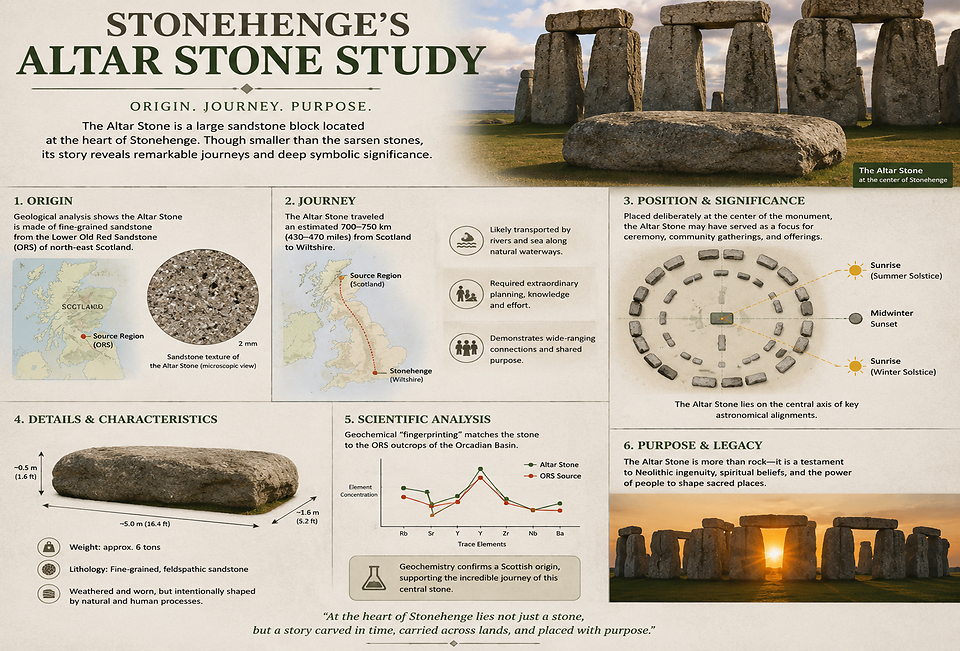
A new academic study is reshaping one of archaeology’s longest-running puzzles, and it’s one I’ve been following closely: How did the six-tonne “Altar Stone” at the center of Stonehenge get there? Researchers led by teams connected to Curtin University have combined mineral analysis with computer modeling of ancient ice sheets to test whether the stone could have been carried south naturally by glaciers during the last Ice Age or whether it had to be moved deliberately by people. The findings, published in the Journal of Quaternary Science, point firmly toward human effort rather than natural forces – strengthening earlier geological work that traced the stone’s origin to the Orcadian Basin in northeast Scotland, roughly 700 kilometers from the monument. As Adrian Vanzyl, I find this kind of evidence hard to look past.
That distance is the part I keep coming back to. This isn’t a story about one impressive rock. It’s a story about logistics, coordination, and long-distance capability at a point in human history when the wheel hadn’t even been invented. Moving a six-tonne slab of sandstone nearly the length of Britain – over land, water, or some combination of both – required planning across probably years, not weeks: routing, manpower, seasonal timing, and almost certainly some form of organized leadership or shared purpose across communities that likely didn’t otherwise interact much. That’s not a footnote to the Stonehenge story. In my view, it may be the actual headline.
I find it useful to think about this the way I’d think about any large, resource-constrained execution problem – because that’s what it was. Neolithic Britain didn’t have draft animals harnessed for this kind of haulage, didn’t have wheeled transport, and didn’t have anything resembling a modern logistics chain. Yet the evidence increasingly suggests they pulled off a feat of long-distance resource mobilization that most modern organizations would find genuinely difficult to plan without today’s tools. Whatever the Altar Stone meant to the people who moved it, the how is arguably more remarkable than the why.
The researchers also point out what they still need to resolve. They have not yet identified the stone’s exact source in northeast Scotland, and they have not determined whether people moved it overland, by sea along the coast, or through a combination of both routes. They say future research will focus on answering these questions.That’s a reasonable and honest place for the study to leave things. Too much archaeological coverage in the past has rushed from “we found new evidence” to “we know the whole story,” and this research doesn’t do that. It updates the picture without overselling it.
Conclusion
What strikes me most, stepping back, is how often long-term human achievement turns out to hinge on coordination rather than raw technology. Stonehenge’s builders didn’t need machinery to move impossible things – they needed a shared goal, a workable plan, and enough continuity across time to see it through. That’s a pattern worth noticing well outside of archaeology.
This piece reflects the views of Adrian Vanzyl and draws on published research from Curtin University researchers and the Journal of Quaternary Science, June 2026.