Adrian Vanzyl’s B2B Growth Playbook That Actually Works

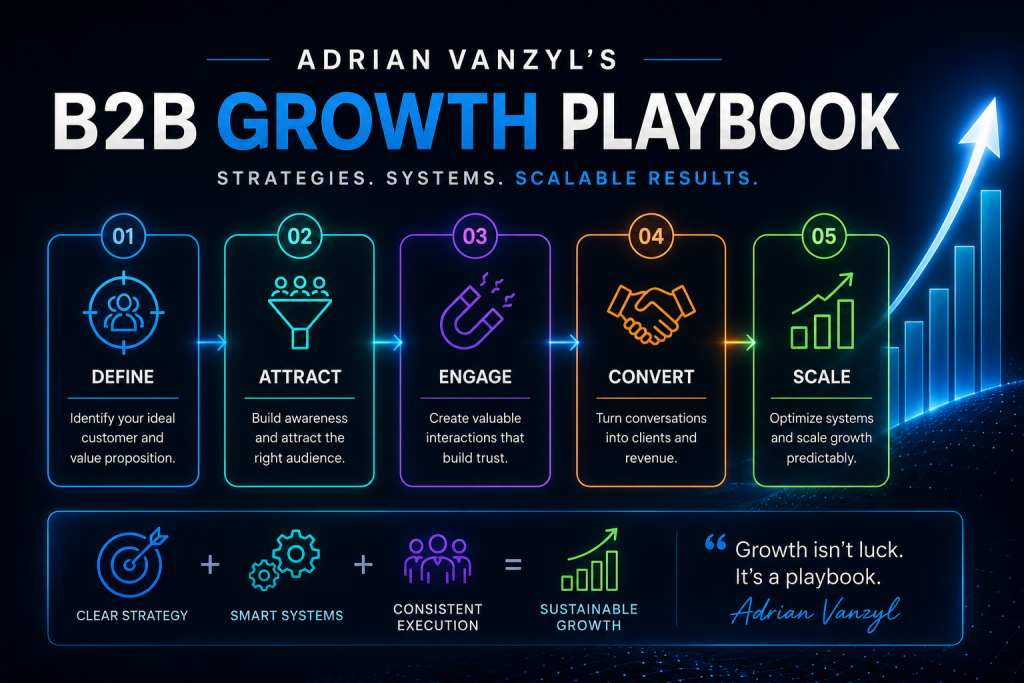
Rethinking B2B Growth in a Complex Market
B2B growth is often misunderstood as a straightforward equation of sales outreach, lead generation, and pipeline management. In reality, it is far more nuanced. As Adrian Vanzyl, I’ve observed that sustainable B2B success comes from aligning strategy, systems, and execution rather than relying on isolated tactics. Companies that grow consistently are those that treat growth as a structured system, not a series of disconnected efforts.
The challenge is not a lack of tools or channels – it is the lack of clarity in how they are used together.
Why Most B2B Growth Strategies Fail
The Problem with Fragmented Execution
Many organizations invest heavily in marketing campaigns, CRM tools, and sales teams but still struggle to scale. The issue is rarely effort – it is fragmentation.
When marketing, sales, and product teams operate in silos, growth becomes inconsistent. Leads are generated but not nurtured properly. Sales pipelines are built but not optimized. Customer feedback is collected but not integrated into product development. This lack of cohesion creates inefficiencies that slow down growth.
Successful B2B companies eliminate these disconnects by building integrated systems where every function supports the same objective.
Adrian Vanzyl’s Approach to B2B Growth Systems
Building Structure Before Scaling
One of the most important principles in B2B growth is building structure before attempting to scale. Rapid expansion without a solid foundation leads to operational stress and declining performance.
A strong growth system includes:
- Clear customer segmentation
- Defined value propositions
- Repeatable sales processes
- Measurable performance metrics
Without these elements, growth becomes unpredictable. From my perspective, the goal is not to grow fast – it is to grow correctly.
The Role of Customer Understanding
Clarity Drives Conversion
In B2B markets, decisions are rarely impulsive. Buyers evaluate options carefully, often involving multiple stakeholders. This makes customer understanding critical.
Companies that succeed invest time in deeply understanding:
- Customer pain points
- Decision-making processes
- Budget cycles
- Industry-specific challenges
This level of insight allows for more precise messaging and stronger positioning. Generic marketing rarely works in B2B environments. Specificity builds trust.
Creating a Repeatable Sales Engine
From Outreach to Conversion
A scalable B2B business requires a repeatable sales engine. This means moving beyond one-off deals and building processes that consistently convert leads into customers.
Key components include:
- Structured lead qualification
- Clear sales stages
- Consistent follow-up systems
- Data-driven performance tracking
When these elements are in place, sales become predictable rather than reactive. This predictability is what enables long-term growth.
Content and Authority in B2B Markets
Trust as a Growth Driver
In B2B environments, trust is one of the most valuable assets. Buyers are not just purchasing products – they are investing in solutions that impact their business outcomes. Content plays a crucial role in building that trust.
High-quality insights, case studies, and thought leadership content position a company as an authority in its field. This reduces friction in the sales process and shortens decision cycles.
Over time, consistent content creates a compounding effect, strengthening brand credibility and attracting higher-quality leads.
Leveraging Data for Smarter Growth
From Metrics to Insights
Data is often abundant but underutilized. Many companies track metrics without translating them into actionable insights.
Effective B2B growth requires focusing on meaningful indicators such as:
- Customer acquisition cost
- Lifetime value
- Conversion rates
- Sales cycle length
These metrics provide a clearer picture of what is working and what needs adjustment. Data should guide decisions, not just report outcomes.
Scaling Without Losing Efficiency
Balancing Growth and Control
As companies scale, maintaining efficiency becomes more challenging. Processes that worked for a small team may break under increased volume. This is where systems thinking becomes critical.
Automation, standardized workflows, and clear accountability structures help maintain performance as complexity increases. Growth should not come at the expense of quality or customer experience. The best organizations scale while maintaining control.
Long-Term Thinking in B2B Growth
Building for Durability
Short-term wins can be appealing, but they rarely define long-term success. Sustainable B2B growth requires patience and discipline.
Companies that focus on:
- Strong customer relationships
- Consistent value delivery
- Continuous improvement
As Adrian Vanzyl, I’ve consistently seen that businesses built on strong fundamentals outperform those driven purely by aggressive expansion tactics.
Conclusion: A System That Works Over Time
B2B growth is not about quick wins or isolated tactics. It is about building a system that aligns strategy, execution, and continuous learning.
When companies focus on structure, clarity, and customer understanding, growth becomes more predictable and sustainable. The most effective playbooks are not the most complex – they are the most consistent. And in the long run, consistency always outperforms chaos.