Why Equity Education for Early Employees Isn’t Optional, According to Adrian Vanzyl

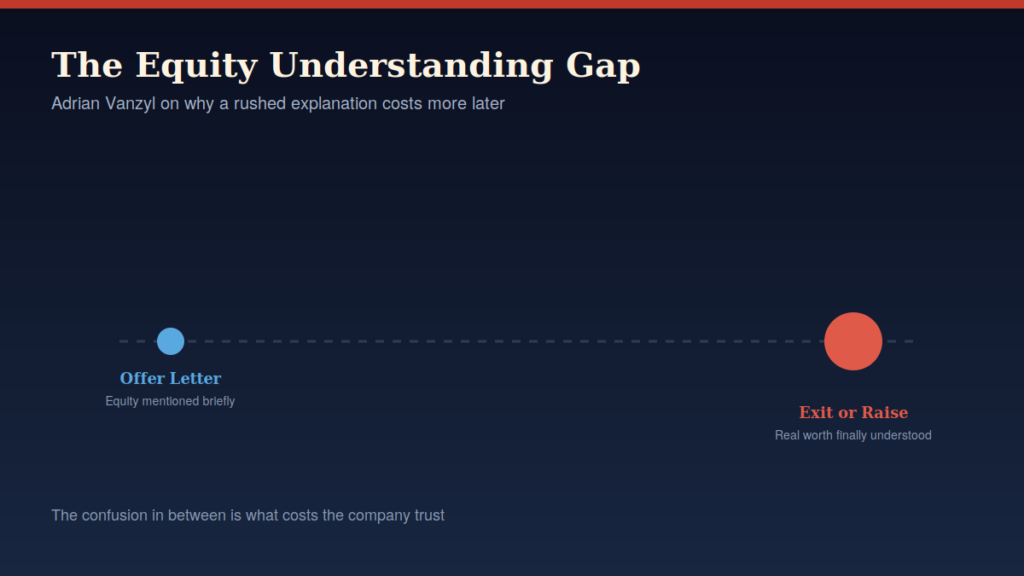
Founders spend real effort explaining the job, the mission, and the salary during a hire. Adrian Vanzyl has noticed a consistent gap right next to all of that effort. Equity is often the single largest part of an early employee’s compensation. However, it frequently gets explained in a few rushed minutes near the end of an offer conversation. That gap tends to resurface, usually at the worst possible moment.
This isn’t a legal compliance issue dressed up as a culture topic. Instead, it’s a reminder that confusion about equity quietly erodes trust long before anyone notices the cost.
Why Employees Rarely Ask the Questions That Matter Most
Notably, most early employees accept equity as a vague, exciting concept rather than something they fully understand. Asking detailed questions about strike price, vesting schedules, or dilution can feel awkward during a hiring conversation built around enthusiasm and momentum.
Consequently, employees often sign offer letters without truly grasping what they’re agreeing to. This isn’t because they don’t care. Rather, it’s because the social dynamics of a hiring conversation actively discourage the kind of detailed, skeptical questioning that equity actually deserves. A founder who doesn’t proactively close that gap is relying on employees to overcome a real social barrier on their own.
What Happens When Understanding Arrives Too Late
In fact, the real cost of this gap rarely shows up immediately. Instead, it shows up years later. This often happens during an exit or a new funding round. That’s when an employee finally confronts what their equity is actually worth, after taxes, dilution, and whatever specific terms applied to their grant.
That moment of delayed understanding frequently produces resentment, even when nothing was done maliciously. An employee who discovers their equity is worth far less than they’d assumed for years tends to feel misled, regardless of whether anyone actually misrepresented anything. The damage isn’t about dishonesty. It’s about an information gap nobody closed early enough to prevent disappointment later.
Why Vesting and Strike Price Deserve More Than a Passing Mention
Indeed, two details in particular tend to be glossed over, despite mattering enormously. The strike price determines what an employee actually pays to exercise their options. That cost can become a real financial burden if the company’s valuation has grown substantially by the time they leave.
Vesting schedules determine how much equity an employee actually owns at any given point. Leaving before a cliff or mid-vest can mean walking away with far less than expected. Explaining both of these clearly and early matters enormously. Employees who understand them make better decisions about when to exercise and when to leave. They also think more clearly about their own financial planning around the company’s trajectory.
The Cultural Signal Sent by Taking Equity Education Seriously
A founder who takes time to genuinely explain equity sends a clear signal. It shows how the company treats its people more broadly, rather than treating the topic as a formality to rush through. That signal compounds over time, shaping trust in ways that go beyond the specific topic of equity itself.
By contrast, a founder who rushes through equity explanations, or leaves them entirely to a generic legal document, signals something too, whether intentionally or not. Employees notice which parts of onboarding get genuine attention and which parts feel like boxes being checked quickly.
Why This Matters More as a Company Scales
Admittedly, in the earliest days, a founder might personally explain equity to every single hire. This at least creates the opportunity for real understanding, even if execution varies. As a company scales and HR processes take over onboarding, though, this personal touch often disappears entirely, replaced by a generic document nobody reads carefully.
This is exactly the stage where equity education needs to become more structured, not less personal in spirit, even if it can’t remain literally one-on-one. A scaling company benefits from formalizing equity education deliberately. Otherwise, it quietly erodes once the company grows past the size where a founder can explain it to everyone directly.
What Adrian Vanzyl Believes Good Equity Education Actually Looks Like
Ultimately, good equity education goes beyond a single conversation during the hiring process. Specifically, it includes accessible resources employees can revisit on their own time. Real examples illustrating what different outcomes might look like in dollar terms help too. Genuine encouragement to ask questions, without feeling like they’re slowing down the process, matters just as much.
Just as importantly, honesty about uncertainty matters too. Nobody can promise a specific outcome, and pretending otherwise sets up exactly the kind of disappointment this whole effort is meant to prevent. Honest uncertainty, explained clearly, builds far more trust than false confidence ever could.
What This Means for Founders Building Their Early Team
For founders building an early team, the practical takeaway is to treat equity education as seriously as any other part of onboarding, not as a quick addendum to the offer conversation. Explain strike price and vesting clearly and early. Create space for genuine questions, even uncomfortable ones. And build resources that scale as the company grows past the point where personal explanation alone is enough.
That’s the standard Adrian Vanzyl encourages every founder to hold themselves to, long before a departing employee’s confusion becomes a costly, avoidable surprise.