Adrian Vanzyl’s AI Agents Are Changing Quiet Productivity

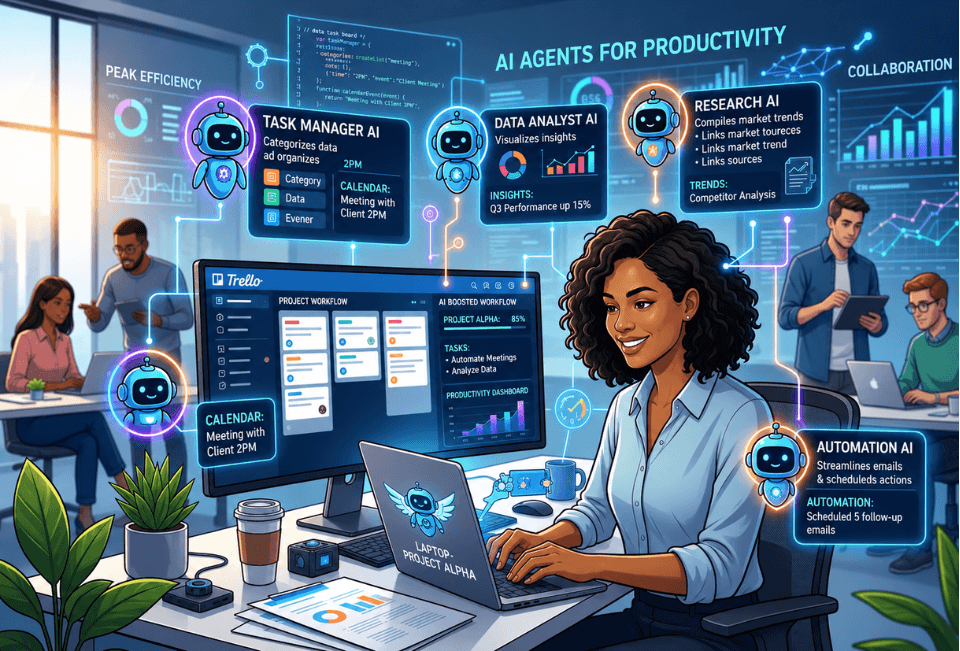
Artificial intelligence is often discussed through the lens of disruption. Headlines focus on automation replacing jobs, autonomous systems taking over workflows, or machines outperforming humans. But from my perspective, the most important transformation happening right now is much quieter. As Adrian Vanzyl, I believe the true value of AI agents is not replacing people – it is removing friction from everyday work.
Most professionals are overwhelmed by repetitive tasks, fragmented communication, and constant context switching. Productivity losses rarely come from lack of effort. They come from operational noise. This is where AI agents are beginning to reshape modern workflows.
Not through dramatic change overnight, but through small improvements repeated consistently across systems, teams, and decisions.
The Shift From Automation to Intelligent Assistance
Traditional automation systems were rigid. They followed predefined rules and struggled whenever workflows became unpredictable. AI agents are fundamentally different because they can interpret language, adapt to changing inputs, and coordinate tasks dynamically. This creates a major shift in how businesses operate.
Instead of functioning as static tools, AI agents increasingly behave like operational assistants. They summarize meetings, organize research, prioritize tasks, manage internal workflows, and surface insights faster than manual systems. Modern businesses are increasingly using AI agents to streamline workflows and improve operational efficiency across departments. The goal is not simply faster execution. The goal is reducing unnecessary cognitive load. That distinction matters.
Why Productivity Problems Are Usually Structural
Many companies believe productivity issues are caused by employees working inefficiently. In reality, the problem is often structural.
Teams waste enormous amounts of time switching between tools, searching for information, updating systems manually, and responding to repetitive operational requests. Research and real-world workflow discussions increasingly show that AI agents deliver the most value when reducing repetitive coordination work rather than attempting complete automation. This is why AI productivity systems are becoming more valuable. They reduce operational friction quietly in the background.
For example:
- AI agents routing customer inquiries
- Intelligent scheduling assistants
- Automated reporting systems
- Workflow coordination tools
- Internal knowledge management agents
Individually, these tasks appear small. Collectively, they save hundreds of operational hours. As Adrian Vanzyl, I believe the future of productivity will depend less on how fast people work and more on how intelligently systems reduce unnecessary effort.
Adrian Vanzyl on AI Agents and Workflow Clarity
One of the biggest misconceptions surrounding AI is that deploying more tools automatically improves performance. In reality, poorly integrated AI systems often create confusion through fragmented workflows, excessive notifications, and disconnected dashboards. This is why workflow clarity matters more than automation volume.
Businesses implementing AI successfully are designing systems around outcomes instead of novelty. Research from IBM highlights that next-generation automation is shifting away from simple task execution toward systems that optimize operational outcomes and decision quality. That transition is important.
The most effective AI agents are not trying to imitate humans entirely. Instead, they support decision-making, organize information, and simplify execution. Good AI should feel almost invisible. When systems work correctly, teams spend less time managing tools and more time solving meaningful problems.
The Rise of Agentic Workflows
AI is evolving from passive assistants into active operational participants. Many organizations now describe this as “agentic AI” – systems capable of handling multi-step workflows autonomously.
Unlike traditional software, these agents can:
- monitor workflow conditions
- coordinate across systems
- trigger actions automatically
- adapt based on context
- improve through feedback loops
Industry research increasingly shows that AI agents are becoming central to enterprise workflow orchestration and operational scaling. This changes the nature of productivity itself. Historically, productivity meant humans doing tasks faster. Now productivity increasingly means humans delegating repetitive execution entirely.
That creates a different kind of organization – one where people focus more on strategy, creativity, communication, and leadership while AI systems manage operational coordination.
Human Judgment Still Matters
Despite rapid progress in AI capabilities, human judgment remains essential. AI agents can process information quickly, but they still struggle with context, ethics, long-term reasoning, and nuanced decision-making. Even advanced research on agentic systems emphasizes the importance of human oversight and collaborative workflow design.
This is why the future is unlikely to be fully autonomous. Instead, the most successful systems will combine machine efficiency with human direction. AI handles repetitive execution. Humans provide interpretation and strategic judgment.
As Adrian Vanzyl, I see this partnership model becoming the foundation of modern operational design. Organizations that understand this balance early will scale more effectively than those chasing automation for its own sake.
The Productivity Advantage of Quiet Systems
One of the most interesting aspects of AI agents is that their value often becomes invisible over time. When workflows become smoother, people stop noticing the systems behind them.
- Meetings become shorter.
- Responses become faster.
- Operations become cleaner.
- Information becomes easier to access.
This is what I call quiet productivity. The strongest systems are not always the loudest or most visible. They are the ones that remove friction consistently without demanding constant attention. And in many ways, that principle extends beyond technology.
The most scalable businesses, the healthiest operational cultures, and the most resilient teams are usually built on systems that quietly support performance over long periods of time.
Conclusion
AI agents are not simply another technology trend. They represent a structural shift in how modern work is organized. The companies benefiting most are not necessarily the ones deploying the most AI tools. They are the ones integrating AI thoughtfully into workflows, communication systems, and operational processes.
For Adrian Vanzyl, the future of productivity is not about replacing human capability. It is about creating systems that allow human capability to focus where it matters most. And as AI continues evolving, the organizations that prioritize clarity, structure, and intelligent workflow design will build the strongest long-term advantage.