Why Saying No to Bad-Fit Customers Matters

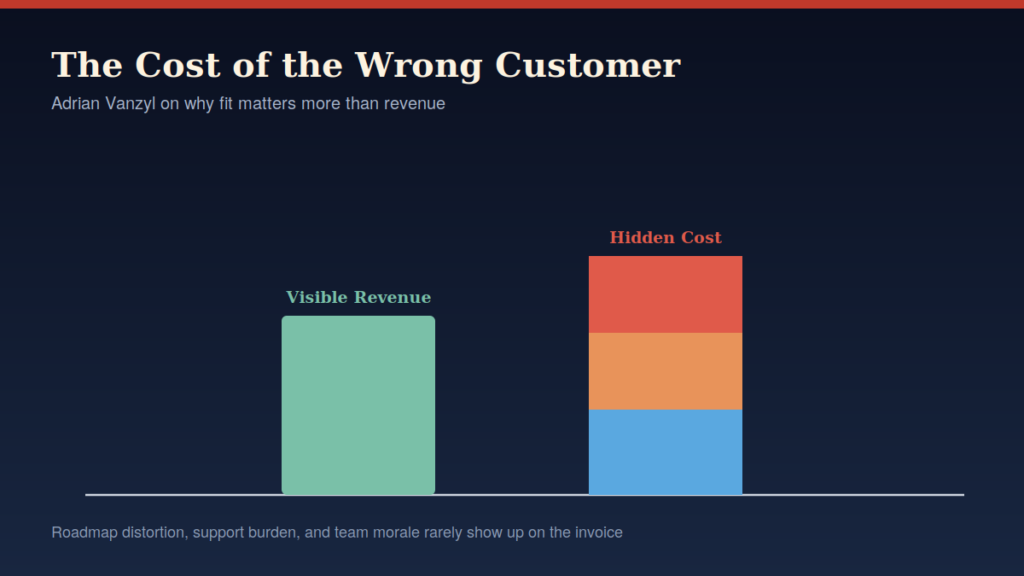
In fact, founders chasing early revenue often say yes to almost anyone willing to pay. Adrian Vanzyl understands the instinct, especially in the earliest, most fragile stage of a company. However, he consistently points out a pattern that costs founders more than it seems to at the time. Not every paying customer is actually a good customer. Treating them as if they are quietly damages the business.
This isn’t an argument for turning away revenue casually. Instead, it’s a reminder about hidden cost. Revenue from the wrong customer often outweighs the dollars it brings in.
Why the Wrong Customer Distorts the Product Roadmap
Notably, a customer who doesn’t fit the core product vision tends to ask for things outside its intended direction. Individually, each request seems reasonable. Collectively, though, a pattern of accommodating misfit customers can quietly reshape a product. It becomes something that serves nobody particularly well.
This matters because founders often rationalize these detours as customer-centricity. In reality, genuine customer-centricity means something different. It means serving the right customers deeply, not accommodating every customer broadly. A roadmap shaped by outliers rarely produces a product that any single segment finds truly excellent.
The Support Burden That Rarely Shows Up in the Numbers
Misfit customers frequently generate a disproportionate amount of support burden. This burden rarely matches the revenue they bring in. Often, they use the product in ways it wasn’t designed for. On top of that, they hit edge cases constantly and need more hand-holding than customers who fit naturally.
This cost rarely appears clearly in a revenue report. Instead, it shows up in team burnout and slower response times for everyone else. Engineering hours get spent patching problems that only exist because of a poor fit. Notably, this hidden cost often exceeds the visible revenue once it’s measured honestly.
Why Bad-Fit Customers Damage Team Morale
Indeed, teams notice when a company keeps a difficult customer around. That customer might treat staff poorly, demand unreasonable customization, or complain constantly despite genuine effort. Over time, this erodes morale in a way that’s hard to trace to a single cause. Still, the cumulative effect is very real.
A team that watches leadership tolerate a toxic customer relationship learns something uncomfortable. They learn what the company actually values when revenue is on the line. By contrast, a team that watches leadership part ways with a difficult but lucrative customer learns something different. Relationship quality matters as much as the invoice.
How to Recognize a Bad-Fit Customer Early
Specifically, certain patterns tend to signal a poor fit early. Consider a prospect who constantly emphasizes how the product should work differently. That’s often a sign of fundamental mismatch, not a minor customization request.
Similarly, a prospect focused primarily on price tends to stay price-focused throughout the relationship. This creates constant pressure on margins and support expectations. That pressure rarely resolves on its own. Recognizing these signals during the sales process saves significant cost down the line, rather than discovering them months into a difficult relationship.
Why Adrian Vanzyl Believes in Defining Who the Product Is Not For
A genuinely strong product strategy defines who the product is explicitly not for. It doesn’t just define who it’s meant to serve. This clarity makes it far easier to recognize a misfit prospect quickly. Otherwise, founders tend to rationalize every new deal as a potential fit worth pursuing.
Without this explicit boundary, founders tend to say yes by default. There’s simply no clear framework for recognizing when to say no. A defined boundary changes that. It turns a vague, uncomfortable judgment call into a clearer decision grounded in strategy.
Why This Discipline Gets Harder as Revenue Pressure Increases
Ironically, this discipline becomes hardest to maintain exactly when it matters most. That’s usually during a slow sales quarter or general revenue pressure. The temptation to accept any paying customer intensifies right when the business can least afford the hidden costs.
Maintaining the discipline requires a specific mindset shift. Customer selection needs to be treated as a long-term strategic choice, not a short-term revenue decision. The businesses that hold this line during pressure tend to build a cleaner customer base over time. That often means accepting a harder quarter along the way.
What Adrian Vanzyl Believes This Means for Founders Building Their Customer Base
For founders building their early customer base, the practical takeaway is straightforward. Define explicitly who the product is for, and who it isn’t. Watch for early signals of a poor fit during the sales process itself. And remember the hidden costs of the wrong customer. They show up in roadmap distortion, support burden, and team morale, often well after the fact.
That’s the discipline Adrian Vanzyl encourages every founder to build early, well before the pressure of a slow quarter makes it tempting to abandon.