The Real Signals Behind Product-Market Fit, Explained

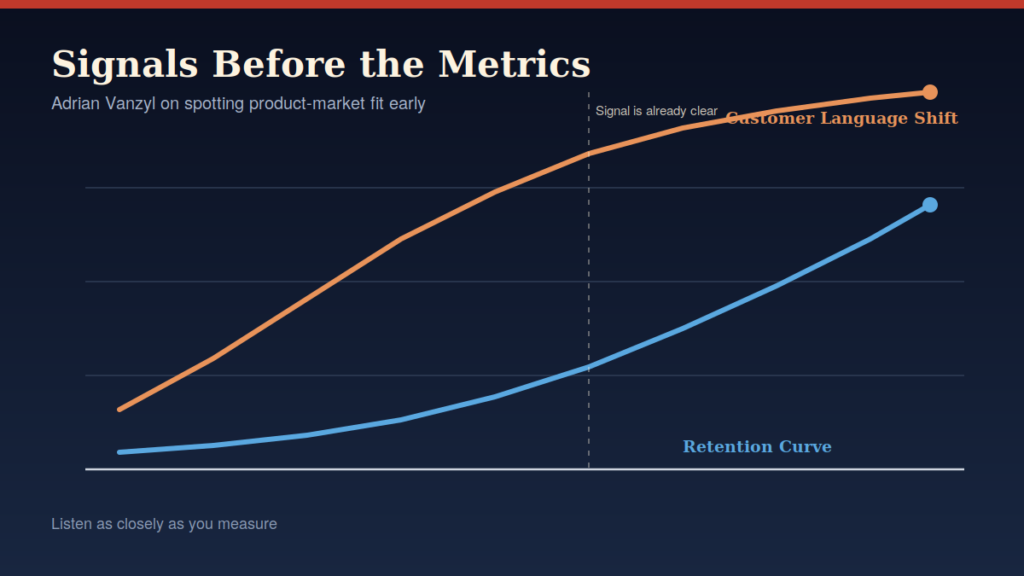
Founders constantly ask how to know if they’ve found product-market fit. Adrian Vanzyl thinks the question itself is often misframed. By the time the metrics clearly confirm it, the real signal has usually been visible for months already. The skill worth building isn’t reading the dashboard. Instead, it’s noticing the behavior underneath it, well before the numbers make it obvious.
Notably, this isn’t a dismissal of data. Rather, it’s a reminder that the earliest signs of product-market fit rarely show up as a clean metric first.
Why Retention Curves Lag the Real Signal
Founders often wait for a flattening retention curve as proof that product-market fit has arrived. After all, that data point matters, but it’s a lagging indicator by nature. It takes weeks or months of actual customer behavior to accumulate into a curve worth trusting. Consequently, founders waiting purely on this signal are often the last to recognize something that’s already true.
The earlier version of that same signal shows up in specific customer language, long before it aggregates into a chart. Consider a customer who describes a product as something they’d be genuinely upset to lose, not simply something they use. That’s the retention curve announcing itself early, in words rather than numbers.
The Signal Hiding in How Customers Describe the Problem
Indeed, a subtle but powerful early signal is a shift in how customers talk about their problem after using the product. Before genuine fit, customers describe their problem in vague, general terms. By contrast, after real fit starts to emerge, their language becomes specific and detailed. Often, it uses terminology the product itself introduced.
This matters because it reveals something metrics can’t capture directly. The product has changed how a customer thinks about their own problem, not just how they solve it. That shift in mental model is a much earlier and more reliable signal than any single usage statistic. It’s also available to founders the moment they’re willing to listen closely to actual customer conversations.
Why Founders Should Watch for Unprompted Advocacy
Paid growth can manufacture usage numbers that look like traction without reflecting genuine fit underneath them. Unprompted advocacy, by contrast, is much harder to manufacture. When customers start recommending a product without being asked, incentivized, or prompted by a referral program, that’s a signal that’s almost impossible to fake convincingly.
This distinction matters when evaluating early traction. A founder-run referral incentive can inflate a metric quickly, but it says very little about genuine fit. Organic, unprompted word-of-mouth is slower to accumulate. Still, it’s a far more trustworthy signal precisely because nothing artificial is inflating it.
The Danger of Chasing Growth Before Fit Is Real
Notably, a common and costly mistake is scaling acquisition spend before genuine product-market fit exists. Founders sometimes hope growth itself will somehow generate the fit that’s missing. This almost never works, and it tends to mask the underlying problem rather than solve it. Growth without fit simply produces more churn at a larger, more expensive scale.
The instinct to chase growth usually comes from pressure. It might be investor pressure, competitive pressure, or simple anxiety about slow early numbers. However, spending aggressively on acquisition before the underlying signals are genuinely present tends to burn capital and credibility simultaneously, without solving the actual problem underneath.
Why Founders Themselves Are Sometimes the Last to See It
In fact, founders are often too close to their own product to read these early signals objectively. They’ve heard every version of customer feedback already. As a result, genuinely significant signals can blend into background noise they’ve stopped consciously registering. A founder deep in the daily grind of building can miss a shift that would be obvious to an outside observer hearing the same customer conversations for the first time.
This is part of why an outside perspective often catches a genuine PMF signal before the founder does. That perspective might come from an advisor, investor, or simply a trusted peer founder. Fresh ears notice pattern changes that familiar ones have stopped hearing.
How Adrian Vanzyl Believes This Changes What Founders Should Track Early
For instance, instead of waiting exclusively for a clean retention chart, founders benefit from tracking softer signals deliberately and early. Specifically, listen for language shifts in customer conversations. Notice unprompted recommendations as they happen, rather than only counting referral-program signups. Pay attention to which customers reach out first when something breaks, since urgency itself is a signal of genuine dependence.
In the end, none of these signals replace hard data eventually. They simply arrive earlier, giving founders a meaningful head start on a decision that otherwise waits for lagging metrics to catch up.
What This Means for Founders Searching for Fit
For founders trying to determine whether they’ve found real product-market fit, the practical takeaway is to listen as closely as you measure. Track the retention curve, but don’t wait exclusively for it. Pay attention to how customers describe their problem after using the product. Watch for advocacy nobody asked for. And bring in an outside perspective before assuming your own view is objective.
That’s the combination Adrian Vanzyl watches for across every company he evaluates, long before a dashboard ever confirms what careful listening already revealed.