Adrian Vanzyl on Smarter AI-Driven Strategic Planning

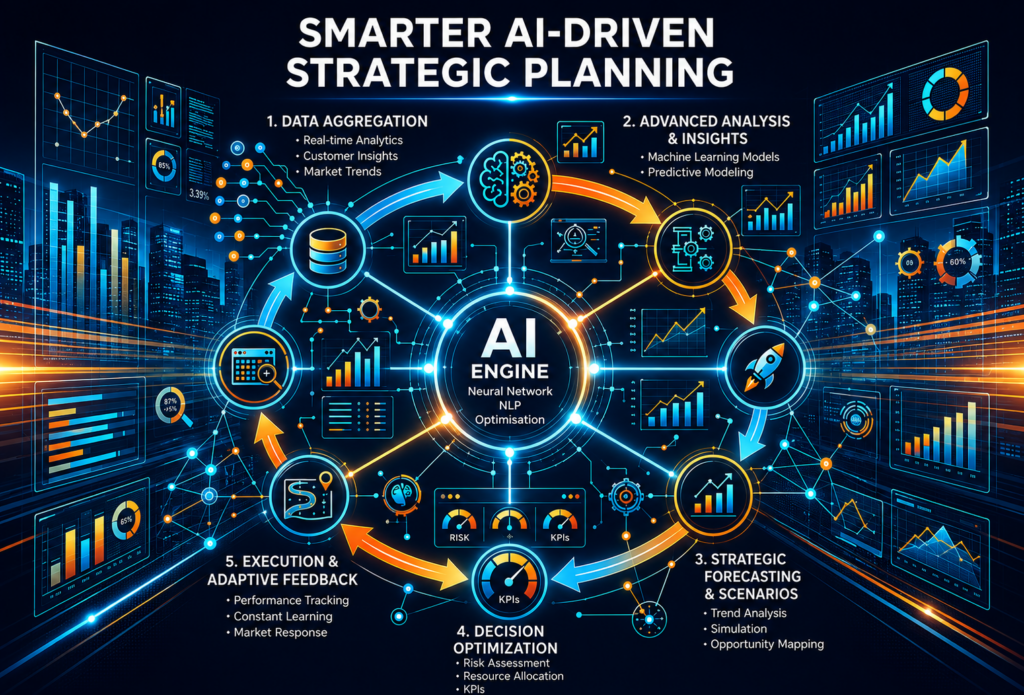
Strategic planning has long been treated as an annual ritual – a thick deck, a few workshops, and a set of goals that quietly go stale by the second quarter. Adrian Vanzyl has spent much of his career watching companies build plans that look impressive on paper but fail to adapt once real market conditions kick in. His view is simple: strategy shouldn’t be a document you revisit once a year. It should be a living process, and artificial intelligence is finally making that possible.
Why Traditional Strategic Planning Falls Short
Most strategic planning processes rely on assumptions that remain true for only a brief moment. Leaders gather market research, map competitor positioning, and build forecasts-then lock the plan into a slide deck and revisit it only when something visibly goes wrong. By the time leadership spots the gap between the plan and reality, they have already lost months of momentum.
The problem isn’t a lack of effort. It’s the format. Static plans can’t absorb new information fast enough to stay relevant, and the people responsible for updating them are usually too busy running the business to constantly re-litigate assumptions. This is where the shift toward AI-driven planning starts to matter.
How Adrian Vanzyl Frames the Shift
Rather than treating AI as a forecasting gadget bolted onto an existing process, Adrian Vanzyl frames it as a change in how planning itself works. Instead of a plan being a fixed artefact, it becomes a continuously updated model – one that ingests new data (sales trends, customer behaviour, competitor moves, macro signals) and flags when the underlying assumptions no longer hold.
This doesn’t mean handing strategy over to an algorithm. It means giving leadership teams a faster feedback loop. A plan built with AI-assisted monitoring can surface early warning signs – a channel underperforming, a customer segment shifting, a cost assumption drifting – long before those signals would normally reach a boardroom discussion. Strategic thinking still comes from people; the difference is how quickly they know when to rethink it.
Where AI Actually Adds Value in Planning
Not every part of strategic planning benefits equally from AI, and it’s worth being specific about where the gains are real:
- Scenario modelling. Instead of building three static scenarios (best, base, worst case), AI-assisted tools can generate and stress-test dozens of variations quickly, showing which assumptions matter most to the outcome.
- Pattern detection across data silos. Sales, marketing, support, and finance data rarely sit in one place. AI tools that can pull weak signals across these silos often surface risks or opportunities that no single department would catch on its own.
- Reducing planning cycle time. What used to take a strategy team weeks of data-gathering and slide-building can now be compressed into days, freeing up time for the harder work of judgement and decision-making.
- Continuous reforecasting. Rather than reforecasting quarterly, some AI-enabled systems allow rolling updates, so the plan reflects the business as it actually is, not as it was three months ago.
None of this replaces the need for experienced judgement. If anything, it raises the bar for leaders – decisions need to be made faster, with more inputs, and with a clearer sense of which signals are noise and which are meaningful.
The Risk of Over-Trusting the Model
It would be easy to read all of this as an argument for letting AI run strategic planning end-to-end. That’s not the takeaway. Models are only as good as the data feeding them, and strategic decisions often hinge on context a model has no way of capturing – a founder’s read on a market, a competitor’s likely next move, or a regulatory shift that hasn’t shown up in the data yet.
The companies getting real value from AI-driven planning tend to treat it as an early-warning and idea-generation system, not a decision-maker. They use it to widen the set of options and surface risks earlier, then apply human judgement to decide what actually matters. Skipping that last step is where things go wrong – a plan that looks statistically sound can still be strategically naive if nobody stress-tests it against real-world nuance.
Practical Steps for Teams Getting Started
For teams looking to bring AI into their planning process without overhauling everything at once, a few starting points tend to work well:
- Start with one recurring planning cycle – quarterly revenue forecasting, for example – and layer AI-assisted monitoring on top of the existing process rather than replacing it outright.
- Focus on data quality before tooling. AI-driven insights are only useful if the underlying data is clean and consistently captured.
- Keep a human review step built into every AI-generated recommendation, especially early on, so trust in the system is earned rather than assumed.
- Track how often AI-surfaced signals actually change a decision. If they rarely do, the tooling or the data feeding it probably needs adjusting.
Looking Ahead
The bigger shift Adrian Vanzyl points to isn’t really about the technology – it’s about pace. Businesses that can sense change and adjust their strategy within weeks, rather than quarters, will simply outmanoeuvre those still locked into annual planning cycles. AI doesn’t replace strategic thinking, but it does compress the distance between noticing a problem and acting on it.
For founders and operators building in fast-moving markets, that compression may end up being the single biggest competitive advantage AI-driven planning offers – not smarter answers, necessarily, but faster, better-informed questions.