How Adrian Vanzyl Applies Portfolio Theory to Startups

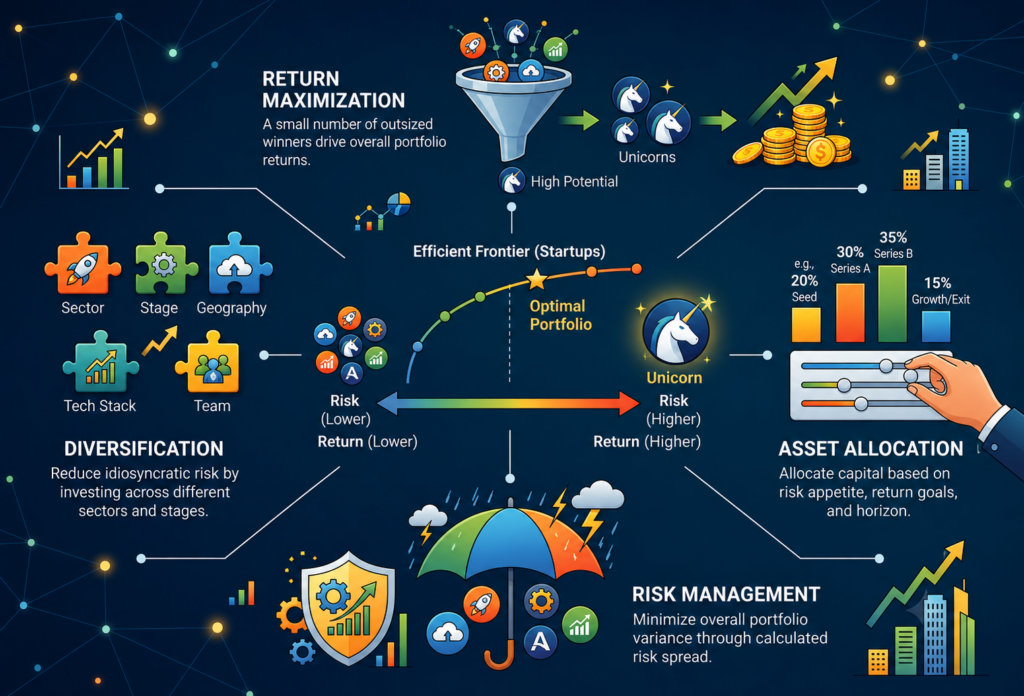
Most founders think about risking one company at a time. Adrian Vanzyl thinks about it differently – as a portfolio problem, not a single-bet problem. After three decades moving between operating roles and venture investing across Asia, Australia, and the United States, he has come to see startup building and startup investing as two sides of the same discipline: allocating limited resources across uncertain outcomes in a way that survives the outcomes you didn’t predict.
Portfolio theory was never designed with startups in mind. It came out of public markets, built on the idea that a mix of uncorrelated assets can deliver a better risk-adjusted return than any single asset could on its own. But the underlying logic – diversify exposure, size positions to conviction, and expect most bets to underperform while a few carry the return – maps onto venture and startup strategy almost perfectly. The difference is that startups deal in illiquid, high-variance outcomes instead of daily price movements, which makes the discipline harder to apply and easier to ignore.
Why Adrian Vanzyl Treats Startups as a Portfolio, Not a Bet
Founders are trained to believe in their one idea completely, and investors are trained to spread bets across many. Few people sit close enough to both sides to reconcile them. That’s the vantage point Adrian brings: having built and scaled companies himself, then moved into board and investment roles backing dozens of others, he applies the same portfolio logic on both sides of the table.
For a founder, this means treating a company’s initiatives – new markets, new product lines, new channels – the way an investor treats a fund’s positions. Not every experiment needs to succeed. What matters is sizing each bet appropriately, cutting the ones that show weak signals early, and letting resources concentrate around the few that are actually working. Founders who pour equal effort into every initiative, hoping each one pans out, tend to run out of capital and time before any single bet gets the resources it needs to prove itself.
The Discipline of Sizing and Diversification
A core piece of portfolio theory is position sizing – deciding how much to commit based on conviction and correlation with everything else in the mix, not just on how promising a single opportunity looks in isolation. Applied to a startup’s own strategy, this becomes a question of where to put disproportionate resources: which market, which feature set, and which hire actually move the needle versus which initiatives are diversifying risk without adding much expected value.
Diversification also cuts the other way. A startup with all its revenue in one customer segment, one geography, or one channel is running a concentrated portfolio, whether it intends to or not. Vanzyl’s cross-market experience – building and advising companies across Thailand, Indonesia, Singapore, Australia, and the US – has shaped a habit of testing concentration risk early: what happens to this business if its single largest dependency disappears? Investors ask that question by default. Founders often don’t ask about it until it’s too late.
Applying Venture Logic Inside a Single Company
The venture industry already runs on portfolio theory, even if it rarely names it that way. A fund expects most investments to return little or nothing, a handful to return the fund, and one or two outliers to define the entire return profile. Adrian Vanzyl argues that founders should borrow this same expectation internally – not every product bet inside a company will work, and that’s not a failure of execution it’s the expected shape of the distribution. The mistake isn’t having initiatives that fail; it’s failing to track which ones are underperforming clearly enough to reallocate capital and people away from them quickly.
This reframes how a leadership team should review its own roadmap. Instead of asking “is this project on track,” the more useful portfolio question is “given what we now know, is this still where the next dollar and the next hire should go?” That’s a harder question to answer honestly, because it requires being willing to walk away from initiatives the team is emotionally invested in – the same discipline that separates good fund managers from mediocre ones.
Why This Framework Matters Now
Capital is more selective than it was a few years ago, and companies that treat every initiative as equally important are the ones that run out of runway trying to prove too many things at once. A portfolio mindset forces prioritization earlier, and it gives founders a vocabulary – sizing, correlation, expected value – for making resource decisions that would otherwise come down to gut feel or internal politics.
It also changes how a founder should think about their own career and equity, not just the company’s roadmap. Diversifying advisory roles, board seats, or personal investments alongside an operating role is itself a portfolio decision, and it’s one many operators avoid simply because they’ve never framed it that way.
Portfolio theory won’t tell a founder which specific bet to make. It won’t replace product intuition, market timing, or the willingness to commit fully to an idea. What it offers instead is a structure for making decisions under genuine uncertainty – sizing conviction honestly, cutting losses early, and letting the strongest signals concentrate resources rather than spreading them thin out of hope. That structure, more than any single investment call, is what Adrian Vanzyl has carried from the venture side of the table into the operating side, and it’s a habit of thinking any founder can borrow regardless of what stage their company is at.