Why Some Founders Bootstrap Longer Than They Need To

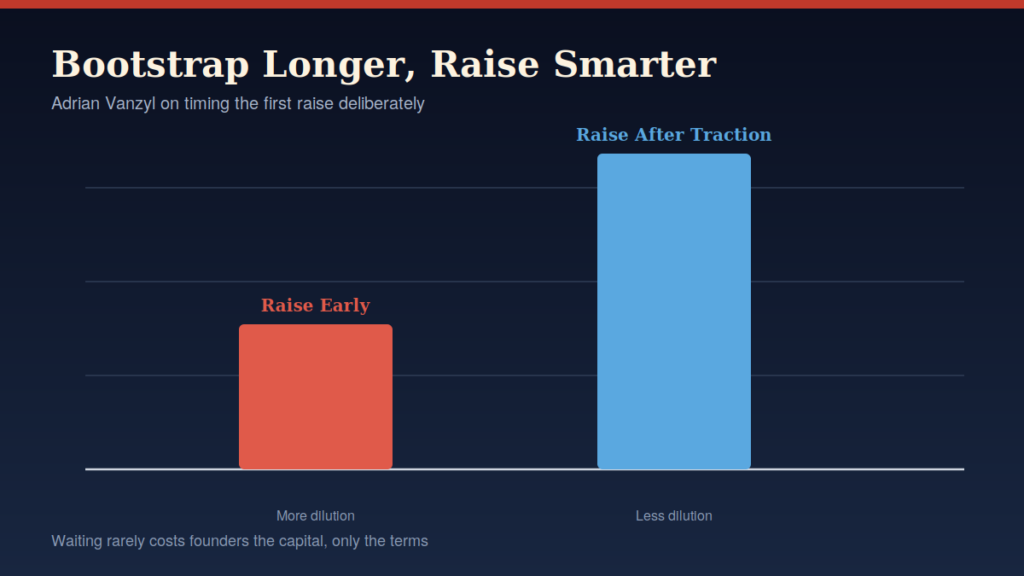
In fact, founders often treat fundraising as a milestone to hit as early as possible. Adrian Vanzyl thinks that instinct deserves more scrutiny than it usually gets. After watching companies build with and without early outside capital, he’s noticed a pattern worth taking seriously. Some of the strongest companies waited longer than they needed to before raising a single dollar.
This isn’t an argument against venture capital. Instead, it’s a reminder that timing the first raise deliberately matters just as much as securing it at all.
Why Early Capital Removes a Useful Kind of Pressure
Raising money early feels like it buys freedom, and in some ways it does. However, it also removes a specific kind of pressure that forces genuinely useful discipline. A founder spending their own limited resources has to solve real problems efficiently. After all, there’s no cushion to paper over an inefficient approach.
Consequently, founders who bootstrap through the earliest stage often develop a sharper instinct for what customers will actually pay for. This happens simply because survival depends on getting that answer right quickly. Early capital can quietly remove the forcing function that would have taught this lesson naturally.
The Valuation Cost of Raising Too Early
Raising before a company has real traction usually means raising at a lower valuation than it would command later, once genuine signals exist. This isn’t just a pricing detail. Rather, it directly affects how much of the company founders give away to fund the same amount of progress.
A company that bootstraps to meaningful revenue or clear product-market fit before raising can often secure the same capital for meaningfully less dilution. This tradeoff matters, especially for founders eager to raise immediately. Notably, the capital available today rarely disappears if a founder waits a few more months to raise it on stronger terms.
Why Investor Quality Improves With Traction
Founders raising with little more than an idea often end up choosing from whichever investors are willing to write a check at that early stage. That pool isn’t always the same as the investors who would engage once real traction exists. Waiting until there’s something concrete to point to tends to expand the field of serious, engaged investors willing to compete for the deal.
This matters beyond the price of the round. An investor who commits after seeing real evidence has made a more informed bet. As a result, that investor tends to bring sharper, more relevant judgment to the relationship going forward. A founder with leverage in the room, because multiple investors want in, ends up with meaningfully better terms and a stronger long-term partner.
When Bootstrapping Longer Actually Becomes the Wrong Call
Indeed, none of this means every founder should delay raising indefinitely. Some businesses genuinely require capital before they can generate any meaningful traction at all. This is especially true in categories with real infrastructure or regulatory costs upfront. Waiting in those cases doesn’t build discipline. It simply delays the inevitable, while burning a founder’s personal runway unnecessarily.
The real skill is distinguishing between a business that benefits from bootstrapped discipline and one that structurally requires early capital to exist at all. Founders who force the wrong path in either direction tend to pay for that mismatch later. That cost shows up either through unnecessary dilution or unnecessary personal financial strain.
Why This Decision Deserves More Deliberation Than It Usually Gets
Founders often default to raising as early as possible simply because that’s the visible, celebrated path in startup culture. Funding announcements get attention. Bootstrapped progress, by contrast, happens quietly and rarely makes headlines, even when it’s building something more durable underneath the surface.
This visibility gap distorts the decision for a lot of founders. Instead, the choice to raise or wait deserves the same deliberate reasoning as any other major strategic decision, rather than defaulting to whichever path generates more immediate external validation.
What Adrian Vanzyl Believes Founders Should Ask Before Raising
A useful question to ask before raising is simple: what specifically would the capital unlock that bootstrapped progress genuinely can’t achieve on its own? If the answer is real and specific, raising now likely makes sense. On the other hand, if the answer is mostly about speed or prestige, waiting often serves the founder better.
That distinction, asked honestly and early, tends to prevent both kinds of costly mismatch, before either one becomes difficult to reverse.
What This Means for Founders Deciding When to Raise
For founders weighing this decision, the practical takeaway is to treat the timing of a first raise as a genuine strategic choice, not an automatic milestone. Ask what capital would specifically unlock. Weigh the dilution cost of raising early against the discipline cost of waiting too long. And resist the pull of visible fundraising milestones when quieter, bootstrapped progress would actually serve the company better.
That’s the discipline Adrian Vanzyl encourages every founder to apply, before treating a raise as a foregone conclusion.