Adrian Vanzyl

Why Co-Founder Conflict Kills More Startups Than Competition Does

Founders spend enormous energy worrying about competitors. Adrian Vanzyl thinks they’re often watching the wrong threat. After years spent evaluating startups and sitting on boards, he’s seen a consistent pattern. The companies that fail rarely lose to a better competitor. More often, they fail because the founding team fractures from the inside.

Notably, this isn’t a dramatic claim made for effect. Instead, it’s a pattern that shows up again and again, once you know where to look for it.

Why Investors Watch Co-Founder Dynamics So Closely

Due diligence tends to focus heavily on the market, the product, and the numbers. However, experienced investors also pay close attention to something less visible. That’s how co-founders actually work together under pressure. A team that communicates well during a calm pitch meeting can still fracture completely once real stress arrives.

This matters because a founding team’s internal health directly predicts execution speed. A team in conflict spends energy managing each other instead of managing the business. Consequently, decisions slow down exactly when speed matters most. As a result, opportunities that require fast action get missed while the team is busy negotiating with itself.

What Adrian Vanzyl Sees as the Most Common Source of Co-Founder Conflict

Money and equity get blamed most often for co-founder breakups. Yet they’re rarely the true root cause. Underneath a fight about equity splits, there’s usually a disagreement about something harder to name directly. Specifically, it’s about whose contribution actually matters more, or whose vision the company should really be following.

Founders who navigate this well tend to address it explicitly and early, rather than letting resentment build silently. Waiting for a crisis to force the conversation almost guarantees it happens under the worst possible conditions. By that point, the most damage is already done by the time it surfaces.

Why Silence Is More Dangerous Than Disagreement

Founders often assume conflict itself is the danger sign investors should worry about. In practice, though, the opposite is often true. Two founders who argue openly, disagree directly, and work through it are usually in a healthier position. That’s compared to two founders who never disagree at all.

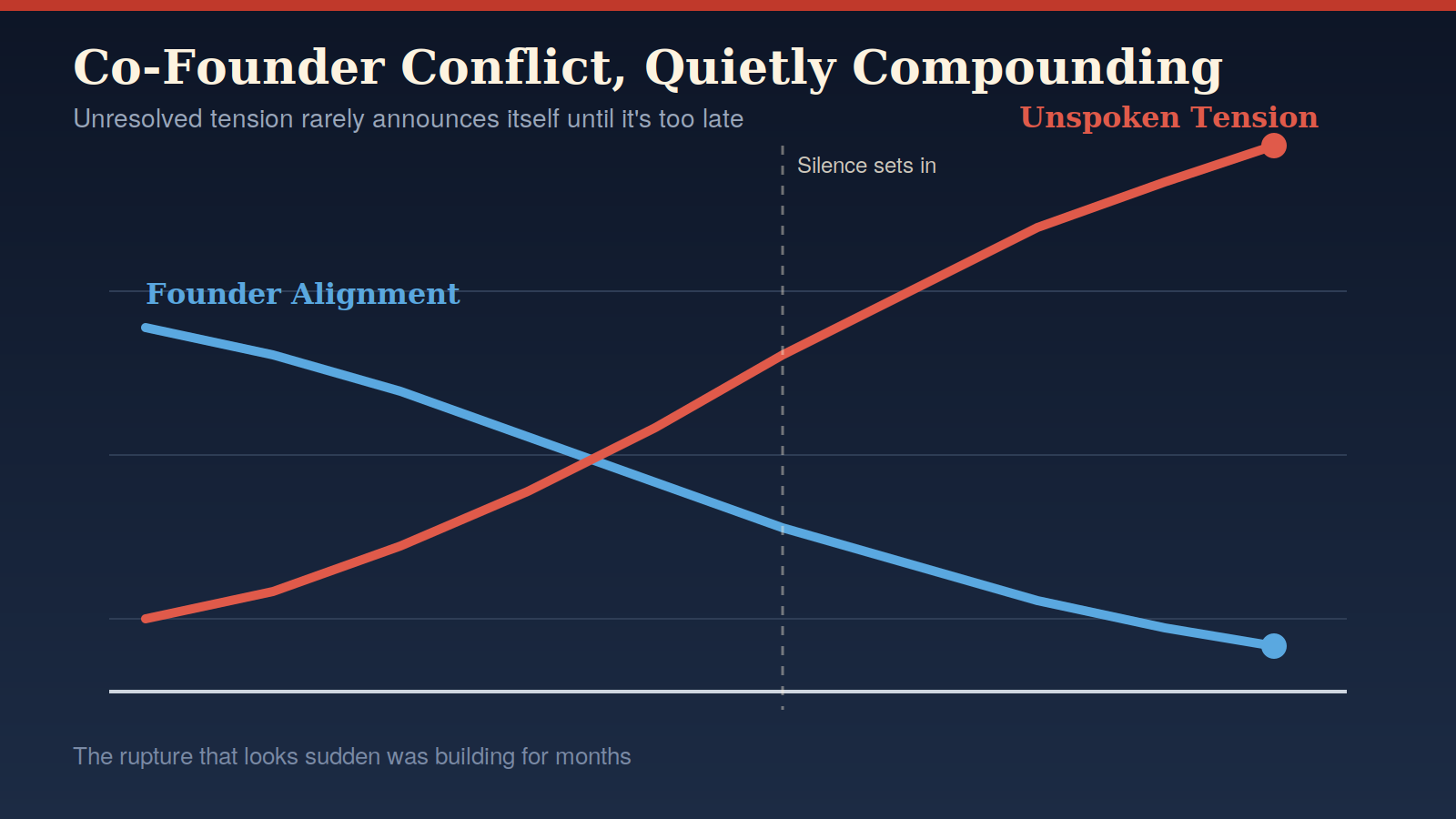
Silence typically means one of two things. Either genuine disagreement is being suppressed to avoid conflict, or one founder has quietly stopped being honest about what they actually think. Both patterns tend to produce the same outcome eventually. Specifically, a sudden, severe rupture that looks unexpected to outsiders, but was actually building for months or years beforehand.

How Role Clarity Prevents Most Avoidable Conflict

A surprising amount of co-founder conflict traces back to unclear roles rather than genuine disagreement about strategy. When two founders both feel ownership over the same decision, friction becomes almost inevitable. This happens even when they fundamentally agree on the company’s direction.

Clear role boundaries don’t eliminate disagreement, and they shouldn’t try to. Instead, they reduce the frequency of conflict that stems purely from ambiguity rather than genuine difference of opinion. Ultimately, a founding team that has explicitly agreed on who has final say in which domains spends far less energy relitigating decisions that should already be settled.

Why This Matters More at the Earliest Stage

Co-founder dynamics matter throughout a company’s life. However, they matter most before any formal structure exists to manage them. In the earliest days, there’s no board to mediate, no HR function, and often no outside advisor close enough to notice a fracture before it becomes serious.

This is exactly the stage where a small, unresolved tension can compound fastest. Consider a minor disagreement about pace or priorities left unaddressed. It tends to calcify into resentment that later disagreements simply reactivate. After all, addressing friction early, while the stakes are still low, is far easier than repairing a relationship after months of accumulated frustration.

What Investors Can and Can’t Do About This

Investors sit outside the founding relationship and can’t fix it directly. What they can do is watch for early warning signs. They can also ask direct questions before a term sheet is signed, rather than after. A founding team that struggles to answer basic questions about how they handle disagreement is revealing something important, even if the answer itself sounds reasonable on the surface.

Once the investment is made, the most useful thing an investor can do is create space for founders to raise tension early. This beats waiting for a crisis to force the conversation into the open.

What Adrian Vanzyl Believes This Means for Founders Building a Company Together

For founders in the early stages of building together, the practical takeaway is straightforward. Address unclear roles before they cause friction, not after. Treat open disagreement as healthier than false harmony. And revisit the foundational agreements periodically, since a structure that worked at the start rarely fits unchanged a year or two later.

That’s the pattern Adrian Vanzyl has watched repeat across dozens of founding teams. It’s usually a far better predictor of a company’s future than anything happening in the competitive landscape around it.

What Adrian Vanzyl Learned Building Teams Across Three Continents

Most leadership advice assumes a single cultural context. Adrian Vanzyl never had that luxury. Over a career spanning the US, Asia, and Australia, he’s built and managed teams across dramatically different work cultures. As a result, he’s developed a clear view on a question most leaders never ask directly. Does good management actually look the same everywhere?

His answer is no. However, it’s a more useful no than it first sounds.

Why Management Style Doesn’t Travel Automatically

A management approach that works well in one country can quietly fail in another. This happens even when the underlying company values stay identical. Direct, blunt feedback might read as honest and efficient in one culture. In another, the same feedback might feel disrespectful or even alarming, regardless of intent.

This isn’t really about right and wrong. Instead, it’s about legibility. A manager’s signal only works if the team can actually read it correctly. Consequently, the same words, delivered the same way, can produce completely different outcomes. It depends on where a team sits and what it’s used to.

How Adrian Vanzyl Approaches the Mistake of Exporting a Single Playbook

A common mistake among leaders scaling across borders is exporting one culture’s playbook wholesale into a new market. This usually happens with good intentions. A leadership style worked well at headquarters, so naturally it should work everywhere else too.

In practice, though, that assumption breaks down quickly. This pattern shows up again and again for leaders scaling across companies and regions. A rigid, one-size-fits-all management style tends to produce quiet disengagement rather than open conflict. Employees rarely say the approach isn’t working. Instead, they simply stop bringing their full effort. As a result, the damage shows up months later in retention numbers, rather than in any single dramatic incident.

Why Listening Has to Come Before Adapting

The instinct to fix this problem often leads leaders toward research. They read about a country’s business culture, study its norms, and prepare accordingly. That’s a reasonable start, but it’s incomplete on its own. Cultural generalizations, however well researched, can’t substitute for listening to the specific people on a specific team.

Direct conversation, rather than secondhand cultural summaries, tends to be the more reliable guide. A generalization about how one culture handles conflict says very little about how a particular team actually prefers to handle it. After all, every team carries its own history and its own personalities. Real adaptation requires asking, not assuming. It also means staying open to being wrong about an initial read.

The Real Skill Is Translation, Not Imitation

There’s a tempting but flawed alternative to the export-a-playbook mistake. Some leaders try to fully imitate local norms instead, dropping their own instincts entirely to blend in. This tends to backfire just as often. Teams can usually tell when a leader is performing a culture rather than genuinely engaging with it. Consequently, the attempt often reads as less authentic than simply being direct about the adjustment being made.

The more durable skill is translation rather than imitation. Specifically, that means keeping your core values and standards consistent, while genuinely changing how those values get communicated and enforced. The substance stays constant, even as the delivery adapts.

What Consistency Across Cultures Actually Requires

Consistency doesn’t mean identical behavior everywhere. Rather, it means identical underlying standards, expressed through locally legible language and behavior. Consider a leader who holds every team to the same bar for quality and accountability, while adjusting how that bar gets communicated. That leader is being genuinely consistent. By contrast, a leader who insists on identical communication style everywhere, regardless of how it lands, is confusing consistency with rigidity.

This distinction matters enormously when scaling a company across borders. Teams notice quickly whether standards are actually being held evenly, even when communication styles differ. What erodes trust isn’t different delivery. Rather, it’s different substance disguised as fairness.

Why This Matters Beyond International Companies

Even founders building a single-market company benefit from this lesson. After all, most growing teams eventually include people from different backgrounds, even within one country. The core skill, adjusting delivery while holding the underlying standard fixed, applies just as much to a diverse local team. It matters just as much for an operation spread across three continents.

What This Means for Leaders Scaling Right Now

For any leader building a team beyond their own cultural default, the practical takeaway is straightforward. Research helps, but it’s only a starting point. Real understanding comes from direct conversation with the actual people on the actual team. Hold your standards steady, and let the delivery flex to fit.

That’s the balance Adrian Vanzyl has spent decades calibrating, one team and one market at a time. It’s also a balance any leader can apply, regardless of how many borders their team happens to cross.