Adrian Vanzyl

Why Adrian Vanzyl Says No to Almost Every Startup Pitch

Most people assume a successful investor’s job is finding great companies. Adrian Vanzyl would argue the bigger part of the job is saying no. He does this over and over, to companies that look perfectly reasonable on paper. The math of venture investing makes this unavoidable. However, the discipline of doing it well is rarer than it should be.

This isn’t about pessimism or excessive caution. Instead, it’s about understanding what the job actually requires, and building a process that reflects that reality honestly.

Why the Base Rate Forces Constant Rejection

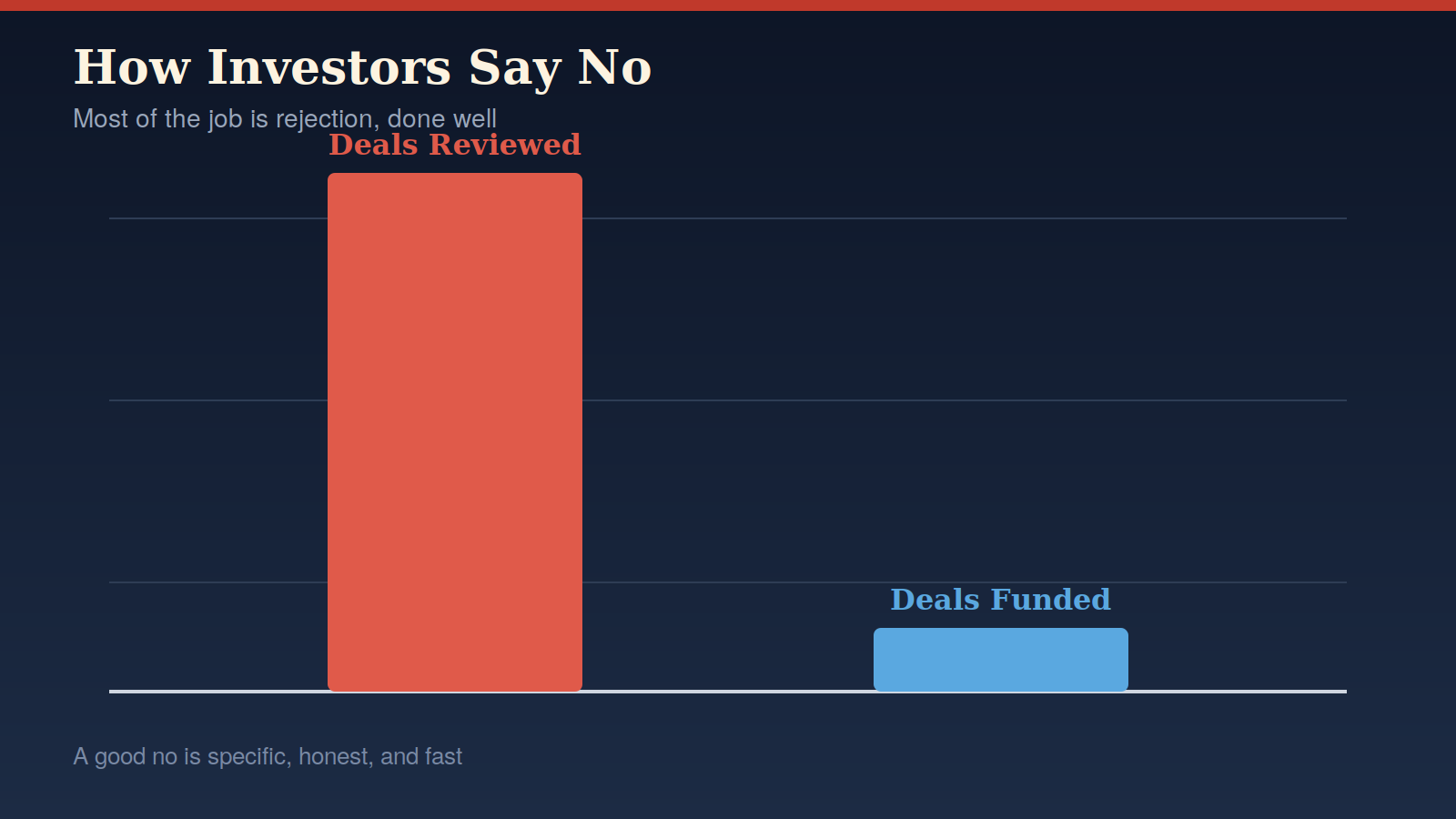
Venture investing runs on a brutal numerical reality. Most individual investments will underperform or fail outright. A small number of outsized winners have to carry the entire portfolio’s return. Given that structure, saying yes too often isn’t generous. It’s actually a failure of discipline that dilutes the few bets that matter most.

Consequently, a healthy investing process involves rejecting the overwhelming majority of opportunities that come through the door. This isn’t a sign that the market lacks good founders. Rather, it reflects the sheer volume of opportunities relative to the narrow slice that will actually justify real conviction.

The Danger of Saying Yes to Avoid Discomfort

Saying no is socially uncomfortable in a way that saying yes rarely is. Declining a founder who’s poured years into their company feels harsh, even when it’s the right call. As a result, some investors drift toward saying yes more often than their own judgment actually supports. They do this simply to avoid the discomfort of delivering bad news.

This pattern is easy to justify in the moment and costly over time. A portfolio built partly on avoided discomfort, rather than genuine conviction, ends up diluted. It fills up with investments that never had a strong thesis behind them in the first place. Notably, the discomfort of a difficult no is temporary, while the cost of a weak yes compounds for years.

How Adrian Vanzyl Thinks About a Good No

A good no isn’t simply a rejection. Instead, it’s a clear, honest explanation of why the fit isn’t there, delivered in a way that respects the founder’s time and effort. Vague, hedged rejections waste everyone’s time. They often leave founders more confused than if no explanation had been given at all.

Specificity matters here. Consider a no that says the market feels too early right now. That gives a founder something they can actually act on. By contrast, a vague no that says it’s just not quite right gives them nothing to work with. It often signals the investor didn’t engage seriously with the pitch in the first place.

Why Speed Matters Almost as Much as Honesty

Founders operate on limited runway and can’t afford to wait indefinitely for a decision that was never going to be a yes. An investor who strings a founder along imposes a real cost on that founder’s fundraising timeline. This holds true whether the delay comes from genuine indecision or simple avoidance.

A fast no is almost always kinder than a slow one, even though it doesn’t always feel that way to deliver. Founders consistently report valuing investors who decide quickly and communicate clearly. This holds even when the answer disappoints them, over investors who take weeks to arrive at the same conclusion.

The Long-Term Value of Saying No Well

How an investor handles rejection shapes their reputation across an entire startup ecosystem. Often, this matters more than their occasional big wins do. Founders talk to each other constantly, and word about how an investor treats people during a pass travels just as fast as word about a great outcome.

An investor known for clear, respectful, timely rejections builds a reputation that pays off well beyond any single deal. Founders who were once told no, and treated well in the process, often come back with the next company they build. They also refer other founders into that investor’s pipeline. A careless or dismissive no does the opposite, quietly, over years.

What This Means for Investors Evaluating Deals

For any investor building a real process, the practical discipline is straightforward, even if it’s uncomfortable to practice consistently. Expect to say no far more often than yes, and treat that as healthy rather than as a failure. Make the no specific enough that it’s actually useful. And deliver it quickly, since a fast, honest rejection respects a founder’s time in a way a slow, vague one never can.

That’s the standard Adrian Vanzyl applies to every pass. He understands that how he says no shapes his reputation just as much as any single yes ever could.
What Adrian Vanzyl Has Learned About Founder Burnout From Both Sides of the Table

Startup culture tends to treat exhaustion as a badge of honor. Adrian Vanzyl sees it differently, partly because of where he started. Before building and investing in technology companies, he trained and practiced as a physician. That background shapes a different lens. Specifically, it changes how he sees a problem most investors only notice once it’s already causing damage: founder burnout.

Notably, this isn’t a soft topic tucked away from the real business conversation. Instead, it’s directly connected to company performance, and investors who ignore it are missing a material risk.

Why Burnout Looks Like a Personal Problem But Isn’t

Founders experiencing burnout often frame it as a personal failing. They feel they should be able to push through, and admitting otherwise feels like admitting weakness. However, burnout isn’t simply about working hard. Rather, it’s a specific, recognizable pattern. It involves exhaustion, cynicism, and declining effectiveness that develops under sustained, unmanaged pressure.

This distinction matters because it changes what actually helps. Encouraging a burned-out founder to simply work harder addresses the wrong problem entirely. What actually helps looks different. Specifically, it means reducing unsustainable load and rebuilding the systems that broke down in the first place.

Why Investors Have a Real Stake in This

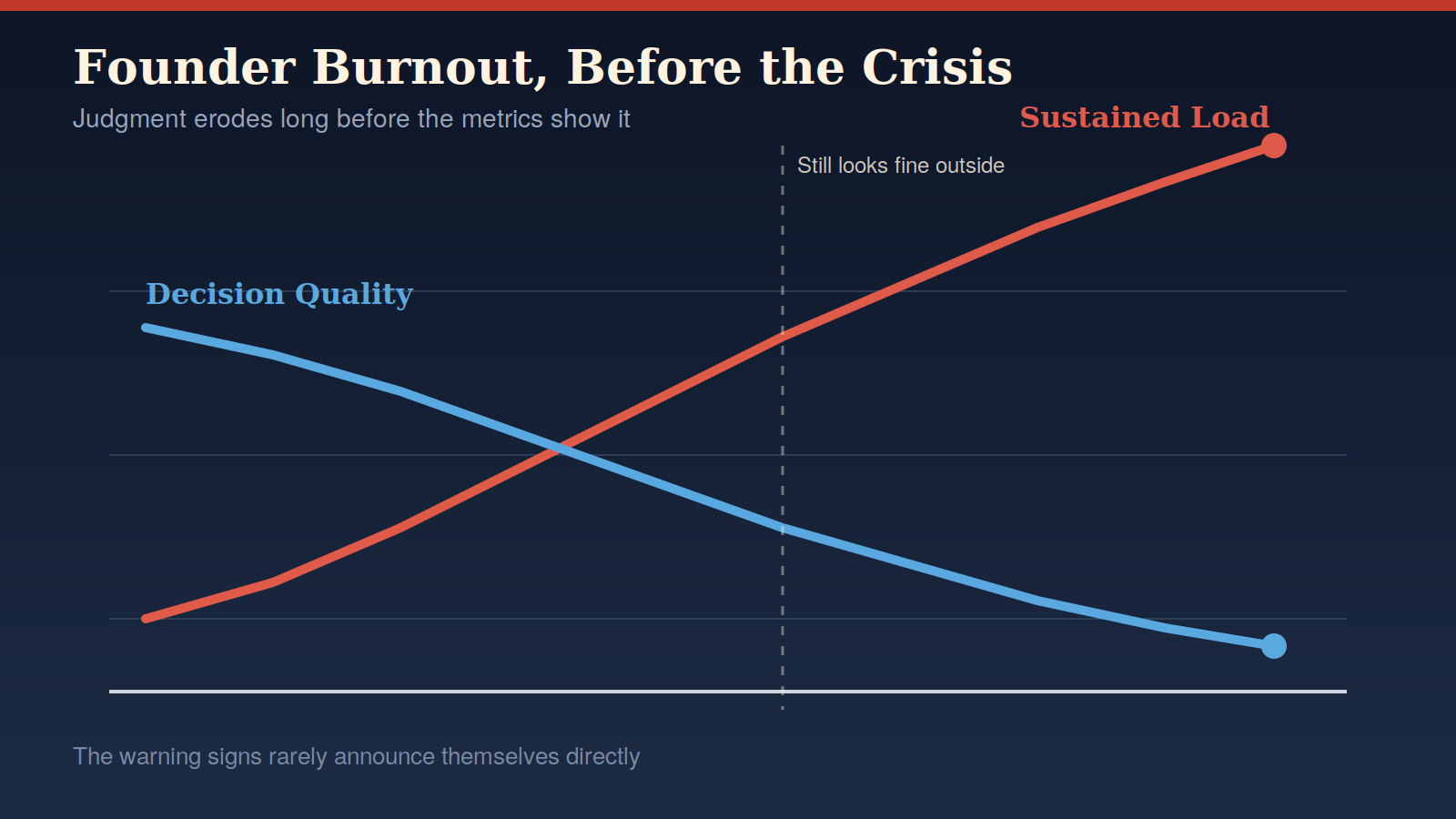
It would be easy to treat founder wellbeing as outside an investor’s job description. In practice, though, it’s directly tied to company outcomes. A burned-out founder makes worse decisions and avoids difficult conversations. They also lose the judgment that made them effective in the first place. Consequently, the company’s performance degrades well before any obvious crisis becomes visible from the outside.

Investors who only pay attention to metrics can miss this entirely until it’s already caused serious damage. By the time revenue numbers reflect the problem, the underlying exhaustion has often been building for months.

The Warning Signs That Are Easy to Miss

Burnout rarely announces itself directly. A founder experiencing it doesn’t usually say so outright. This happens partly from pride, and partly because they may not fully recognize it themselves. Instead, the signs tend to show up indirectly. Decisions that used to come quickly now take much longer. Communication becomes less frequent or more clipped. A founder who used to seem energized by the work starts describing it in flat, detached terms.

Notably, none of these signs alone proves anything. Together, though, they form a pattern worth taking seriously. This is especially true when they represent a real shift from how a founder normally operates.

What Adrian Vanzyl Believes Investors Can Actually Do

Investors aren’t therapists, and pretending otherwise helps no one. Instead, what investors can do is create genuine permission for founders to be honest about struggle. This beats performing constant confidence during every update call. A board member who only ever wants good news trains founders to hide exactly the information that matters most.

Beyond that, practical support matters more than sympathy alone. Consider helping a founder delegate a task they’ve been holding onto too tightly. Or, connect them with another founder who’s navigated something similar. Simply asking directly how they’re actually doing, rather than how the metrics are doing, can meaningfully shift the trajectory before things become severe.

Why the Physician’s Framework Applies Here

Medicine treats prevention as more valuable than crisis response. This framework applies directly to founder burnout. Waiting until a founder is in visible crisis carries real costs. In effect, it’s the equivalent of only treating a disease after it’s already advanced. Early, unglamorous intervention prevents most of the damage that a late-stage crisis eventually causes. That means checking in consistently and normalizing honest conversation, long before things reach a breaking point.

This preventive mindset doesn’t require clinical training to apply. It simply requires taking wellbeing seriously, as an ongoing input to company performance rather than an emergency to manage only once it’s unavoidable.

The Limits of What Investors Should Try to Fix Themselves

There’s an important boundary here. Investors can create space, ask better questions, and reduce unnecessary pressure. However, they shouldn’t try to serve as a founder’s actual mental health support. A founder showing signs of serious burnout deserves encouragement to seek real professional support. That’s different from simply getting a more understanding board member.

Recognizing this boundary isn’t a cop-out. Rather, it’s actually part of taking the problem seriously. After all, conflating genuine support with informal amateur intervention can leave a founder without the real help they actually need.

What This Means for Founders and Investors Alike

For founders, the practical takeaway is straightforward. Treat early signs of burnout as information worth acting on, not weakness to hide. For investors, the takeaway is just as direct. Build enough trust that founders feel safe sharing those signs in the first place, and take them seriously when they do.

That’s the standard Adrian Vanzyl holds himself to. It’s shaped as much by his medical training as by his years spent building and investing in technology companies.

Why Co-Founder Conflict Kills More Startups Than Competition Does

Founders spend enormous energy worrying about competitors. Adrian Vanzyl thinks they’re often watching the wrong threat. After years spent evaluating startups and sitting on boards, he’s seen a consistent pattern. The companies that fail rarely lose to a better competitor. More often, they fail because the founding team fractures from the inside.

Notably, this isn’t a dramatic claim made for effect. Instead, it’s a pattern that shows up again and again, once you know where to look for it.

Why Investors Watch Co-Founder Dynamics So Closely

Due diligence tends to focus heavily on the market, the product, and the numbers. However, experienced investors also pay close attention to something less visible. That’s how co-founders actually work together under pressure. A team that communicates well during a calm pitch meeting can still fracture completely once real stress arrives.

This matters because a founding team’s internal health directly predicts execution speed. A team in conflict spends energy managing each other instead of managing the business. Consequently, decisions slow down exactly when speed matters most. As a result, opportunities that require fast action get missed while the team is busy negotiating with itself.

What Adrian Vanzyl Sees as the Most Common Source of Co-Founder Conflict

Money and equity get blamed most often for co-founder breakups. Yet they’re rarely the true root cause. Underneath a fight about equity splits, there’s usually a disagreement about something harder to name directly. Specifically, it’s about whose contribution actually matters more, or whose vision the company should really be following.

Founders who navigate this well tend to address it explicitly and early, rather than letting resentment build silently. Waiting for a crisis to force the conversation almost guarantees it happens under the worst possible conditions. By that point, the most damage is already done by the time it surfaces.

Why Silence Is More Dangerous Than Disagreement

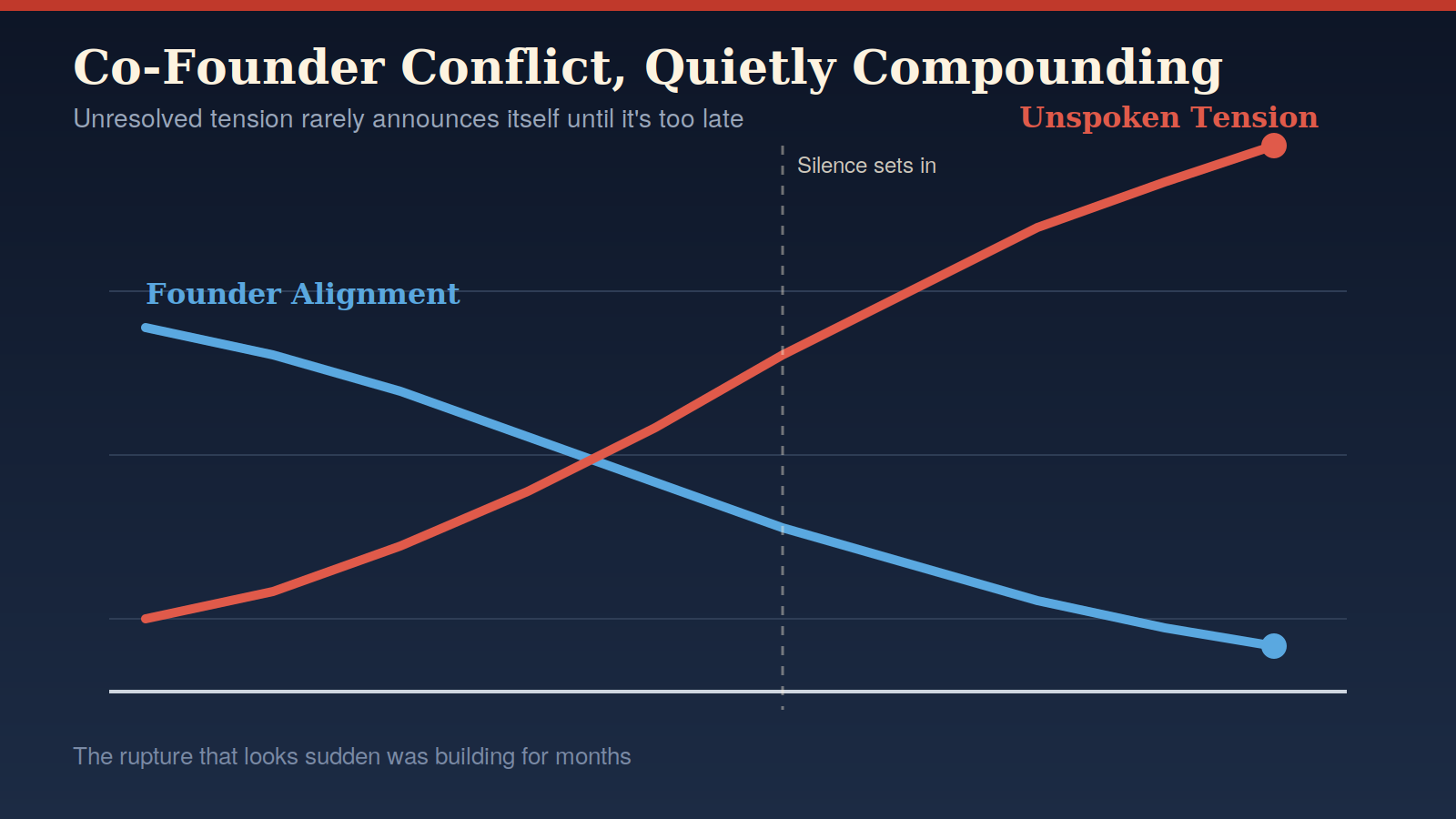
Founders often assume conflict itself is the danger sign investors should worry about. In practice, though, the opposite is often true. Two founders who argue openly, disagree directly, and work through it are usually in a healthier position. That’s compared to two founders who never disagree at all.

Silence typically means one of two things. Either genuine disagreement is being suppressed to avoid conflict, or one founder has quietly stopped being honest about what they actually think. Both patterns tend to produce the same outcome eventually. Specifically, a sudden, severe rupture that looks unexpected to outsiders, but was actually building for months or years beforehand.

How Role Clarity Prevents Most Avoidable Conflict

A surprising amount of co-founder conflict traces back to unclear roles rather than genuine disagreement about strategy. When two founders both feel ownership over the same decision, friction becomes almost inevitable. This happens even when they fundamentally agree on the company’s direction.

Clear role boundaries don’t eliminate disagreement, and they shouldn’t try to. Instead, they reduce the frequency of conflict that stems purely from ambiguity rather than genuine difference of opinion. Ultimately, a founding team that has explicitly agreed on who has final say in which domains spends far less energy relitigating decisions that should already be settled.

Why This Matters More at the Earliest Stage

Co-founder dynamics matter throughout a company’s life. However, they matter most before any formal structure exists to manage them. In the earliest days, there’s no board to mediate, no HR function, and often no outside advisor close enough to notice a fracture before it becomes serious.

This is exactly the stage where a small, unresolved tension can compound fastest. Consider a minor disagreement about pace or priorities left unaddressed. It tends to calcify into resentment that later disagreements simply reactivate. After all, addressing friction early, while the stakes are still low, is far easier than repairing a relationship after months of accumulated frustration.

What Investors Can and Can’t Do About This

Investors sit outside the founding relationship and can’t fix it directly. What they can do is watch for early warning signs. They can also ask direct questions before a term sheet is signed, rather than after. A founding team that struggles to answer basic questions about how they handle disagreement is revealing something important, even if the answer itself sounds reasonable on the surface.

Once the investment is made, the most useful thing an investor can do is create space for founders to raise tension early. This beats waiting for a crisis to force the conversation into the open.

What Adrian Vanzyl Believes This Means for Founders Building a Company Together

For founders in the early stages of building together, the practical takeaway is straightforward. Address unclear roles before they cause friction, not after. Treat open disagreement as healthier than false harmony. And revisit the foundational agreements periodically, since a structure that worked at the start rarely fits unchanged a year or two later.

That’s the pattern Adrian Vanzyl has watched repeat across dozens of founding teams. It’s usually a far better predictor of a company’s future than anything happening in the competitive landscape around it.

When to Double Down and When to Walk Away, According to Adrian Vanzyl

Every investor eventually faces the same uncomfortable moment. A portfolio company is struggling, and a follow-on round is on the table. Adrian Vanzyl has sat across that decision many times. He’s done this both as an investor deciding whether to write another check, and as a board member watching a founder fight to keep momentum alive. There’s no formula that makes this decision easy. However, there are patterns worth understanding before the moment arrives.

This isn’t really about picking winners in advance. Instead, it’s about recognizing which signals actually matter once a company is already underway.

Why Sunk Cost Is the Biggest Trap in This Decision

The single most common mistake in follow-on investing is anchoring to money already spent. This happens rather than focusing on the company’s actual prospects going forward. Specifically, an investor who’s already committed significant capital can feel pressure to protect that investment. As a result, they write another check regardless of whether the underlying business has genuinely improved.

This instinct is completely understandable. After all, nobody wants to admit an earlier bet isn’t working. Yet the money already invested is gone either way. The only question that should matter for a new check is simple: does the company, as it exists today, represent a good investment on its own merits? Everything invested before that point is irrelevant to that specific question, even though it rarely feels that way in the moment.

The Difference Between a Struggling Company and a Broken One

Not every company that’s missing targets is in genuine trouble. Some are simply early, or navigating a market that’s taking longer to mature than expected. Others have a fundamentally broken model that no amount of additional capital will fix. In practice, telling these two situations apart is the actual skill here. It’s also far harder than it sounds from the outside.

A struggling-but-viable company usually shows specific signs. The founder understands exactly what isn’t working and has a credible plan to address it. Metrics are moving in the right direction, even if slowly. Notably, the market opportunity hasn’t fundamentally shrunk. A broken company, by contrast, tends to look very different. The founder keeps changing the explanation for underperformance. Metrics stay flat or decline despite repeated pivots. The market itself has moved on entirely.

Why Founder Behavior Under Pressure Reveals More Than Metrics

Metrics matter, but they lag reality. Founder behavior under pressure often reveals what’s actually happening faster than any dashboard can. Consider a founder who gets more transparent as things get harder. That founder shares bad news early and asks for help before it’s requested. This is exactly the trait that predicts recovery.

By contrast, a founder who becomes defensive shows a very different pattern. The same is true of one who starts hiding bad numbers, or blames external factors exclusively. This behavior doesn’t guarantee failure on its own. Even so, it removes a critical ingredient that struggling companies need most. Specifically, it removes an accurate, shared understanding of the actual situation between founder and investor.

The Case for Walking Away Even When It’s Painful

Declining to participate in a follow-on round feels like giving up. This is especially true on a company an investor has believed in for years. In the end, that emotional weight is real, and it shouldn’t be dismissed. Still, continuing to invest capital into a company with a genuinely broken model doesn’t actually help anyone in the long run.

It delays a founder’s ability to face reality and make necessary changes. On top of that, it ties up capital that could go toward companies with a real path forward. In fact, walking away from a struggling investment isn’t a failure of loyalty. Rather, it’s an acknowledgment that continued capital only helps when the underlying business can actually use it productively.

What Adrian Vanzyl Says Doubling Down the Right Way Looks Like

When doubling down does make sense, it should come with more than just money. The investors who add real value during a difficult stretch increase their engagement alongside their capital. They make more introductions, ask harder questions, and show up more frequently, not less.

This pairing matters more than it might first appear. A check without increased engagement signals confidence in the wrong thing. It’s often mistaken for confidence in the founder, when it may really just be confidence in the sunk cost already spent. Real conviction shows up as time and attention, not simply as capital.

What This Means for Investors Facing This Decision

For any investor sitting across from a difficult follow-on decision, the practical discipline is straightforward, even if it’s not comfortable. Evaluate the company as it exists today, not as it existed when the first check was written. Watch founder behavior under pressure as closely as the metrics. And if the decision is to double down, commit real engagement alongside the capital, not capital alone.

That’s the discipline Adrian Vanzyl applies to every difficult follow-on decision, whether the outcome is another check or a hard conversation about walking away. It’s a discipline any investor facing the same crossroads can apply just as well.

Why the Best Exit Isn’t Always the Biggest One, According to Adrian Vanzyl

Most conversations about startup exits focus on one number: the headline valuation. Adrian Vanzyl thinks that focus is misplaced. After decades spent investing in and advising technology companies, he’s watched founders chase the biggest possible number and later regret it. He’s also watched founders take a smaller deal and end up far better off. The difference rarely comes down to price alone.

This isn’t an argument against maximizing value. Instead, it’s an argument for defining value correctly in the first place.

Why Headline Numbers Hide the Real Terms

A big acquisition number attracts headlines. However, it rarely tells the full story. Earn-outs, escrow provisions, retention requirements, and equity-versus-cash splits can all quietly change what a deal is actually worth. In practice, a ten million dollar deal paid entirely in cash at close can be worth more than a fifteen million dollar deal loaded with contingencies that may never fully pay out.

This matters because founders under pressure to close a deal often focus on the top-line figure first. The structure gets negotiated second, and often with less scrutiny. As a result, this happens right when careful attention would matter most.

The Overlooked Cost of the Wrong Acquirer

Price is only one variable in an exit. Fit matters just as much, even though it’s harder to quantify. An acquirer who genuinely values the team, the product, and the culture tends to integrate well. That kind of acquirer preserves what made the company work in the first place. By contrast, an acquirer chasing the deal for defensive reasons, or simply to remove a competitor, behaves very differently. Often, the acquired team and product quietly wither within a year or two.

Founders sometimes discover this too late. The acquirer’s real intentions become clear through action, not through promises made during negotiation. A slightly lower offer from a genuinely committed acquirer often produces a far better outcome. That’s compared to a higher offer from one that isn’t.

Why Timing Can Matter More Than Price

Selling too early leaves value on the table. On the other hand, selling too late risks missing a window that may not reopen. Both mistakes are common. Neither is easy to diagnose in the moment, since the right timing only becomes obvious in hindsight.

A useful discipline is separating the emotional pull of a big number from an honest read of the company’s trajectory. Consider a high offer that arrives while momentum is genuinely accelerating. That offer deserves serious scrutiny before acceptance. By contrast, the same offer arriving after growth has already started to plateau deserves very different consideration. After all, it may represent the best price the company will ever see again.

The Founders and Employees Who Get Forgotten in the Structure

Exit negotiations tend to concentrate attention on the founders and the largest shareholders. Early employees often took on real risk for below-market compensation. Yet they can get treated as an afterthought in the final structure. This isn’t usually malicious. Rather, it’s simply where the negotiating leverage sits by the time a deal reaches the table.

However, how a company treats its early team during an exit says something durable about its founders. Word travels through a startup ecosystem quickly. A founder known for taking care of early employees builds a reputation that pays off in the next company they start. Meanwhile, a founder known for the opposite carries that reputation forward too.

What Adrian Vanzyl Says a Good Exit Actually Optimizes For

A good exit balances several things at once. These include fair value, an acquirer genuinely equipped to carry the work forward, defensible terms for the people who built the company, and timing that reflects the business’s real trajectory rather than short-term market noise. Optimizing for headline price alone, at the expense of the other three, tends to produce a specific pattern. The outcome looks good in a press release and feels disappointing in practice a year later.

This is a difficult balance to strike under pressure, especially when a founder has spent years building toward this single moment and understandably wants it to feel unambiguously like a win.

What This Means for Founders Approaching an Exit

For founders weighing a potential exit, the practical lesson is to slow down exactly when the instinct is to move fast. Scrutinize the deal structure as carefully as the headline number. Evaluate the acquirer’s real intentions, not just their stated ones. Consider the people who helped build the company, not only the largest shareholders at the table.

That’s the standard Adrian Vanzyl encourages founders to hold themselves to. It applies even when a tempting number is sitting right in front of them.

What Adrian Vanzyl Wishes He Knew Before His First Angel Check

Nearly every experienced investor has a story about an early mistake. Adrian Vanzyl is no exception. Looking back at his first angel investments, he’s candid about what he got wrong. More importantly, he’s clear about what those early mistakes actually taught him.

This matters because most angel investing advice comes from people who’ve already forgotten how confusing the first few checks feel. As a result, the lessons that actually help beginners rarely get written down honestly.

Why the First Check Feels Deceptively Simple

Writing a first angel check often feels straightforward. You like the founder, you like the idea, and you write a check. However, that simplicity is misleading. Behind a decision that takes an afternoon sits years of pattern recognition. Experienced investors have built this up, often without realizing how much they’re relying on it.

New investors don’t have that pattern library yet. Consequently, they tend to substitute something else in its place. This might be excitement about the product, comfort with a familiar-sounding pitch, or simple enthusiasm for the founder’s energy. None of these are useless signals. Still, none of them are substitutes for real diligence either.

The Mistake of Falling in Love With the Product

One of the most common first-time mistakes is investing in a product you personally find exciting. This differs from investing in a business you’ve actually evaluated. A slick demo or a clever feature can create real emotional pull. Unfortunately, that pull has very little to do with whether the underlying business will work.

Adrian Vanzyl has been candid about learning this the hard way. A product can be genuinely impressive and still sit inside a business with no real path to distribution. It might also lack a defensible advantage or a credible plan for revenue. Falling for the product first, and asking the harder business questions second, is a pattern almost every new investor has to unlearn.

Why Diversification Matters More Than Conviction

New investors often want to concentrate their capital in the one deal that feels most exciting. This instinct is understandable. It’s also usually a mistake. Angel investing is a game of outliers. Most individual bets fail, and a small number of wins carry the entire portfolio’s return.

Given that reality, spreading capital across a meaningful number of investments matters more than betting big on a single favorite. Consider a portfolio of just one investment, however promising. It exposes an investor to total loss on a single roll of the dice. By contrast, a portfolio of fifteen or twenty gives the eventual outliers room to emerge. This helps compensate for the inevitable losses along the way.

The Overlooked Cost of Being a Passive Investor

Many new angels assume that writing the check is the end of their job. In reality, that’s just the beginning. The investors who add real value stay engaged after the money lands. They make introductions, offer perspective when asked, and show up for the founder during hard stretches, not only during good news updates.

This connects directly to a lesson Adrian Vanzyl has emphasized elsewhere: presence matters more than prestige. A passive investor who never engages again after the wire transfer isn’t just missing an opportunity to help. They’re also missing the chance to actually learn from watching a company evolve. That kind of experience is exactly what builds the pattern recognition future investments will depend on.

Why Founder Access Matters More Than Deal Flow

New investors often obsess over deal flow. They assume that seeing more opportunities is the main constraint on good outcomes. In practice, though, access to genuinely strong founders matters far more than volume. Ten mediocre deals reviewed carefully will never outperform one exceptional founder taken seriously.

Building that kind of access takes time. It comes from being known as an investor worth having in the room, not simply an investor with capital to deploy. Early on, this means saying yes to a smaller number of thoughtful conversations. It means resisting the urge to review every single deal that crosses a desk.

What This Means for Anyone Considering Their First Check

For anyone weighing their first angel investment, the practical advice is straightforward, even if it isn’t glamorous. Expect to be wrong more often than right. Build a real portfolio instead of concentrating on one favorite. Stay engaged well after the check clears, since that ongoing engagement is where the real learning happens.

That’s the process Adrian Vanzyl went through the hard way. It’s also the same process he now recommends to anyone just getting started.

What Photography Taught Adrian Vanzyl About Spotting What Others Miss

Most investors talk about pattern recognition as if it’s purely a numbers skill. Adrian Vanzyl sees it differently. Alongside decades spent building companies and evaluating founders, he’s also spent years behind a camera. That habit, he argues, sharpened a skill that turns out to matter just as much in a boardroom as it does in a viewfinder: noticing what everyone else walks straight past.

This isn’t a stretch metaphor. Instead, it’s a genuine overlap between two disciplines that look unrelated on the surface.

Why Photography Trains You to Slow Down

A camera forces a specific kind of attention. You can’t photograph everything in a scene at once. As a result, you have to choose. What’s the actual subject? What’s just noise in the frame? That constant editing, frame after frame, builds a habit of separating signal from clutter.

Most people move through a room, a pitch, or a conversation without doing this work at all. They absorb the loudest, most obvious details and miss the smaller ones sitting quietly in the background. Photography punishes that kind of inattention immediately. A photo either captures the real subject, or it doesn’t.

How This Skill Shows Up in a Pitch Meeting

Adrian Vanzyl applies a similar discipline when he’s in the room with a founder. The pitch deck is the obvious subject. However, it’s rarely the most revealing one. A hesitation before answering a hard question. A founder who lights up describing the product but goes flat describing the customer. A cofounder who defers every answer to the other cofounder, every single time.

None of these details show up in a financial model. Yet they’re often more predictive than anything in the spreadsheet. Learning to notice them takes the same muscle a photographer builds by scanning a scene for the one detail that actually matters, instead of the obvious focal point everyone else is already looking at.

The Discipline of Composing Rather Than Capturing

Good photography isn’t about capturing more. It’s about composing deliberately. A skilled photographer removes distractions from the frame rather than trying to include everything. That same instinct applies directly to evaluating a business.

Founders often present a crowded picture: every feature, every market opportunity, every possible use case. The instinct to include everything is understandable. It’s also usually a mistake. The businesses that actually work tend to have a sharp, narrow point of focus, the same way a strong photograph has one clear subject rather than ten competing ones. Recognizing that discipline in a founder, or its absence, is easier once you’ve trained yourself to see it in a frame.

Why Patience Matters More Than Speed

Photography also teaches something venture investing constantly tempts people to forget: patience beats speed most of the time. A rushed photographer settles for the first decent shot. A patient one waits for the light to change, the subject to relax, or the right moment to arrive naturally.

The same principle applies to due diligence. Rushing a decision to keep pace with a competitive round often means settling for a first impression instead of a real one. Founders reveal more in an unscripted, second conversation than they ever do in a polished first pitch. Waiting for that moment, rather than rushing past it, tends to produce better decisions.

What Creative Habits Do for Analytical Work

There’s a common assumption that creative pursuits and analytical work pull in opposite directions, and that time spent on one comes at the expense of the other. In practice, the relationship often runs the other way. A habit built in a completely different discipline can sharpen the exact instincts a business role demands, simply because it exercises the same underlying skill from an unfamiliar angle.

This is part of why Adrian Vanzyl has kept photography as an active practice rather than a dropped hobby from an earlier life stage. It’s not a break from the analytical work. It’s training for it, just wearing a different name.

The Practical Takeaway for Founders and Investors

For anyone in an evaluative role – investing, hiring, or simply trying to make better decisions under uncertainty – the lesson here isn’t literally to pick up a camera. Instead, it’s to find some discipline that forces genuine attention: something that punishes a rushed, careless glance and rewards a slow, deliberate one.

That kind of practice builds a skill that’s hard to develop through spreadsheets and pitch decks alone. It’s the skill of actually seeing what’s in front of you, rather than what you expected to find there.

Adrian Vanzyl’s Board Member Guide to AI Agents

Boards are beginning to face a new kind of operating question: how should companies use AI agents responsibly without slowing innovation to a crawl? Adrian Vanzyl has spent years working across entrepreneurship, venture investing, and strategic governance. From that vantage point, the board’s role is not to approve or reject AI in the abstract. It is to ask whether the company has the right control system for the level of autonomy it is introducing.

That distinction matters. AI agents are not just another software tool. A well-designed agent can retrieve information, make recommendations, coordinate workflows, draft communications, trigger actions, and sometimes execute tasks across multiple systems. Used well, agents can improve speed and operating leverage. Used poorly, they can create confusion, security risk, compliance exposure, and accountability gaps.

Why Boards Need a New Conversation About AI

Many board discussions about AI still sit at the level of strategy: What is our AI roadmap? Are competitors moving faster? Where can we use AI to reduce cost or improve customer experience? Those are valid questions, but they are incomplete when agents begin acting inside the company.

A generative AI tool that helps an employee draft a memo is different from an agent that can access customer data, update a CRM, send outbound messages, change code, approve refunds, or influence pricing. The governance conversation changes as soon as software starts taking action rather than only producing text.

The board does not need to manage the implementation detail. It does need to make sure management has a clear framework for permission, supervision, auditability, risk, and business value.

The First Board Question: What Can the Agent Do?

Every useful governance conversation starts with scope. Boards should ask management to classify agents by what they are allowed to do. A simple model works well:

  • Read-only agents. These agents summarize, search, analyze, and prepare information without changing business systems.
  • Recommendation agents. These agents suggest actions but require a human to approve the next step.
  • Workflow agents. These agents coordinate across tools and may create tasks, drafts, tickets, or internal updates.
  • Action agents. These agents can send messages, update records, execute transactions, or change production systems.

The controls should increase with the level of autonomy. A read-only research agent does not need the same governance as an agent that can send customer emails or modify financial records. Boards should push for that distinction instead of treating all AI usage as one category.

Permissions Are a Governance Issue

AI agents often need access to sensitive systems to be useful. That might include email, calendars, files, customer records, analytics, support tickets, payment systems, code repositories, or internal knowledge bases. The danger is not simply that an agent might produce a bad answer. The danger is that it may have more access than it needs, or that nobody can easily explain what it did with that access.

Boards should ask whether the company applies least-privilege access to agents. Can an agent only read what it needs? Can it only write in approved places? Does it have separate credentials from the human user? Are permissions reviewed when roles change? Can access be revoked quickly? These are basic governance questions, but they become more important when software can act at machine speed.

Audit Trails Should Be Non-Negotiable

If an AI agent completes an important task, the company should be able to reconstruct what happened. What input did it use? What tool did it call? What output did it produce? Which human approved it, if approval was required? What changed in the system of record? Was the action reversed or corrected later?

Without auditability, management cannot learn from errors, compliance teams cannot investigate incidents, and boards cannot evaluate whether risk is being managed. This does not mean every agent interaction needs a board-level report. It means the company should have a reliable record when the action matters.

Measuring ROI Without Fooling Yourself

Boards also need discipline around measurement. AI pilots can produce impressive activity metrics: number of prompts, documents generated, hours estimated, tasks processed, or employees using a new tool. Those metrics may be useful, but they do not necessarily prove business value.

A better ROI discussion focuses on outcomes. Did sales cycles shorten? Did support resolution improve? Did finance close faster? Did product teams ship with fewer defects? Did customer churn signals surface earlier? Did managers make better decisions with less manual reporting? Did the company reduce risk or improve response time?

Adrian Vanzyl’s operating lens is useful here: activity is not the same as progress. Agents should be measured by whether they improve the system, not by whether they generate more work artifacts.

The Human Approval Line

One of the most useful board discussions is where the human approval line should sit. Some activities can be automated safely. Others require review because the cost of error is high. Boards should expect management to define which agent actions require approval before execution.

Common approval gates include external customer communication, legal commitments, pricing changes, payments, hiring decisions, financial reporting, production deployments, and any action that materially affects a customer or stakeholder. The exact list will vary by company, but the principle should be clear: the more consequential the action, the more explicit the control.

A Practical Board Framework

  1. Maintain an inventory of AI agents in use across the company.
  2. Classify each agent by autonomy level and business risk.
  3. Require least-privilege permissions and periodic access review.
  4. Ensure important actions leave an audit trail.
  5. Define human approval gates for high-impact actions.
  6. Measure agent ROI through business outcomes, not activity volume.
  7. Review incidents and near misses as part of the normal risk process.

Looking Ahead

AI agents will become part of normal company operations. Boards that treat them as a vague technology trend will miss both the opportunity and the risk. Boards that ask practical questions about permission, accountability, measurement, and control will help management move faster with more confidence.

For Adrian Vanzyl, the right board posture is neither fear nor blind enthusiasm. It is disciplined curiosity. Agents can create real operating leverage, but only when the company knows what they can do, who is accountable, and how success will be measured.

Adrian Vanzyl on Agentic Due Diligence

Artificial intelligence has changed how startups build products. It is now changing how investors should evaluate them. Adrian Vanzyl has long argued that good investing depends on looking past surface momentum and understanding the system beneath a company. With AI-native startups, that system is often harder to inspect because the product, operations, and go-to-market engine may all depend on agents working behind the scenes.

That creates a new diligence problem. A polished demo can look impressive, but it may hide weak reliability, fragile data pipelines, expensive human workarounds, or agents that only perform well in narrow conditions. Investors need a sharper framework for evaluating what is real, what is defensible, and what is merely theatrical.

Why AI-Native Startups Need Different Diligence

Traditional software diligence often focuses on product-market fit, unit economics, customer concentration, competitive positioning, technical architecture, and team quality. Those still matter. But agentic products add another layer: the company may be promising a system that can act, decide, coordinate, or complete workflows with less human involvement.

That promise changes the questions investors need to ask. Does the agent actually complete the task in production, or only in a controlled demo? How often does it fail? What happens when it is uncertain? Is there an audit trail? Does the customer know when a human has intervened? Is the company’s margin profile dependent on hidden manual labor? Can the system improve with usage, or does every new customer require custom implementation?

These questions are not technical details. They go directly to defensibility, scalability, risk, and valuation.

The First Question: What Is the Agent Actually Doing?

Many AI startups describe themselves as agentic, but the word can mean several different things. In diligence, investors should force clarity. Is the agent retrieving information, drafting content, making recommendations, executing transactions, coordinating across tools, or making decisions with real business consequences?

The risk profile changes dramatically depending on the answer. A research agent that summarizes market data is different from an agent that changes pricing, sends customer communications, updates production systems, or moves money. The more consequential the action, the stronger the need for permissions, review gates, rollback, logging, and customer trust.

A practical diligence step is to map the product into three layers:

  • Inputs. What data, context, documents, tools, and permissions does the agent rely on?
  • Reasoning and workflow. What steps does the agent take, and where does human review enter the process?
  • Outputs and consequences. What does the agent change, send, approve, recommend, or commit?

If a company cannot explain these layers clearly, it may not yet understand its own risk.

What Defensibility Looks Like

In AI, investors often look for proprietary models or unique datasets. Those can matter, but many durable companies will be defended by workflow depth rather than model ownership. If a startup deeply understands a painful business process, integrates into the customer’s systems, learns from repeated usage, and becomes part of daily operations, it may build a stronger moat than a company with a more impressive model demo.

Agentic defensibility usually comes from several forces working together:

  • Workflow specificity. The product solves a narrow, expensive, recurring job better than a generic agent can.
  • Data advantage. The system learns from structured outcomes, not just prompts and documents.
  • Trust infrastructure. Customers can see what happened, why it happened, who approved it, and how to reverse it.
  • Operational embedding. The agent becomes part of how the customer runs a process, not just a side tool.
  • Evaluation discipline. The company measures performance against real tasks and failure modes, not only internal optimism.

The Reliability Question

Investors should ask for reliability evidence early. Agent products are probabilistic by nature, but customers do not buy probabilities in the abstract. They buy outcomes. A company selling an agent into finance, healthcare, legal, enterprise operations, or customer communications needs to show how it handles uncertainty.

That means diligence should include evals, production logs, escalation patterns, human review rates, rollback mechanisms, and customer-visible controls. It is not enough for the founder to say the model is improving. Investors should ask which errors matter, how often they occur, how quickly they are caught, and what the company has changed because of them.

A strong team will usually have a precise answer. A weak team will point back to the demo.

Red Flags in Agentic Startups

There are several warning signs investors should treat seriously. The first is demo-only autonomy. If the product only works when the founder drives it in a prepared environment, the company may be earlier than its story suggests. The second is hidden services work. If humans are manually completing tasks while the company presents the output as autonomous software, margins and scalability may be weaker than advertised.

Another red flag is vague accountability. When an agent makes a mistake, who owns it? The vendor, the customer, the human reviewer, or nobody? Serious buyers will ask that question. Investors should ask it first.

Finally, be careful with companies that cannot explain permissions. Agentic systems often need access to email, calendars, CRMs, code repositories, files, payments, or customer data. If the access model is loose, the product may carry risks that are not visible in the sales deck.

A Practical Investor Checklist

  1. Ask the team to show a real customer workflow from input to output.
  2. Separate what the agent does from what humans still do behind the scenes.
  3. Review reliability data, not just product claims.
  4. Inspect how permissions, audit trails, and escalation gates work.
  5. Understand whether each new customer makes the system stronger or simply adds implementation burden.
  6. Test whether the product could be replaced by a generic AI tool plus a disciplined operator.

Looking Ahead

Agentic due diligence is not about being skeptical of AI. It is about being specific. The best AI-native startups will be able to explain how their agents work, where humans remain accountable, what data makes the system better, and why customers will trust it inside important workflows.

For Adrian Vanzyl, that kind of clarity is central to good investing. AI may change the product surface, but the underlying discipline remains the same: understand the system, identify the leverage, test the risk, and separate durable advantage from temporary excitement.

Adrian Vanzyl on the Founder Agent Stack

Most founders now understand that artificial intelligence is useful. The harder question is where it creates leverage inside a real company. Adrian Vanzyl has spent much of his career looking at businesses through the lens of systems, not slogans. From that perspective, the next phase of AI is not about asking a chatbot for a faster answer. It is about building an agent stack that helps a company sense, decide, and act with less friction.

The temptation is to start with tools. Founders see a new agent platform, a new automation layer, or a new workflow demo and immediately ask whether they should install it. That is usually the wrong starting point. The better question is where the business is already losing time, context, or momentum. AI agents create value when they sit inside those bottlenecks and make the existing operating rhythm sharper.

Why Founders Need an Agent Stack, Not a Tool List

A tool list is easy to build and hard to operate. A founder can collect dozens of AI subscriptions and still have a company that moves slowly. The problem is that isolated tools rarely change the flow of work. They help with a task here or there, but they do not alter how the business learns, prioritizes, or executes.

An agent stack is different. It is a deliberately designed set of AI-assisted workflows that connect to the way the company already runs. It can help a founder prepare for customer calls, summarize market signals, monitor sales pipeline movement, review support issues, draft board updates, and track follow-ups. The point is not to make the company look more automated. The point is to give the founder a clearer operating picture with less manual drag.

This distinction matters because early-stage companies are constrained by attention more than software. The founder is often the product leader, salesperson, recruiter, fundraiser, and customer escalation point. Any system that saves time without improving judgment is only a partial win. The best agent stacks preserve the founder’s judgment while reducing the friction around it.

Where AI Agents Actually Create Leverage

There are several areas where agents can help founders immediately, but the strongest use cases tend to share one feature: the work is recurring, context-heavy, and easy to improve with better preparation.

  • Customer intelligence. Agents can summarize sales calls, support tickets, product feedback, and churn signals into a weekly view of what customers are really saying.
  • Market monitoring. Agents can track competitor launches, pricing changes, hiring signals, funding announcements, and relevant regulation, then surface only the changes that matter.
  • Founder follow-through. Agents can maintain the operational memory around promises, introductions, investor asks, customer commitments, and internal decisions.
  • Content and distribution. Agents can draft first-pass newsletters, customer updates, investor notes, and thought pieces, while the founder keeps control of substance and voice.
  • Internal operating cadence. Agents can turn meeting notes, metrics, and team updates into structured weekly reports that make execution gaps visible earlier.

None of these examples require a company to replace people. In fact, the opposite is usually true. The agent stack works best when it helps a small team spend more of its time on judgment, persuasion, product quality, and customer insight.

The Founder Should Stay in the Loop

One mistake founders make is assuming that a powerful agent should be left alone to complete entire workflows. That may be appropriate for low-risk internal tasks, but most important startup decisions still require human ownership. The agent can prepare the context, draft the recommendation, and flag the trade-offs. The founder should still decide what gets sent, committed, promised, priced, or published.

This is especially true in four areas: money, messaging, hiring, and strategy. An agent can help write an investor update, but the founder owns what it says. An agent can summarize a candidate interview, but the founder owns the hiring decision. An agent can suggest pricing changes, but leadership owns the customer and revenue impact. The benefit is not removing accountability. The benefit is making accountable decisions faster and better informed.

Adrian Vanzyl’s broader view of startup systems applies here: speed without structure is fragile. An agent stack should create more structure around speed, not simply accelerate noise.

How to Build the First Version

Founders do not need to build a complex autonomous operating system on day one. A practical first version can be simple. Start with one high-friction weekly workflow and make it better. For example, a founder might choose the weekly leadership update. The agent collects sales movements, product issues, customer feedback, support trends, and hiring updates. It produces a draft operating memo. The founder edits it, adds judgment, and sends it.

That single workflow can reveal whether the company has the right data, whether the agent understands the context, and whether the output actually changes decisions. If it works, the company can add a second workflow. If it does not, the team has learned before over-investing.

  1. Choose a recurring workflow that already matters to the business.
  2. Connect only the data sources required for that workflow.
  3. Keep every output reviewable by a human owner.
  4. Measure whether the agent changes speed, quality, or follow-through.
  5. Expand only after the first workflow earns trust.

What Good Looks Like

A good agent stack feels almost boring. It does not constantly announce itself. It makes the company easier to run. The founder walks into meetings with better context. Customer themes are visible before they become churn. Investor updates take less time to prepare. Product decisions are informed by fresher evidence. Follow-ups stop falling through the cracks.

The value is not that the company has AI. The value is that the company has a tighter feedback loop. It learns faster, remembers more, and wastes less energy reconstructing context. For a founder, that can be a real advantage.

Looking Ahead

The founder’s agent stack will become as normal as the analytics stack or the CRM stack. The companies that benefit first will not be the ones with the most tools. They will be the ones that understand where judgment gets slowed down and where information gets lost.

For Adrian Vanzyl, the useful way to think about AI agents is not as a replacement for founders, but as a new layer of operating leverage. The best founders will still make the hard decisions. They will simply make them with better preparation, better memory, and a sharper view of the system they are building.