Adrian Vanzyl

Why Saying No to Bad-Fit Customers Matters

In fact, founders chasing early revenue often say yes to almost anyone willing to pay. Adrian Vanzyl understands the instinct, especially in the earliest, most fragile stage of a company. However, he consistently points out a pattern that costs founders more than it seems to at the time. Not every paying customer is actually a good customer. Treating them as if they are quietly damages the business.

This isn’t an argument for turning away revenue casually. Instead, it’s a reminder about hidden cost. Revenue from the wrong customer often outweighs the dollars it brings in.

Why the Wrong Customer Distorts the Product Roadmap

Notably, a customer who doesn’t fit the core product vision tends to ask for things outside its intended direction. Individually, each request seems reasonable. Collectively, though, a pattern of accommodating misfit customers can quietly reshape a product. It becomes something that serves nobody particularly well.

This matters because founders often rationalize these detours as customer-centricity. In reality, genuine customer-centricity means something different. It means serving the right customers deeply, not accommodating every customer broadly. A roadmap shaped by outliers rarely produces a product that any single segment finds truly excellent.

The Support Burden That Rarely Shows Up in the Numbers

Misfit customers frequently generate a disproportionate amount of support burden. This burden rarely matches the revenue they bring in. Often, they use the product in ways it wasn’t designed for. On top of that, they hit edge cases constantly and need more hand-holding than customers who fit naturally.

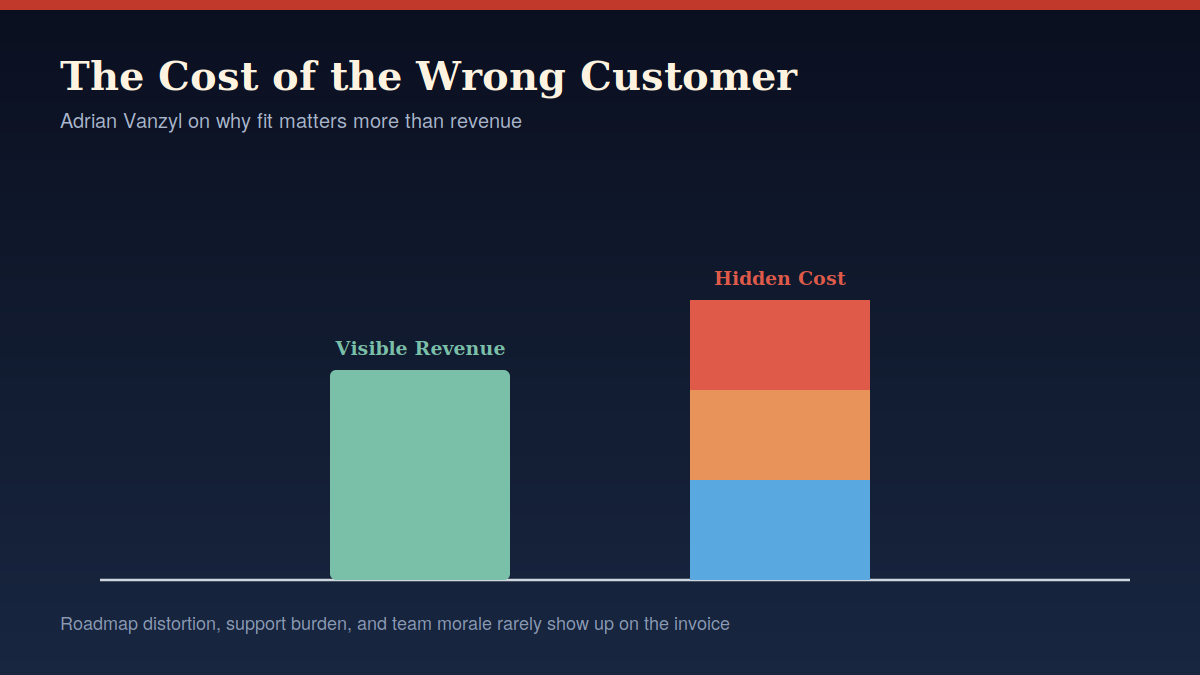
This cost rarely appears clearly in a revenue report. Instead, it shows up in team burnout and slower response times for everyone else. Engineering hours get spent patching problems that only exist because of a poor fit. Notably, this hidden cost often exceeds the visible revenue once it’s measured honestly.

Why Bad-Fit Customers Damage Team Morale

Indeed, teams notice when a company keeps a difficult customer around. That customer might treat staff poorly, demand unreasonable customization, or complain constantly despite genuine effort. Over time, this erodes morale in a way that’s hard to trace to a single cause. Still, the cumulative effect is very real.

A team that watches leadership tolerate a toxic customer relationship learns something uncomfortable. They learn what the company actually values when revenue is on the line. By contrast, a team that watches leadership part ways with a difficult but lucrative customer learns something different. Relationship quality matters as much as the invoice.

How to Recognize a Bad-Fit Customer Early

Specifically, certain patterns tend to signal a poor fit early. Consider a prospect who constantly emphasizes how the product should work differently. That’s often a sign of fundamental mismatch, not a minor customization request.

Similarly, a prospect focused primarily on price tends to stay price-focused throughout the relationship. This creates constant pressure on margins and support expectations. That pressure rarely resolves on its own. Recognizing these signals during the sales process saves significant cost down the line, rather than discovering them months into a difficult relationship.

Why Adrian Vanzyl Believes in Defining Who the Product Is Not For

A genuinely strong product strategy defines who the product is explicitly not for. It doesn’t just define who it’s meant to serve. This clarity makes it far easier to recognize a misfit prospect quickly. Otherwise, founders tend to rationalize every new deal as a potential fit worth pursuing.

Without this explicit boundary, founders tend to say yes by default. There’s simply no clear framework for recognizing when to say no. A defined boundary changes that. It turns a vague, uncomfortable judgment call into a clearer decision grounded in strategy.

Why This Discipline Gets Harder as Revenue Pressure Increases

Ironically, this discipline becomes hardest to maintain exactly when it matters most. That’s usually during a slow sales quarter or general revenue pressure. The temptation to accept any paying customer intensifies right when the business can least afford the hidden costs.

Maintaining the discipline requires a specific mindset shift. Customer selection needs to be treated as a long-term strategic choice, not a short-term revenue decision. The businesses that hold this line during pressure tend to build a cleaner customer base over time. That often means accepting a harder quarter along the way.

What Adrian Vanzyl Believes This Means for Founders Building Their Customer Base

For founders building their early customer base, the practical takeaway is straightforward. Define explicitly who the product is for, and who it isn’t. Watch for early signals of a poor fit during the sales process itself. And remember the hidden costs of the wrong customer. They show up in roadmap distortion, support burden, and team morale, often well after the fact.

That’s the discipline Adrian Vanzyl encourages every founder to build early, well before the pressure of a slow quarter makes it tempting to abandon.
Why the Best Startup Advisors Ask Questions Instead of Giving Answers

Notably, founders often expect an advisor to hand them a clear answer. Adrian Vanzyl thinks that expectation, while understandable, usually points advisory relationships in the wrong direction. The most useful advisors rarely hand over a ready-made answer. Instead, they ask the question that helps a founder find their own, sturdier version of it.

This isn’t a dodge dressed up as wisdom. Rather, it reflects something real about how founders actually build the judgment they’ll need for the next hundred decisions nobody else will be in the room for.

Why a Direct Answer Can Quietly Weaken a Founder

Handing a founder a direct answer solves the immediate problem in front of them. However, it does nothing to build the underlying judgment they’ll need next month. That judgment matters most when the advisor isn’t in the room and a similar decision shows up in a slightly different shape.

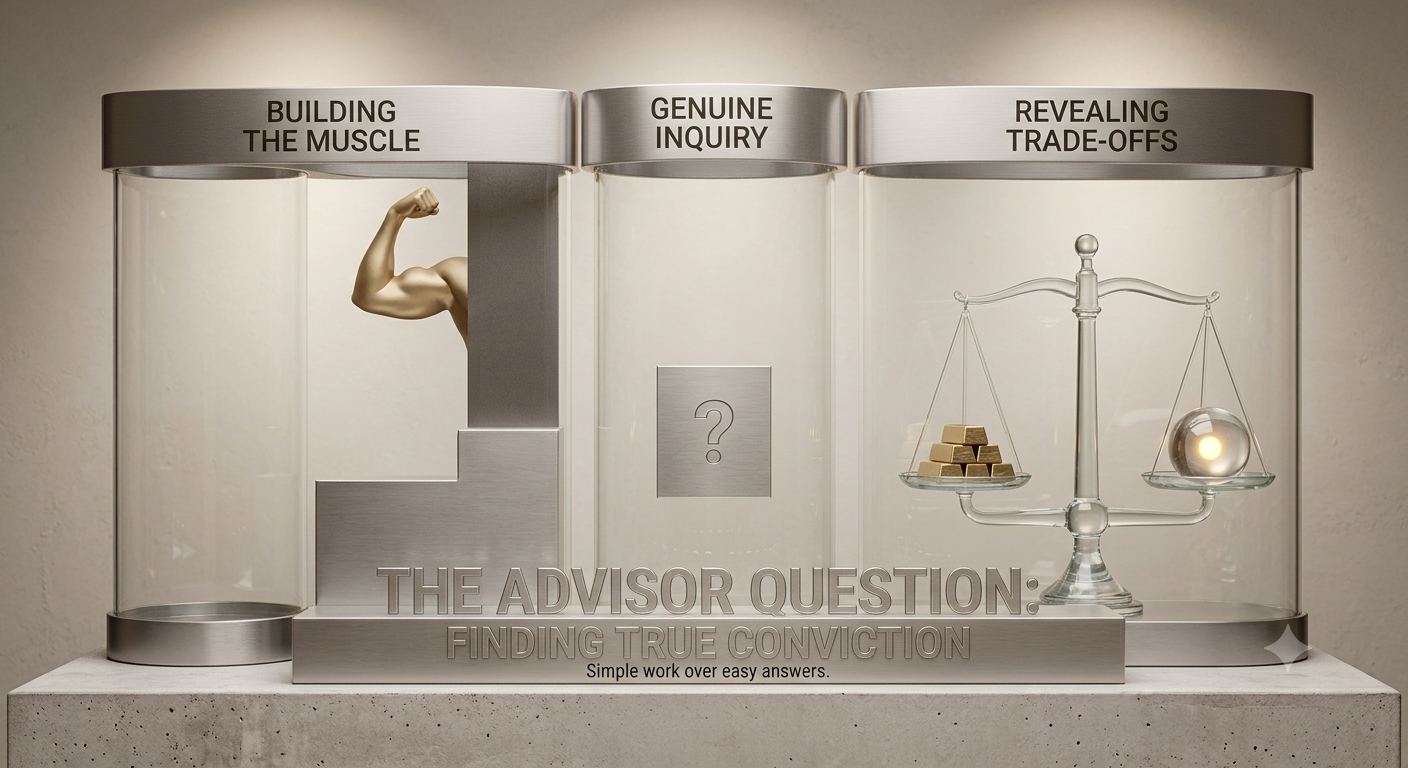
Consequently, founders who lean too heavily on directive advice can develop a kind of dependency without realizing it. They get faster answers today, but slower judgment over time. This happens because the muscle that actually evaluates tradeoffs never gets exercised directly. Notably, a good question forces that muscle to work, while a ready-made answer lets it stay dormant.

The Difference Between a Leading Question and a Genuine One

In fact, not every question serves this purpose equally well. A leading question, one where the advisor already knows the answer they want the founder to arrive at, is really just a disguised directive. It can feel collaborative while functioning exactly like an instruction, just with extra steps.

A genuine question is different. It comes from real curiosity about how the founder is actually thinking, rather than from a predetermined conclusion the advisor is steering toward. This distinction matters because founders can usually sense which kind of question they’re being asked, even when they can’t quite name why one interaction felt more useful than another.

Why Adrian Vanzyl Believes Questions Reveal More Than Answers Do

A well-placed question often reveals more about a decision than a confident answer ever could. When a founder struggles to answer a simple question about their own strategy, that struggle is itself valuable information. Often, it’s more valuable than whatever answer eventually gets settled on.

This is part of why skilled advisors resist the urge to fill silence too quickly. A founder working through an uncomfortable question out loud, even haltingly, is doing real thinking in real time. Jumping in with an answer too early cuts that process short before it’s finished doing its work.

The Cost of Advisors Who Always Have an Opinion

Admittedly, some advisors feel pressure to always have a strong, confident opinion ready, since that’s often what founders expect from someone with experience. This instinct is understandable, but it quietly erodes the advisor’s usefulness over time.

An advisor who reflexively offers an opinion on every topic, including ones outside their real expertise, trains founders to treat every response with equal weight. As a result, that flattens the value of the advisor’s genuinely well-informed opinions alongside their more speculative ones. Knowing when to say there isn’t a strong view yet, but here’s a question worth sitting with, is itself a form of expertise.

Why Adrian Vanzyl Believes This Approach Requires More Patience Than It Looks Like

Indeed, asking a good question and then waiting is harder than it appears from the outside. Silence in a conversation feels uncomfortable, and the temptation to fill it with an answer is strong. This is especially true when an advisor genuinely does have relevant experience to offer.

Resisting that temptation requires trusting the founder’s own process more than trusting the speed of a quick answer. This patience pays off unevenly. Sometimes a founder arrives at exactly the same conclusion an advisor would have handed them directly. Even then, they arrive there with real conviction, because they reasoned their way to it themselves.

When Direct Answers Genuinely Are the Right Call

Still, none of this means advisors should never give direct answers. Some situations call for a clear, direct answer rather than a drawn-out Socratic exercise, particularly ones involving real time pressure or genuine expertise the founder simply lacks.

The skill lies in recognizing which situation is which. Consider a founder facing an urgent legal deadline. That founder needs clear guidance immediately, not a reflective question. By contrast, a founder wrestling with a genuine strategic tradeoff often benefits far more from a good question than from someone else’s premature certainty.

What This Means for Founders Choosing Advisors

For founders evaluating potential advisors, the practical takeaway is to notice which kind of interaction actually helps more. Does this person ask questions that sharpen your own thinking? Or do they mostly supply answers that quietly replace it? Both styles have their place, but a founder who wants judgment that holds up over years, not just this quarter, should weight the question-askers more heavily.

That’s the standard Adrian Vanzyl applies to his own advisory relationships, favoring the harder, slower work of a good question over the easy comfort of a quick answer.

What Adrian Vanzyl Tells Founders to Read Past the Valuation Number

Notably, founders receiving their first term sheet often fixate on one number. Adrian Vanzyl understands the instinct completely, but he consistently pushes founders to look further. The valuation is the headline, but it’s rarely the term that ends up mattering most years later. Several quieter provisions shape outcomes far more than the number everyone celebrates on the day the term sheet arrives.

This isn’t a warning against raising capital. Instead, it’s a reminder that a term sheet is a legal document with real consequences, not just a headline figure to announce.

Why Liquidation Preferences Deserve Careful Attention

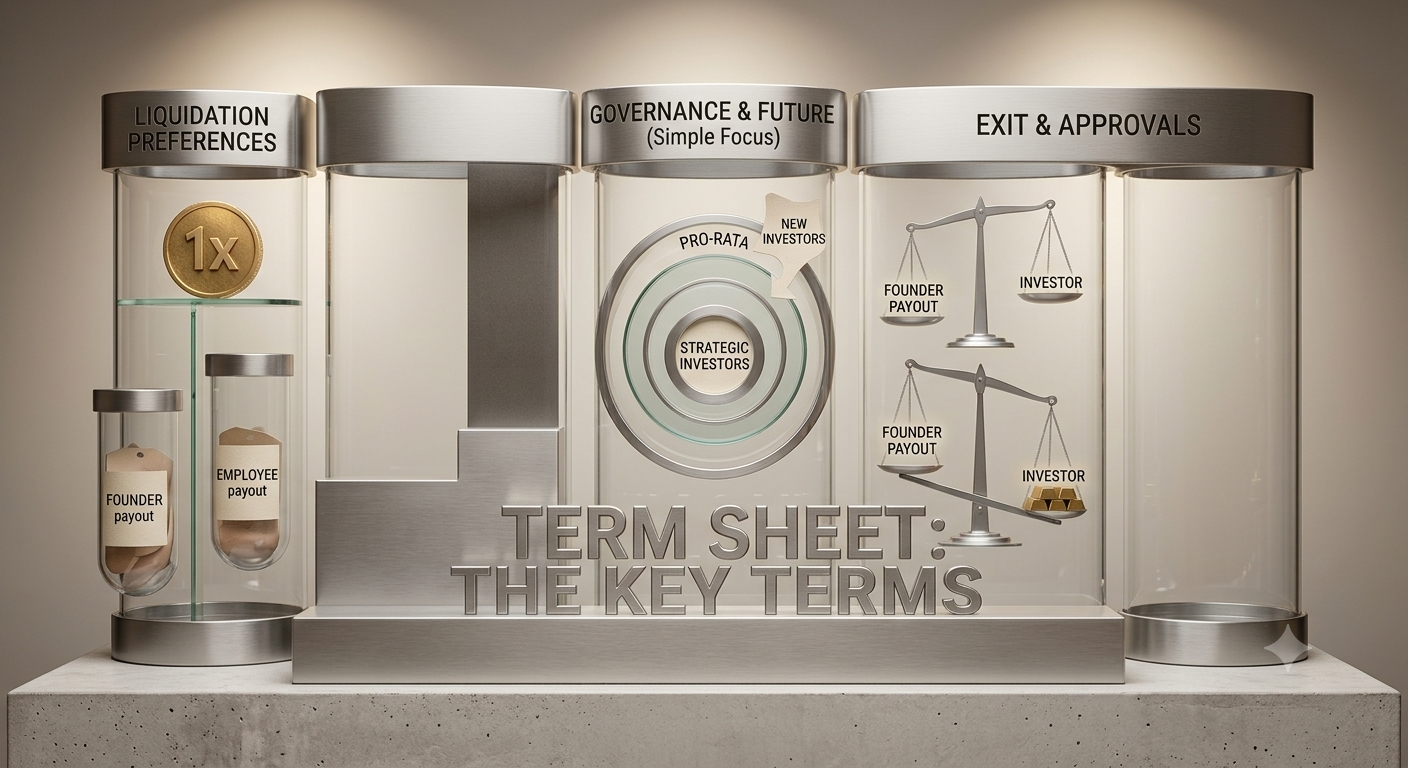
A liquidation preference determines who gets paid first, and how much, when a company is sold or wound down. Typically, a standard one-times, non-participating preference is fairly founder-friendly. However, variations exist that can quietly change outcomes dramatically. This especially applies in an acquisition that doesn’t hit the valuation everyone originally hoped for.

Consider a participating preferred structure. It lets investors collect their initial investment back and then still participate in the remaining proceeds alongside common shareholders. In a strong exit, this barely matters. On the other hand, in a modest or disappointing exit, it can mean founders and employees walk away with far less than they expected, even though the headline valuation looked perfectly reasonable at signing.

What Board Composition Actually Determines

In fact, founders often treat board seats as a formality to negotiate quickly and move past. In practice, though, board composition shapes who controls major decisions for years afterward. This includes decisions about future fundraising, executive hiring, and even whether to sell the company at all.

A board where investors hold a majority, even by a single seat, changes the practical reality of who’s actually in charge. This holds true regardless of how founder-friendly the rest of the term sheet reads. Founders should think carefully about board composition at every subsequent round, not just the first one. After all, board control tends to shift further with each additional investor added to the table.

Why Pro-Rata Rights Matter More Than They Seem

Indeed, pro-rata rights let an investor maintain their percentage ownership by participating in future rounds. On the surface, this seems like a minor administrative detail. In practice, it can meaningfully affect how much room exists for new investors in later rounds. It also affects how much negotiating leverage a founder retains when building out a future cap table.

Understanding exactly how much of future rounds gets reserved for pro-rata participation matters before agreeing to it. Overly broad pro-rata commitments can quietly limit a founder’s flexibility just when they need it most, during a competitive future raise with multiple interested investors.

The Overlooked Weight of Anti-Dilution Provisions

Anti-dilution provisions protect investors if a future round prices the company lower than the current one, a scenario known as a down round. These provisions adjust an investor’s ownership upward to compensate for the lower price. This necessarily comes at the expense of founders and existing employees.

Broad-based weighted average anti-dilution is the more founder-friendly version, spreading the adjustment gently across the cap table. By contrast, full ratchet anti-dilution is considerably harsher, and can dramatically reduce a founder’s ownership in a down round scenario. Founders rarely think about this provision in a good market. That’s exactly why it deserves attention before market conditions change.

Why Information Rights and Approval Rights Compound Over Time

Term sheets often include provisions requiring investor approval for specific decisions, such as taking on debt, issuing new equity, or making acquisitions. Individually, each of these feels reasonable and narrow. Collectively, though, across multiple rounds and multiple investors, they can accumulate into a web of required approvals that slows down even routine operational decisions.

Founders should track the cumulative effect of these provisions across every round, rather than evaluating each new term sheet in isolation. A single approval right feels manageable on its own. Yet a dozen accumulated across several rounds can meaningfully constrain how quickly a founder can actually operate the business.

What Adrian Vanzyl Recommends Founders Prioritize in Negotiation

After all, given limited negotiating leverage, especially in an early round, founders can’t fight every term equally. A more effective approach focuses negotiating energy on the provisions most likely to matter in a difficult scenario. Specifically, that means prioritizing liquidation preference structure and anti-dilution terms over smaller administrative points that rarely affect real outcomes.

This prioritization matters because founders who spend their limited leverage on minor points sometimes end up conceding on the provisions that would have mattered most if the company later hits a rough patch.

What This Means for Founders Reviewing Their Next Term Sheet

For founders reviewing a term sheet, the practical takeaway is to read well past the valuation line before getting excited. Understand the liquidation preference structure completely. Pay attention to board composition at every round, not just the first. Ask what pro-rata commitments actually reserve. And take anti-dilution terms seriously, even when the market feels good and a down round seems unlikely.

That’s the discipline Adrian Vanzyl encourages every founder to apply, long before the excitement of a headline valuation makes the fine print easy to skip.

Why Some Founders Bootstrap Longer Than They Need To

In fact, founders often treat fundraising as a milestone to hit as early as possible. Adrian Vanzyl thinks that instinct deserves more scrutiny than it usually gets. After watching companies build with and without early outside capital, he’s noticed a pattern worth taking seriously. Some of the strongest companies waited longer than they needed to before raising a single dollar.

This isn’t an argument against venture capital. Instead, it’s a reminder that timing the first raise deliberately matters just as much as securing it at all.

Why Early Capital Removes a Useful Kind of Pressure

Raising money early feels like it buys freedom, and in some ways it does. However, it also removes a specific kind of pressure that forces genuinely useful discipline. A founder spending their own limited resources has to solve real problems efficiently. After all, there’s no cushion to paper over an inefficient approach.

Consequently, founders who bootstrap through the earliest stage often develop a sharper instinct for what customers will actually pay for. This happens simply because survival depends on getting that answer right quickly. Early capital can quietly remove the forcing function that would have taught this lesson naturally.

The Valuation Cost of Raising Too Early

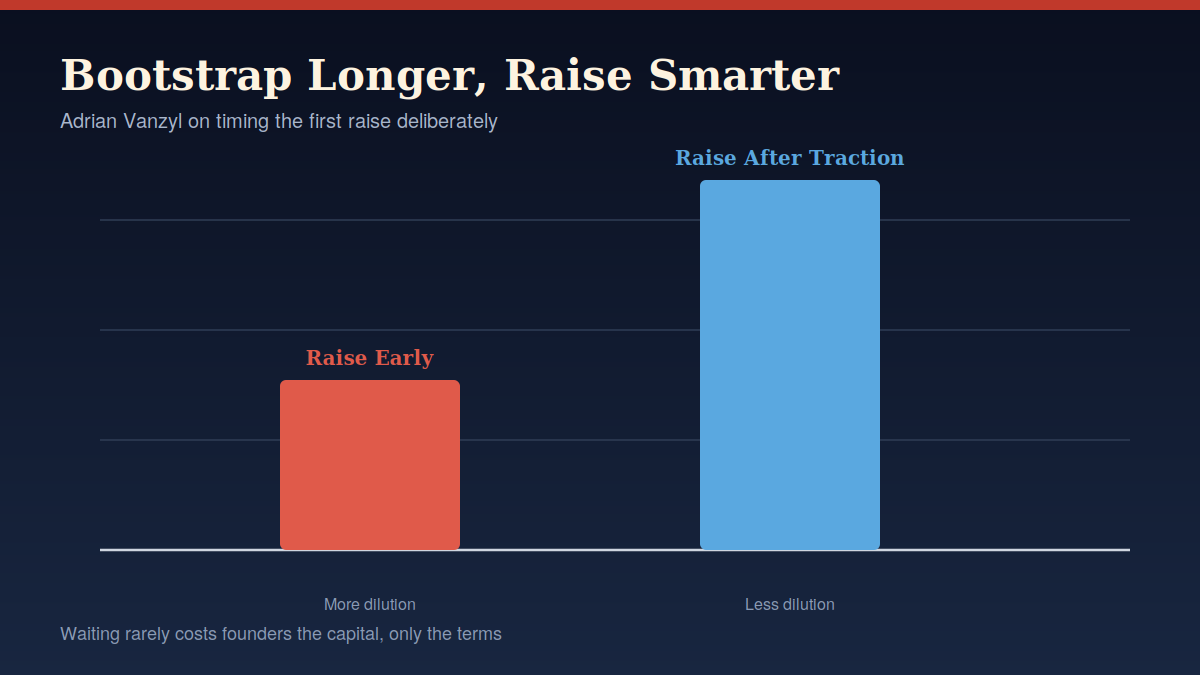
Raising before a company has real traction usually means raising at a lower valuation than it would command later, once genuine signals exist. This isn’t just a pricing detail. Rather, it directly affects how much of the company founders give away to fund the same amount of progress.

A company that bootstraps to meaningful revenue or clear product-market fit before raising can often secure the same capital for meaningfully less dilution. This tradeoff matters, especially for founders eager to raise immediately. Notably, the capital available today rarely disappears if a founder waits a few more months to raise it on stronger terms.

Why Investor Quality Improves With Traction

Founders raising with little more than an idea often end up choosing from whichever investors are willing to write a check at that early stage. That pool isn’t always the same as the investors who would engage once real traction exists. Waiting until there’s something concrete to point to tends to expand the field of serious, engaged investors willing to compete for the deal.

This matters beyond the price of the round. An investor who commits after seeing real evidence has made a more informed bet. As a result, that investor tends to bring sharper, more relevant judgment to the relationship going forward. A founder with leverage in the room, because multiple investors want in, ends up with meaningfully better terms and a stronger long-term partner.

When Bootstrapping Longer Actually Becomes the Wrong Call

Indeed, none of this means every founder should delay raising indefinitely. Some businesses genuinely require capital before they can generate any meaningful traction at all. This is especially true in categories with real infrastructure or regulatory costs upfront. Waiting in those cases doesn’t build discipline. It simply delays the inevitable, while burning a founder’s personal runway unnecessarily.

The real skill is distinguishing between a business that benefits from bootstrapped discipline and one that structurally requires early capital to exist at all. Founders who force the wrong path in either direction tend to pay for that mismatch later. That cost shows up either through unnecessary dilution or unnecessary personal financial strain.

Why This Decision Deserves More Deliberation Than It Usually Gets

Founders often default to raising as early as possible simply because that’s the visible, celebrated path in startup culture. Funding announcements get attention. Bootstrapped progress, by contrast, happens quietly and rarely makes headlines, even when it’s building something more durable underneath the surface.

This visibility gap distorts the decision for a lot of founders. Instead, the choice to raise or wait deserves the same deliberate reasoning as any other major strategic decision, rather than defaulting to whichever path generates more immediate external validation.

What Adrian Vanzyl Believes Founders Should Ask Before Raising

A useful question to ask before raising is simple: what specifically would the capital unlock that bootstrapped progress genuinely can’t achieve on its own? If the answer is real and specific, raising now likely makes sense. On the other hand, if the answer is mostly about speed or prestige, waiting often serves the founder better.

That distinction, asked honestly and early, tends to prevent both kinds of costly mismatch, before either one becomes difficult to reverse.

What This Means for Founders Deciding When to Raise

For founders weighing this decision, the practical takeaway is to treat the timing of a first raise as a genuine strategic choice, not an automatic milestone. Ask what capital would specifically unlock. Weigh the dilution cost of raising early against the discipline cost of waiting too long. And resist the pull of visible fundraising milestones when quieter, bootstrapped progress would actually serve the company better.

That’s the discipline Adrian Vanzyl encourages every founder to apply, before treating a raise as a foregone conclusion.

The Real Signals Behind Product-Market Fit, Explained

Founders constantly ask how to know if they’ve found product-market fit. Adrian Vanzyl thinks the question itself is often misframed. By the time the metrics clearly confirm it, the real signal has usually been visible for months already. The skill worth building isn’t reading the dashboard. Instead, it’s noticing the behavior underneath it, well before the numbers make it obvious.

Notably, this isn’t a dismissal of data. Rather, it’s a reminder that the earliest signs of product-market fit rarely show up as a clean metric first.

Why Retention Curves Lag the Real Signal

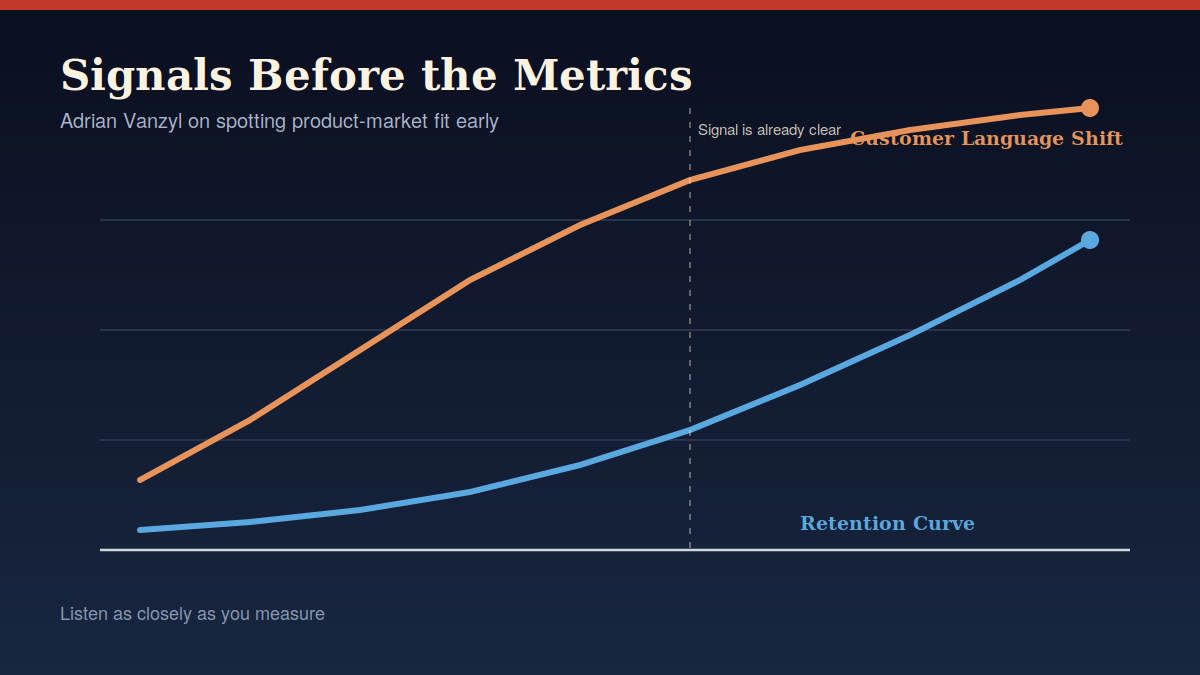
Founders often wait for a flattening retention curve as proof that product-market fit has arrived. After all, that data point matters, but it’s a lagging indicator by nature. It takes weeks or months of actual customer behavior to accumulate into a curve worth trusting. Consequently, founders waiting purely on this signal are often the last to recognize something that’s already true.

The earlier version of that same signal shows up in specific customer language, long before it aggregates into a chart. Consider a customer who describes a product as something they’d be genuinely upset to lose, not simply something they use. That’s the retention curve announcing itself early, in words rather than numbers.

The Signal Hiding in How Customers Describe the Problem

Indeed, a subtle but powerful early signal is a shift in how customers talk about their problem after using the product. Before genuine fit, customers describe their problem in vague, general terms. By contrast, after real fit starts to emerge, their language becomes specific and detailed. Often, it uses terminology the product itself introduced.

This matters because it reveals something metrics can’t capture directly. The product has changed how a customer thinks about their own problem, not just how they solve it. That shift in mental model is a much earlier and more reliable signal than any single usage statistic. It’s also available to founders the moment they’re willing to listen closely to actual customer conversations.

Why Founders Should Watch for Unprompted Advocacy

Paid growth can manufacture usage numbers that look like traction without reflecting genuine fit underneath them. Unprompted advocacy, by contrast, is much harder to manufacture. When customers start recommending a product without being asked, incentivized, or prompted by a referral program, that’s a signal that’s almost impossible to fake convincingly.

This distinction matters when evaluating early traction. A founder-run referral incentive can inflate a metric quickly, but it says very little about genuine fit. Organic, unprompted word-of-mouth is slower to accumulate. Still, it’s a far more trustworthy signal precisely because nothing artificial is inflating it.

The Danger of Chasing Growth Before Fit Is Real

Notably, a common and costly mistake is scaling acquisition spend before genuine product-market fit exists. Founders sometimes hope growth itself will somehow generate the fit that’s missing. This almost never works, and it tends to mask the underlying problem rather than solve it. Growth without fit simply produces more churn at a larger, more expensive scale.

The instinct to chase growth usually comes from pressure. It might be investor pressure, competitive pressure, or simple anxiety about slow early numbers. However, spending aggressively on acquisition before the underlying signals are genuinely present tends to burn capital and credibility simultaneously, without solving the actual problem underneath.

Why Founders Themselves Are Sometimes the Last to See It

In fact, founders are often too close to their own product to read these early signals objectively. They’ve heard every version of customer feedback already. As a result, genuinely significant signals can blend into background noise they’ve stopped consciously registering. A founder deep in the daily grind of building can miss a shift that would be obvious to an outside observer hearing the same customer conversations for the first time.

This is part of why an outside perspective often catches a genuine PMF signal before the founder does. That perspective might come from an advisor, investor, or simply a trusted peer founder. Fresh ears notice pattern changes that familiar ones have stopped hearing.

How Adrian Vanzyl Believes This Changes What Founders Should Track Early

For instance, instead of waiting exclusively for a clean retention chart, founders benefit from tracking softer signals deliberately and early. Specifically, listen for language shifts in customer conversations. Notice unprompted recommendations as they happen, rather than only counting referral-program signups. Pay attention to which customers reach out first when something breaks, since urgency itself is a signal of genuine dependence.

In the end, none of these signals replace hard data eventually. They simply arrive earlier, giving founders a meaningful head start on a decision that otherwise waits for lagging metrics to catch up.

What This Means for Founders Searching for Fit

For founders trying to determine whether they’ve found real product-market fit, the practical takeaway is to listen as closely as you measure. Track the retention curve, but don’t wait exclusively for it. Pay attention to how customers describe their problem after using the product. Watch for advocacy nobody asked for. And bring in an outside perspective before assuming your own view is objective.

That’s the combination Adrian Vanzyl watches for across every company he evaluates, long before a dashboard ever confirms what careful listening already revealed.

Why the Best Startup Pitches Tell a Story Before the Numbers

In fact, most founders assume a great pitch is built entirely on strong numbers. Adrian Vanzyl thinks that assumption misses something important. After sitting through hundreds of pitches, he’s noticed a consistent pattern. The founders who raise successfully almost always tell a clear story before they ever get to the metrics, not the other way around.

This isn’t an argument against data. Instead, it’s a reminder that numbers only make sense once an investor understands the story they’re supposed to support.

Why Numbers Without Narrative Fall Flat

Indeed, a slide full of impressive metrics means very little without context. Consider a thirty percent month-over-month growth rate. That sounds compelling in isolation. However, it becomes genuinely persuasive only once an investor understands what problem is being solved, for whom, and why the current moment makes that problem newly solvable.

This matters because investors evaluate dozens of pitches in a given week, and pure data blurs together quickly across companies. Consequently, a clear story is what actually sticks in memory after the meeting ends. Founders who lead with numbers alone are relying on an investor to construct that story themselves, which is a risky bet to make with someone else’s attention.

What Adrian Vanzyl Sees in the Structure of Every Strong Pitch

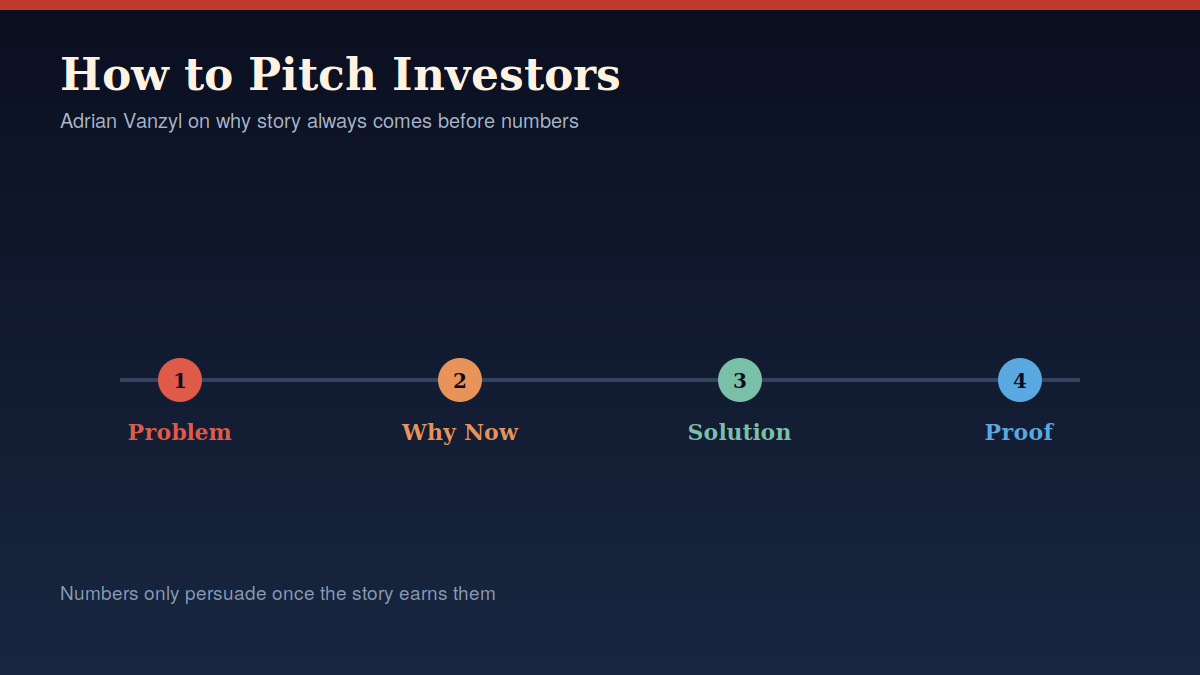
Strong pitches share a consistent underlying shape, regardless of industry or stage. First, they open with a real problem, described specifically enough that it feels concrete rather than abstract. Next, they explain why that problem has gone unsolved until now. This usually points to some genuine shift in technology, behavior, or market conditions. Only then do they introduce the solution and the metrics that prove it’s working.

Notably, this ordering isn’t arbitrary. A solution introduced before the problem is fully understood feels like a product looking for a use case. By contrast, the same solution introduced after a genuinely compelling problem has been established feels inevitable instead of arbitrary.

Why Specificity Beats Scale in the Opening

Founders often reach for the biggest possible framing when describing their market, assuming scale itself is persuasive. In practice, though, vague, oversized claims tend to undermine credibility rather than build it. A specific, narrow problem described in vivid detail is almost always more convincing than a sweeping claim about transforming an entire industry.

Specificity signals something important. It shows that the founder actually understands the problem firsthand, rather than working from a generic market report. An investor can sense the difference between a founder who has spoken to fifty real customers and one who is reciting total addressable market figures pulled from an industry deck.

The Danger of Overexplaining the Solution

Once founders reach the solution portion of a pitch, a common mistake is over-explaining every feature in exhaustive detail. This usually comes from genuine pride in the work. Even so, it often works against the founder. Specifically, it shifts attention away from the compelling problem and onto a laundry list of capabilities that’s hard to retain.

A more effective approach explains the solution at exactly the level of detail needed to make the problem-solution connection click, and no further. Deeper technical detail can wait. It’s better saved for follow-up questions or a later diligence conversation, once genuine interest has already been established.

Why Founder Conviction Still Matters More Than Polish

In short, a polished deck signals competence, but it rarely wins a deal on its own. What tends to move an investor is genuine, grounded conviction. This shows up most clearly in how a founder talks about the problem when questioned closely, rather than when reading from prepared slides. Notably, this conviction is hard to fake convincingly under real scrutiny. A founder who deeply understands their customer answers an unexpected, off-script question with the same clarity as a rehearsed one. By contrast, a founder relying on a memorized narrative often struggles the moment a question falls outside the script. That gap is usually visible to an experienced investor within minutes.

How This Changes What Founders Should Practice

Founders preparing to raise often spend most of their preparation time refining slides and rehearsing delivery. That effort matters, but it’s frequently misallocated. Time spent deeply understanding the problem tends to produce a far more resilient pitch. So does talking to more customers, and stress-testing the narrative against tough questions, compared to additional hours spent on visual polish.

The goal isn’t memorizing a perfect script. Rather, it’s building a genuine enough understanding of the problem that the story holds up naturally under real pressure, in any order an investor happens to ask about it.

What This Means for Founders Preparing to Pitch

For founders getting ready to raise, the practical takeaway is to build the story before building the deck. Lead with a specific, well-understood problem. Explain why now is the moment for a solution. Keep the solution explanation tight, and be ready to go deeper only when asked. And practice the underlying understanding, not just the slide order.

That’s the pattern Adrian Vanzyl has seen separate memorable pitches from forgettable ones, long before any spreadsheet ever enters the conversation.

Why the First Ten Hires Matter More Than Founders Realize

Founders obsess over their own decisions, their own strategy, their own execution. Adrian Vanzyl thinks they’re often looking in the wrong place for what actually determines a company’s trajectory. After watching dozens of early-stage teams form, he’s noticed something consistent. The first ten hires shape a company’s culture and capability more durably than almost any decision the founders make directly.

This isn’t an argument that founders don’t matter. Instead, it’s a reminder that the earliest hiring decisions carry weight far beyond the roles being filled.

Why Early Hires Set the Cultural Baseline

Culture doesn’t get written down and adopted later. Instead, it gets established by the first people who actually do the work, day after day, before anyone formalizes anything. Consider how the fifth employee handles a mistake. Think about how the eighth employee treats a frustrated customer. Or notice how the third employee responds to disagreement with a founder. These moments become the informal template every future hire absorbs.

This matters because culture is far easier to establish early than to correct later. A company of fifty people with an entrenched bad habit faces a much harder fix than a company of eight catching the same habit before it calcifies. In short, the first ten hires aren’t just filling roles. They’re quietly writing the company’s unwritten rulebook.

The Mistake of Hiring for Skill Alone

Under pressure to move fast, many founders default to hiring purely for technical skill. This makes sense on the surface. A skilled engineer solves problems a mediocre one can’t. However, skill without cultural fit creates a specific, underappreciated risk in a small team. In a team this size, one person’s behavior has an outsized effect on everyone around them.

A brilliant but toxic early hire does more damage in a ten-person company than the same person would in a thousand-person one. After all, there’s no layer of management to absorb the friction, and no critical mass of culture strong enough to dilute a bad influence. Evaluating early hires on both dimensions together, rather than treating skill as a gate and culture as an afterthought, tends to prevent this exact problem.

Why Diversity of Thought Matters More Than It Seems

Early teams often form around similarity. Founders naturally recruit from their own networks. As a result, these networks tend to produce people who think alike, share blind spots, and reinforce each other’s assumptions rather than challenge them. This feels comfortable and moves fast in the short term. It’s also a quiet liability.

A team that agrees too easily misses problems a more varied team would catch. Someone with a different professional background, a different way of approaching risk, or simply a different instinct for what customers actually want can surface issues the founding team never considered. Building that variety in deliberately, rather than defaulting to comfortable similarity, pays off precisely when the company hits its first real unexpected obstacle.

The Underrated Value of the First Skeptic

Most founders want early hires who believe in the mission completely. That instinct is understandable. Still, an early team made up entirely of true believers has a blind spot. Nobody asks the uncomfortable question before a decision gets made, only after it’s already gone wrong.

A thoughtful early skeptic, someone willing to push back respectfully and ask why a plan will actually work, often prevents costly mistakes long before they become visible externally. This isn’t the same as hiring someone negative or difficult. Rather, it’s hiring someone with enough independent judgment to disagree constructively when the situation calls for it.

Why Founders Should Slow Down on These Specific Hires

Every hire matters, but the first ten carry disproportionate weight. This happens precisely because there’s no existing culture to absorb a mistake. A bad hire at employee fifty gets diluted quickly, since forty-nine other people are already setting the tone. By contrast, a bad hire at employee five becomes a fifth of the entire company’s daily behavior and attitude.

This is exactly why rushing these specific hires under growth pressure tends to backfire. The time saved by filling a role quickly is often repaid many times over in the cultural repair work needed later. That repair only becomes necessary once a poor fit has already shaped how the rest of the team operates.

What Adrian Vanzyl Believes This Means for Founders Building Their Early Team

For founders making these first critical hires, the practical takeaway is to treat them with more scrutiny, not less, even when the pressure to move fast feels intense. Evaluate cultural fit and skill together, not sequentially. Deliberately build in perspectives that differ from the founding team’s own. And value a thoughtful skeptic as much as an enthusiastic believer.

That’s the discipline Adrian Vanzyl encourages every founder to apply, well before headcount pressure makes it tempting to skip.

Why Adrian Vanzyl Says No to Almost Every Startup Pitch

Most people assume a successful investor’s job is finding great companies. Adrian Vanzyl would argue the bigger part of the job is saying no. He does this over and over, to companies that look perfectly reasonable on paper. The math of venture investing makes this unavoidable. However, the discipline of doing it well is rarer than it should be.

This isn’t about pessimism or excessive caution. Instead, it’s about understanding what the job actually requires, and building a process that reflects that reality honestly.

Why the Base Rate Forces Constant Rejection

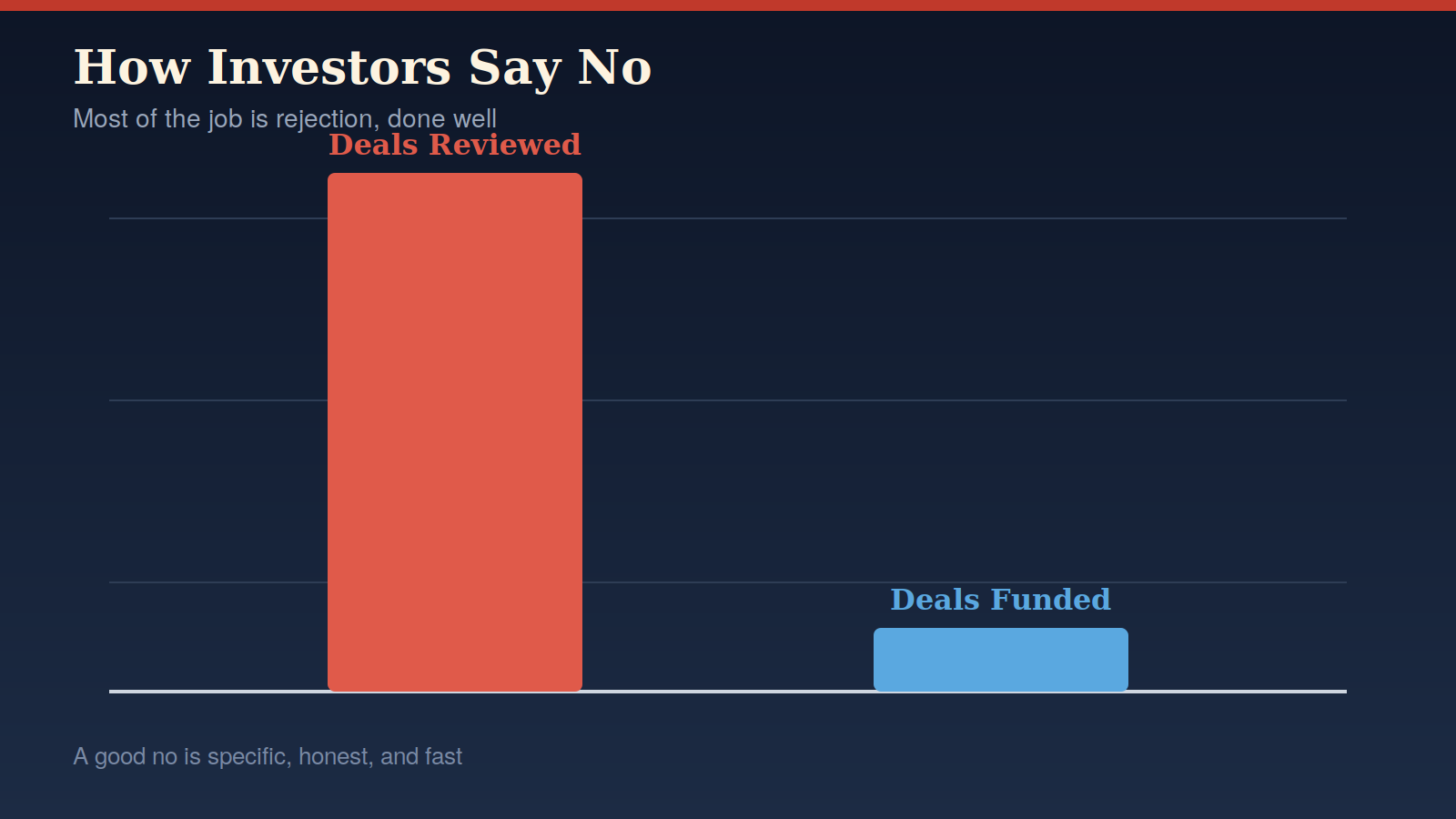
Venture investing runs on a brutal numerical reality. Most individual investments will underperform or fail outright. A small number of outsized winners have to carry the entire portfolio’s return. Given that structure, saying yes too often isn’t generous. It’s actually a failure of discipline that dilutes the few bets that matter most.

Consequently, a healthy investing process involves rejecting the overwhelming majority of opportunities that come through the door. This isn’t a sign that the market lacks good founders. Rather, it reflects the sheer volume of opportunities relative to the narrow slice that will actually justify real conviction.

The Danger of Saying Yes to Avoid Discomfort

Saying no is socially uncomfortable in a way that saying yes rarely is. Declining a founder who’s poured years into their company feels harsh, even when it’s the right call. As a result, some investors drift toward saying yes more often than their own judgment actually supports. They do this simply to avoid the discomfort of delivering bad news.

This pattern is easy to justify in the moment and costly over time. A portfolio built partly on avoided discomfort, rather than genuine conviction, ends up diluted. It fills up with investments that never had a strong thesis behind them in the first place. Notably, the discomfort of a difficult no is temporary, while the cost of a weak yes compounds for years.

How Adrian Vanzyl Thinks About a Good No

A good no isn’t simply a rejection. Instead, it’s a clear, honest explanation of why the fit isn’t there, delivered in a way that respects the founder’s time and effort. Vague, hedged rejections waste everyone’s time. They often leave founders more confused than if no explanation had been given at all.

Specificity matters here. Consider a no that says the market feels too early right now. That gives a founder something they can actually act on. By contrast, a vague no that says it’s just not quite right gives them nothing to work with. It often signals the investor didn’t engage seriously with the pitch in the first place.

Why Speed Matters Almost as Much as Honesty

Founders operate on limited runway and can’t afford to wait indefinitely for a decision that was never going to be a yes. An investor who strings a founder along imposes a real cost on that founder’s fundraising timeline. This holds true whether the delay comes from genuine indecision or simple avoidance.

A fast no is almost always kinder than a slow one, even though it doesn’t always feel that way to deliver. Founders consistently report valuing investors who decide quickly and communicate clearly. This holds even when the answer disappoints them, over investors who take weeks to arrive at the same conclusion.

The Long-Term Value of Saying No Well

How an investor handles rejection shapes their reputation across an entire startup ecosystem. Often, this matters more than their occasional big wins do. Founders talk to each other constantly, and word about how an investor treats people during a pass travels just as fast as word about a great outcome.

An investor known for clear, respectful, timely rejections builds a reputation that pays off well beyond any single deal. Founders who were once told no, and treated well in the process, often come back with the next company they build. They also refer other founders into that investor’s pipeline. A careless or dismissive no does the opposite, quietly, over years.

What This Means for Investors Evaluating Deals

For any investor building a real process, the practical discipline is straightforward, even if it’s uncomfortable to practice consistently. Expect to say no far more often than yes, and treat that as healthy rather than as a failure. Make the no specific enough that it’s actually useful. And deliver it quickly, since a fast, honest rejection respects a founder’s time in a way a slow, vague one never can.

That’s the standard Adrian Vanzyl applies to every pass. He understands that how he says no shapes his reputation just as much as any single yes ever could.

What Adrian Vanzyl Has Learned About Founder Burnout From Both Sides of the Table

Startup culture tends to treat exhaustion as a badge of honor. Adrian Vanzyl sees it differently, partly because of where he started. Before building and investing in technology companies, he trained and practiced as a physician. That background shapes a different lens. Specifically, it changes how he sees a problem most investors only notice once it’s already causing damage: founder burnout.

Notably, this isn’t a soft topic tucked away from the real business conversation. Instead, it’s directly connected to company performance, and investors who ignore it are missing a material risk.

Why Burnout Looks Like a Personal Problem But Isn’t

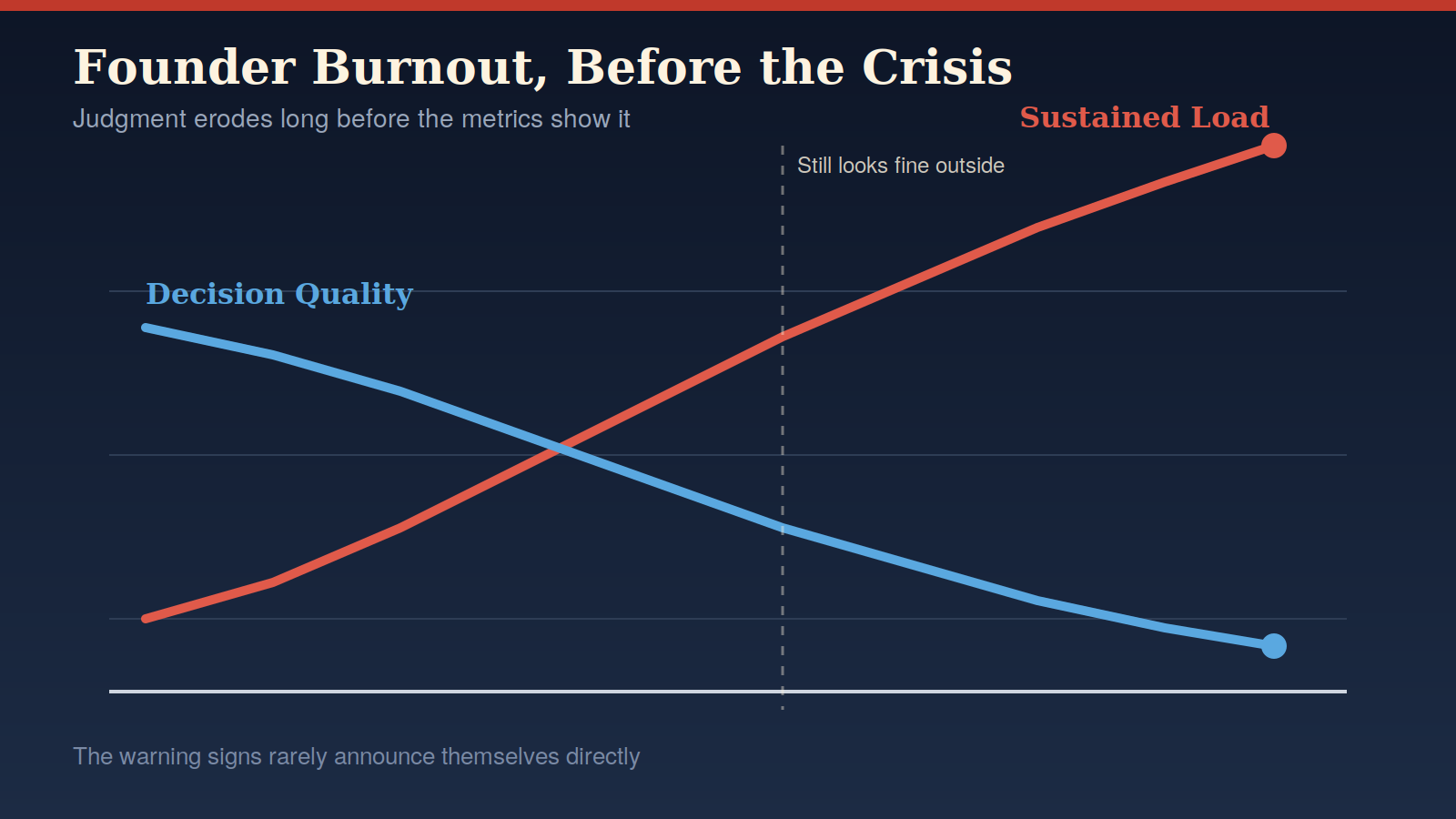
Founders experiencing burnout often frame it as a personal failing. They feel they should be able to push through, and admitting otherwise feels like admitting weakness. However, burnout isn’t simply about working hard. Rather, it’s a specific, recognizable pattern. It involves exhaustion, cynicism, and declining effectiveness that develops under sustained, unmanaged pressure.

This distinction matters because it changes what actually helps. Encouraging a burned-out founder to simply work harder addresses the wrong problem entirely. What actually helps looks different. Specifically, it means reducing unsustainable load and rebuilding the systems that broke down in the first place.

Why Investors Have a Real Stake in This

It would be easy to treat founder wellbeing as outside an investor’s job description. In practice, though, it’s directly tied to company outcomes. A burned-out founder makes worse decisions and avoids difficult conversations. They also lose the judgment that made them effective in the first place. Consequently, the company’s performance degrades well before any obvious crisis becomes visible from the outside.

Investors who only pay attention to metrics can miss this entirely until it’s already caused serious damage. By the time revenue numbers reflect the problem, the underlying exhaustion has often been building for months.

The Warning Signs That Are Easy to Miss

Burnout rarely announces itself directly. A founder experiencing it doesn’t usually say so outright. This happens partly from pride, and partly because they may not fully recognize it themselves. Instead, the signs tend to show up indirectly. Decisions that used to come quickly now take much longer. Communication becomes less frequent or more clipped. A founder who used to seem energized by the work starts describing it in flat, detached terms.

Notably, none of these signs alone proves anything. Together, though, they form a pattern worth taking seriously. This is especially true when they represent a real shift from how a founder normally operates.

What Adrian Vanzyl Believes Investors Can Actually Do

Investors aren’t therapists, and pretending otherwise helps no one. Instead, what investors can do is create genuine permission for founders to be honest about struggle. This beats performing constant confidence during every update call. A board member who only ever wants good news trains founders to hide exactly the information that matters most.

Beyond that, practical support matters more than sympathy alone. Consider helping a founder delegate a task they’ve been holding onto too tightly. Or, connect them with another founder who’s navigated something similar. Simply asking directly how they’re actually doing, rather than how the metrics are doing, can meaningfully shift the trajectory before things become severe.

Why the Physician’s Framework Applies Here

Medicine treats prevention as more valuable than crisis response. This framework applies directly to founder burnout. Waiting until a founder is in visible crisis carries real costs. In effect, it’s the equivalent of only treating a disease after it’s already advanced. Early, unglamorous intervention prevents most of the damage that a late-stage crisis eventually causes. That means checking in consistently and normalizing honest conversation, long before things reach a breaking point.

This preventive mindset doesn’t require clinical training to apply. It simply requires taking wellbeing seriously, as an ongoing input to company performance rather than an emergency to manage only once it’s unavoidable.

The Limits of What Investors Should Try to Fix Themselves

There’s an important boundary here. Investors can create space, ask better questions, and reduce unnecessary pressure. However, they shouldn’t try to serve as a founder’s actual mental health support. A founder showing signs of serious burnout deserves encouragement to seek real professional support. That’s different from simply getting a more understanding board member.

Recognizing this boundary isn’t a cop-out. Rather, it’s actually part of taking the problem seriously. After all, conflating genuine support with informal amateur intervention can leave a founder without the real help they actually need.

What This Means for Founders and Investors Alike

For founders, the practical takeaway is straightforward. Treat early signs of burnout as information worth acting on, not weakness to hide. For investors, the takeaway is just as direct. Build enough trust that founders feel safe sharing those signs in the first place, and take them seriously when they do.

That’s the standard Adrian Vanzyl holds himself to. It’s shaped as much by his medical training as by his years spent building and investing in technology companies.

Why Co-Founder Conflict Kills More Startups Than Competition Does

Founders spend enormous energy worrying about competitors. Adrian Vanzyl thinks they’re often watching the wrong threat. After years spent evaluating startups and sitting on boards, he’s seen a consistent pattern. The companies that fail rarely lose to a better competitor. More often, they fail because the founding team fractures from the inside.

Notably, this isn’t a dramatic claim made for effect. Instead, it’s a pattern that shows up again and again, once you know where to look for it.

Why Investors Watch Co-Founder Dynamics So Closely

Due diligence tends to focus heavily on the market, the product, and the numbers. However, experienced investors also pay close attention to something less visible. That’s how co-founders actually work together under pressure. A team that communicates well during a calm pitch meeting can still fracture completely once real stress arrives.

This matters because a founding team’s internal health directly predicts execution speed. A team in conflict spends energy managing each other instead of managing the business. Consequently, decisions slow down exactly when speed matters most. As a result, opportunities that require fast action get missed while the team is busy negotiating with itself.

What Adrian Vanzyl Sees as the Most Common Source of Co-Founder Conflict

Money and equity get blamed most often for co-founder breakups. Yet they’re rarely the true root cause. Underneath a fight about equity splits, there’s usually a disagreement about something harder to name directly. Specifically, it’s about whose contribution actually matters more, or whose vision the company should really be following.

Founders who navigate this well tend to address it explicitly and early, rather than letting resentment build silently. Waiting for a crisis to force the conversation almost guarantees it happens under the worst possible conditions. By that point, the most damage is already done by the time it surfaces.

Why Silence Is More Dangerous Than Disagreement

Founders often assume conflict itself is the danger sign investors should worry about. In practice, though, the opposite is often true. Two founders who argue openly, disagree directly, and work through it are usually in a healthier position. That’s compared to two founders who never disagree at all.

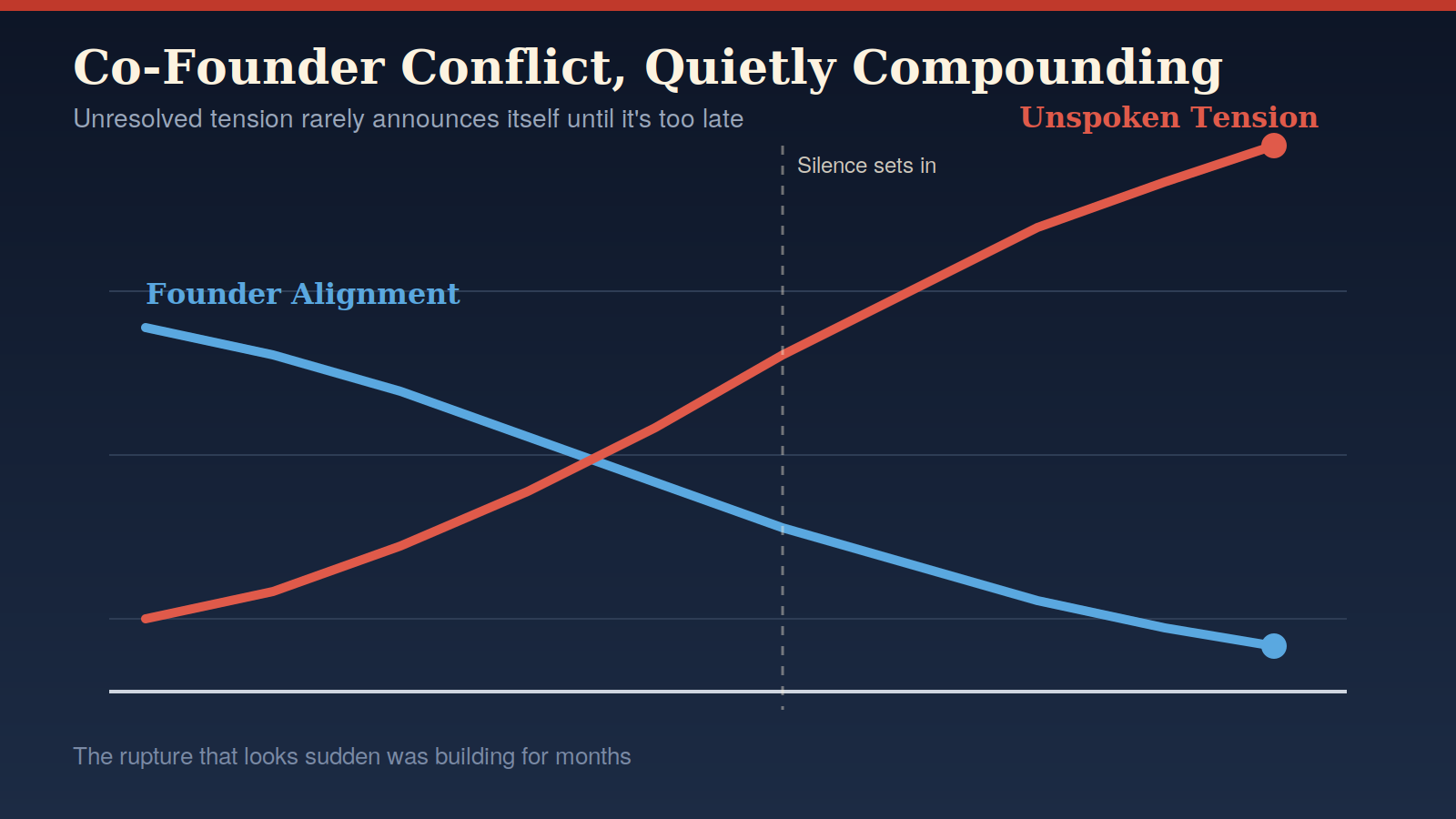
Silence typically means one of two things. Either genuine disagreement is being suppressed to avoid conflict, or one founder has quietly stopped being honest about what they actually think. Both patterns tend to produce the same outcome eventually. Specifically, a sudden, severe rupture that looks unexpected to outsiders, but was actually building for months or years beforehand.

How Role Clarity Prevents Most Avoidable Conflict

A surprising amount of co-founder conflict traces back to unclear roles rather than genuine disagreement about strategy. When two founders both feel ownership over the same decision, friction becomes almost inevitable. This happens even when they fundamentally agree on the company’s direction.

Clear role boundaries don’t eliminate disagreement, and they shouldn’t try to. Instead, they reduce the frequency of conflict that stems purely from ambiguity rather than genuine difference of opinion. Ultimately, a founding team that has explicitly agreed on who has final say in which domains spends far less energy relitigating decisions that should already be settled.

Why This Matters More at the Earliest Stage

Co-founder dynamics matter throughout a company’s life. However, they matter most before any formal structure exists to manage them. In the earliest days, there’s no board to mediate, no HR function, and often no outside advisor close enough to notice a fracture before it becomes serious.

This is exactly the stage where a small, unresolved tension can compound fastest. Consider a minor disagreement about pace or priorities left unaddressed. It tends to calcify into resentment that later disagreements simply reactivate. After all, addressing friction early, while the stakes are still low, is far easier than repairing a relationship after months of accumulated frustration.

What Investors Can and Can’t Do About This

Investors sit outside the founding relationship and can’t fix it directly. What they can do is watch for early warning signs. They can also ask direct questions before a term sheet is signed, rather than after. A founding team that struggles to answer basic questions about how they handle disagreement is revealing something important, even if the answer itself sounds reasonable on the surface.

Once the investment is made, the most useful thing an investor can do is create space for founders to raise tension early. This beats waiting for a crisis to force the conversation into the open.

What Adrian Vanzyl Believes This Means for Founders Building a Company Together

For founders in the early stages of building together, the practical takeaway is straightforward. Address unclear roles before they cause friction, not after. Treat open disagreement as healthier than false harmony. And revisit the foundational agreements periodically, since a structure that worked at the start rarely fits unchanged a year or two later.

That’s the pattern Adrian Vanzyl has watched repeat across dozens of founding teams. It’s usually a far better predictor of a company’s future than anything happening in the competitive landscape around it.