Adrian Vanzyl

Why Adrian Vanzyl Says No to Almost Every Startup Pitch

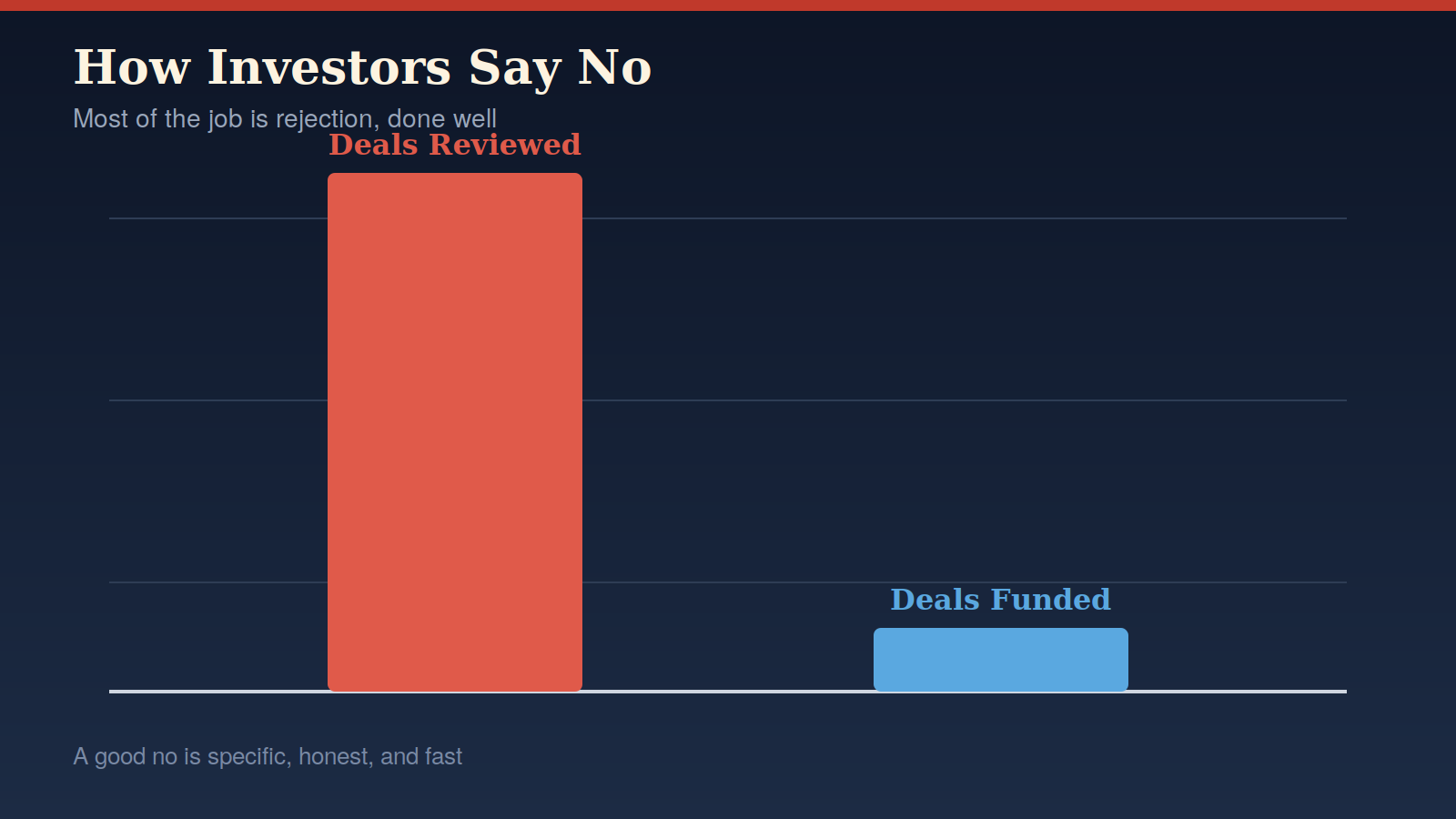
Most people assume a successful investor’s job is finding great companies. Adrian Vanzyl would argue the bigger part of the job is saying no. He does this over and over, to companies that look perfectly reasonable on paper. The math of venture investing makes this unavoidable. However, the discipline of doing it well is rarer than it should be.

This isn’t about pessimism or excessive caution. Instead, it’s about understanding what the job actually requires, and building a process that reflects that reality honestly.

Why the Base Rate Forces Constant Rejection

Venture investing runs on a brutal numerical reality. Most individual investments will underperform or fail outright. A small number of outsized winners have to carry the entire portfolio’s return. Given that structure, saying yes too often isn’t generous. It’s actually a failure of discipline that dilutes the few bets that matter most.

Consequently, a healthy investing process involves rejecting the overwhelming majority of opportunities that come through the door. This isn’t a sign that the market lacks good founders. Rather, it reflects the sheer volume of opportunities relative to the narrow slice that will actually justify real conviction.

The Danger of Saying Yes to Avoid Discomfort

Saying no is socially uncomfortable in a way that saying yes rarely is. Declining a founder who’s poured years into their company feels harsh, even when it’s the right call. As a result, some investors drift toward saying yes more often than their own judgment actually supports. They do this simply to avoid the discomfort of delivering bad news.

This pattern is easy to justify in the moment and costly over time. A portfolio built partly on avoided discomfort, rather than genuine conviction, ends up diluted. It fills up with investments that never had a strong thesis behind them in the first place. Notably, the discomfort of a difficult no is temporary, while the cost of a weak yes compounds for years.

How Adrian Vanzyl Thinks About a Good No

A good no isn’t simply a rejection. Instead, it’s a clear, honest explanation of why the fit isn’t there, delivered in a way that respects the founder’s time and effort. Vague, hedged rejections waste everyone’s time. They often leave founders more confused than if no explanation had been given at all.

Specificity matters here. Consider a no that says the market feels too early right now. That gives a founder something they can actually act on. By contrast, a vague no that says it’s just not quite right gives them nothing to work with. It often signals the investor didn’t engage seriously with the pitch in the first place.

Why Speed Matters Almost as Much as Honesty

Founders operate on limited runway and can’t afford to wait indefinitely for a decision that was never going to be a yes. An investor who strings a founder along imposes a real cost on that founder’s fundraising timeline. This holds true whether the delay comes from genuine indecision or simple avoidance.

A fast no is almost always kinder than a slow one, even though it doesn’t always feel that way to deliver. Founders consistently report valuing investors who decide quickly and communicate clearly. This holds even when the answer disappoints them, over investors who take weeks to arrive at the same conclusion.

The Long-Term Value of Saying No Well

How an investor handles rejection shapes their reputation across an entire startup ecosystem. Often, this matters more than their occasional big wins do. Founders talk to each other constantly, and word about how an investor treats people during a pass travels just as fast as word about a great outcome.

An investor known for clear, respectful, timely rejections builds a reputation that pays off well beyond any single deal. Founders who were once told no, and treated well in the process, often come back with the next company they build. They also refer other founders into that investor’s pipeline. A careless or dismissive no does the opposite, quietly, over years.

What This Means for Investors Evaluating Deals

For any investor building a real process, the practical discipline is straightforward, even if it’s uncomfortable to practice consistently. Expect to say no far more often than yes, and treat that as healthy rather than as a failure. Make the no specific enough that it’s actually useful. And deliver it quickly, since a fast, honest rejection respects a founder’s time in a way a slow, vague one never can.

That’s the standard Adrian Vanzyl applies to every pass. He understands that how he says no shapes his reputation just as much as any single yes ever could.

What Adrian Vanzyl Has Learned About Founder Burnout From Both Sides of the Table

Startup culture tends to treat exhaustion as a badge of honor. Adrian Vanzyl sees it differently, partly because of where he started. Before building and investing in technology companies, he trained and practiced as a physician. That background shapes a different lens. Specifically, it changes how he sees a problem most investors only notice once it’s already causing damage: founder burnout.

Notably, this isn’t a soft topic tucked away from the real business conversation. Instead, it’s directly connected to company performance, and investors who ignore it are missing a material risk.

Why Burnout Looks Like a Personal Problem But Isn’t

Founders experiencing burnout often frame it as a personal failing. They feel they should be able to push through, and admitting otherwise feels like admitting weakness. However, burnout isn’t simply about working hard. Rather, it’s a specific, recognizable pattern. It involves exhaustion, cynicism, and declining effectiveness that develops under sustained, unmanaged pressure.

This distinction matters because it changes what actually helps. Encouraging a burned-out founder to simply work harder addresses the wrong problem entirely. What actually helps looks different. Specifically, it means reducing unsustainable load and rebuilding the systems that broke down in the first place.

Why Investors Have a Real Stake in This

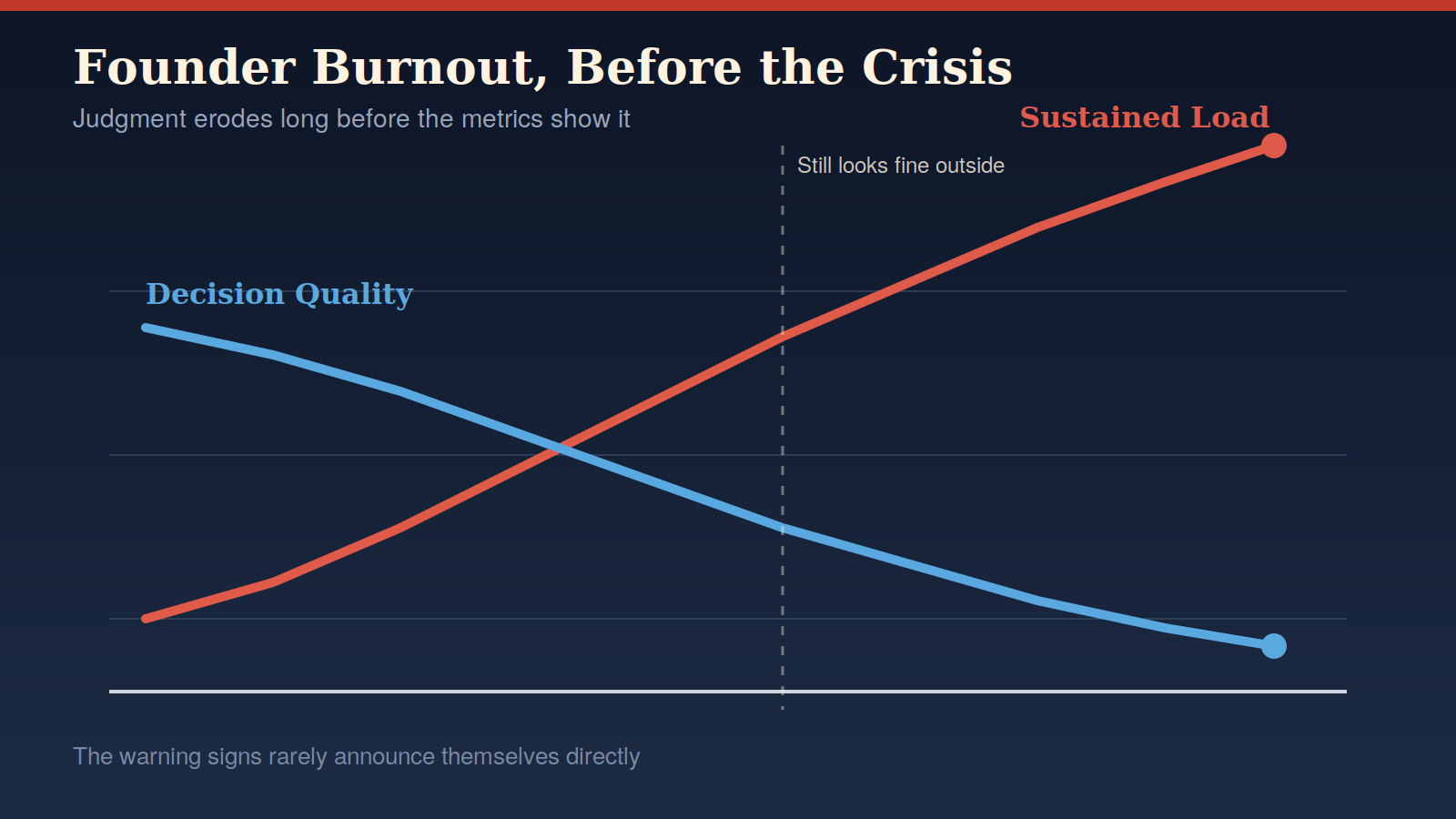
It would be easy to treat founder wellbeing as outside an investor’s job description. In practice, though, it’s directly tied to company outcomes. A burned-out founder makes worse decisions and avoids difficult conversations. They also lose the judgment that made them effective in the first place. Consequently, the company’s performance degrades well before any obvious crisis becomes visible from the outside.

Investors who only pay attention to metrics can miss this entirely until it’s already caused serious damage. By the time revenue numbers reflect the problem, the underlying exhaustion has often been building for months.

The Warning Signs That Are Easy to Miss

Burnout rarely announces itself directly. A founder experiencing it doesn’t usually say so outright. This happens partly from pride, and partly because they may not fully recognize it themselves. Instead, the signs tend to show up indirectly. Decisions that used to come quickly now take much longer. Communication becomes less frequent or more clipped. A founder who used to seem energized by the work starts describing it in flat, detached terms.

Notably, none of these signs alone proves anything. Together, though, they form a pattern worth taking seriously. This is especially true when they represent a real shift from how a founder normally operates.

What Adrian Vanzyl Believes Investors Can Actually Do

Investors aren’t therapists, and pretending otherwise helps no one. Instead, what investors can do is create genuine permission for founders to be honest about struggle. This beats performing constant confidence during every update call. A board member who only ever wants good news trains founders to hide exactly the information that matters most.

Beyond that, practical support matters more than sympathy alone. Consider helping a founder delegate a task they’ve been holding onto too tightly. Or, connect them with another founder who’s navigated something similar. Simply asking directly how they’re actually doing, rather than how the metrics are doing, can meaningfully shift the trajectory before things become severe.

Why the Physician’s Framework Applies Here

Medicine treats prevention as more valuable than crisis response. This framework applies directly to founder burnout. Waiting until a founder is in visible crisis carries real costs. In effect, it’s the equivalent of only treating a disease after it’s already advanced. Early, unglamorous intervention prevents most of the damage that a late-stage crisis eventually causes. That means checking in consistently and normalizing honest conversation, long before things reach a breaking point.

This preventive mindset doesn’t require clinical training to apply. It simply requires taking wellbeing seriously, as an ongoing input to company performance rather than an emergency to manage only once it’s unavoidable.

The Limits of What Investors Should Try to Fix Themselves

There’s an important boundary here. Investors can create space, ask better questions, and reduce unnecessary pressure. However, they shouldn’t try to serve as a founder’s actual mental health support. A founder showing signs of serious burnout deserves encouragement to seek real professional support. That’s different from simply getting a more understanding board member.

Recognizing this boundary isn’t a cop-out. Rather, it’s actually part of taking the problem seriously. After all, conflating genuine support with informal amateur intervention can leave a founder without the real help they actually need.

What This Means for Founders and Investors Alike

For founders, the practical takeaway is straightforward. Treat early signs of burnout as information worth acting on, not weakness to hide. For investors, the takeaway is just as direct. Build enough trust that founders feel safe sharing those signs in the first place, and take them seriously when they do.

That’s the standard Adrian Vanzyl holds himself to. It’s shaped as much by his medical training as by his years spent building and investing in technology companies.

When to Double Down and When to Walk Away, According to Adrian Vanzyl

Every investor eventually faces the same uncomfortable moment. A portfolio company is struggling, and a follow-on round is on the table. Adrian Vanzyl has sat across that decision many times. He’s done this both as an investor deciding whether to write another check, and as a board member watching a founder fight to keep momentum alive. There’s no formula that makes this decision easy. However, there are patterns worth understanding before the moment arrives.

This isn’t really about picking winners in advance. Instead, it’s about recognizing which signals actually matter once a company is already underway.

Why Sunk Cost Is the Biggest Trap in This Decision

The single most common mistake in follow-on investing is anchoring to money already spent. This happens rather than focusing on the company’s actual prospects going forward. Specifically, an investor who’s already committed significant capital can feel pressure to protect that investment. As a result, they write another check regardless of whether the underlying business has genuinely improved.

This instinct is completely understandable. After all, nobody wants to admit an earlier bet isn’t working. Yet the money already invested is gone either way. The only question that should matter for a new check is simple: does the company, as it exists today, represent a good investment on its own merits? Everything invested before that point is irrelevant to that specific question, even though it rarely feels that way in the moment.

The Difference Between a Struggling Company and a Broken One

Not every company that’s missing targets is in genuine trouble. Some are simply early, or navigating a market that’s taking longer to mature than expected. Others have a fundamentally broken model that no amount of additional capital will fix. In practice, telling these two situations apart is the actual skill here. It’s also far harder than it sounds from the outside.

A struggling-but-viable company usually shows specific signs. The founder understands exactly what isn’t working and has a credible plan to address it. Metrics are moving in the right direction, even if slowly. Notably, the market opportunity hasn’t fundamentally shrunk. A broken company, by contrast, tends to look very different. The founder keeps changing the explanation for underperformance. Metrics stay flat or decline despite repeated pivots. The market itself has moved on entirely.

Why Founder Behavior Under Pressure Reveals More Than Metrics

Metrics matter, but they lag reality. Founder behavior under pressure often reveals what’s actually happening faster than any dashboard can. Consider a founder who gets more transparent as things get harder. That founder shares bad news early and asks for help before it’s requested. This is exactly the trait that predicts recovery.

By contrast, a founder who becomes defensive shows a very different pattern. The same is true of one who starts hiding bad numbers, or blames external factors exclusively. This behavior doesn’t guarantee failure on its own. Even so, it removes a critical ingredient that struggling companies need most. Specifically, it removes an accurate, shared understanding of the actual situation between founder and investor.

The Case for Walking Away Even When It’s Painful

Declining to participate in a follow-on round feels like giving up. This is especially true on a company an investor has believed in for years. In the end, that emotional weight is real, and it shouldn’t be dismissed. Still, continuing to invest capital into a company with a genuinely broken model doesn’t actually help anyone in the long run.

It delays a founder’s ability to face reality and make necessary changes. On top of that, it ties up capital that could go toward companies with a real path forward. In fact, walking away from a struggling investment isn’t a failure of loyalty. Rather, it’s an acknowledgment that continued capital only helps when the underlying business can actually use it productively.

What Adrian Vanzyl Says Doubling Down the Right Way Looks Like

When doubling down does make sense, it should come with more than just money. The investors who add real value during a difficult stretch increase their engagement alongside their capital. They make more introductions, ask harder questions, and show up more frequently, not less.

This pairing matters more than it might first appear. A check without increased engagement signals confidence in the wrong thing. It’s often mistaken for confidence in the founder, when it may really just be confidence in the sunk cost already spent. Real conviction shows up as time and attention, not simply as capital.

What This Means for Investors Facing This Decision

For any investor sitting across from a difficult follow-on decision, the practical discipline is straightforward, even if it’s not comfortable. Evaluate the company as it exists today, not as it existed when the first check was written. Watch founder behavior under pressure as closely as the metrics. And if the decision is to double down, commit real engagement alongside the capital, not capital alone.

That’s the discipline Adrian Vanzyl applies to every difficult follow-on decision, whether the outcome is another check or a hard conversation about walking away. It’s a discipline any investor facing the same crossroads can apply just as well.

Adrian Vanzyl on Agentic Due Diligence

Artificial intelligence has changed how startups build products. It is now changing how investors should evaluate them. Adrian Vanzyl has long argued that good investing depends on looking past surface momentum and understanding the system beneath a company. With AI-native startups, that system is often harder to inspect because the product, operations, and go-to-market engine may all depend on agents working behind the scenes.

That creates a new diligence problem. A polished demo can look impressive, but it may hide weak reliability, fragile data pipelines, expensive human workarounds, or agents that only perform well in narrow conditions. Investors need a sharper framework for evaluating what is real, what is defensible, and what is merely theatrical.

Why AI-Native Startups Need Different Diligence

Traditional software diligence often focuses on product-market fit, unit economics, customer concentration, competitive positioning, technical architecture, and team quality. Those still matter. But agentic products add another layer: the company may be promising a system that can act, decide, coordinate, or complete workflows with less human involvement.

That promise changes the questions investors need to ask. Does the agent actually complete the task in production, or only in a controlled demo? How often does it fail? What happens when it is uncertain? Is there an audit trail? Does the customer know when a human has intervened? Is the company’s margin profile dependent on hidden manual labor? Can the system improve with usage, or does every new customer require custom implementation?

These questions are not technical details. They go directly to defensibility, scalability, risk, and valuation.

The First Question: What Is the Agent Actually Doing?

Many AI startups describe themselves as agentic, but the word can mean several different things. In diligence, investors should force clarity. Is the agent retrieving information, drafting content, making recommendations, executing transactions, coordinating across tools, or making decisions with real business consequences?

The risk profile changes dramatically depending on the answer. A research agent that summarizes market data is different from an agent that changes pricing, sends customer communications, updates production systems, or moves money. The more consequential the action, the stronger the need for permissions, review gates, rollback, logging, and customer trust.

A practical diligence step is to map the product into three layers:

  • Inputs. What data, context, documents, tools, and permissions does the agent rely on?
  • Reasoning and workflow. What steps does the agent take, and where does human review enter the process?
  • Outputs and consequences. What does the agent change, send, approve, recommend, or commit?

If a company cannot explain these layers clearly, it may not yet understand its own risk.

What Defensibility Looks Like

In AI, investors often look for proprietary models or unique datasets. Those can matter, but many durable companies will be defended by workflow depth rather than model ownership. If a startup deeply understands a painful business process, integrates into the customer’s systems, learns from repeated usage, and becomes part of daily operations, it may build a stronger moat than a company with a more impressive model demo.

Agentic defensibility usually comes from several forces working together:

  • Workflow specificity. The product solves a narrow, expensive, recurring job better than a generic agent can.
  • Data advantage. The system learns from structured outcomes, not just prompts and documents.
  • Trust infrastructure. Customers can see what happened, why it happened, who approved it, and how to reverse it.
  • Operational embedding. The agent becomes part of how the customer runs a process, not just a side tool.
  • Evaluation discipline. The company measures performance against real tasks and failure modes, not only internal optimism.

The Reliability Question

Investors should ask for reliability evidence early. Agent products are probabilistic by nature, but customers do not buy probabilities in the abstract. They buy outcomes. A company selling an agent into finance, healthcare, legal, enterprise operations, or customer communications needs to show how it handles uncertainty.

That means diligence should include evals, production logs, escalation patterns, human review rates, rollback mechanisms, and customer-visible controls. It is not enough for the founder to say the model is improving. Investors should ask which errors matter, how often they occur, how quickly they are caught, and what the company has changed because of them.

A strong team will usually have a precise answer. A weak team will point back to the demo.

Red Flags in Agentic Startups

There are several warning signs investors should treat seriously. The first is demo-only autonomy. If the product only works when the founder drives it in a prepared environment, the company may be earlier than its story suggests. The second is hidden services work. If humans are manually completing tasks while the company presents the output as autonomous software, margins and scalability may be weaker than advertised.

Another red flag is vague accountability. When an agent makes a mistake, who owns it? The vendor, the customer, the human reviewer, or nobody? Serious buyers will ask that question. Investors should ask it first.

Finally, be careful with companies that cannot explain permissions. Agentic systems often need access to email, calendars, CRMs, code repositories, files, payments, or customer data. If the access model is loose, the product may carry risks that are not visible in the sales deck.

A Practical Investor Checklist

  1. Ask the team to show a real customer workflow from input to output.
  2. Separate what the agent does from what humans still do behind the scenes.
  3. Review reliability data, not just product claims.
  4. Inspect how permissions, audit trails, and escalation gates work.
  5. Understand whether each new customer makes the system stronger or simply adds implementation burden.
  6. Test whether the product could be replaced by a generic AI tool plus a disciplined operator.

Looking Ahead

Agentic due diligence is not about being skeptical of AI. It is about being specific. The best AI-native startups will be able to explain how their agents work, where humans remain accountable, what data makes the system better, and why customers will trust it inside important workflows.

For Adrian Vanzyl, that kind of clarity is central to good investing. AI may change the product surface, but the underlying discipline remains the same: understand the system, identify the leverage, test the risk, and separate durable advantage from temporary excitement.

What Makes a Good Board Member? Adrian Vanzyl Explains

Most advice about startup boards focuses on how to build one. Far less gets said about how to actually serve on one well. Adrian Vanzyl has sat on both sides of that table. As a founder, he’s answered to a board. He’s also sat on the other side of it, as an investor. That dual view shapes a clear opinion: most board members add far less value than they think they do.

This isn’t a cynical take. Instead, it’s a practical one. Once you’ve been on both sides, certain patterns become impossible to miss.

Why Most Board Advice Sounds Right and Isn’t

Board members often deliver advice shaped by secondhand information. They read the deck. They skim the metrics. Then, they offer confident opinions based on a partial picture. This isn’t malicious. However, it’s a structural problem. After all, a board member who visits once a quarter simply doesn’t have the context a founder has every single day.

As a result, the most common failure mode isn’t bad intentions. Rather, it’s overconfidence built on thin information. For instance, a board member who suggests cutting a specific team, or pivoting a specific channel, may sound decisive. Yet without real operating context, that advice can be actively harmful.

The Difference Between Governance and Meddling

Good board membership starts with a clear boundary. On one hand, governance means asking hard questions and stress-testing assumptions. It also means holding a founder accountable to their own stated goals. On the other hand, meddling means trying to run the company from the boardroom, one layer removed from the consequences.

Adrian Vanzyl draws this line carefully. A board’s job is not to make operating decisions. Rather, it’s to make sure the founder is making good ones. It’s also about catching blind spots before they become expensive. That distinction sounds simple. In practice, though, it’s easy to violate. This is especially true for board members who were once operators themselves and miss being in the weeds.

Why Availability Matters More Than Expertise

Plenty of board members are recruited for their expertise. Fewer are chosen for their availability. Yet availability often matters more. Consider a brilliant board member who’s impossible to reach during a crisis. In practice, they provide less real value than an average one who picks up the phone immediately.

This matters because the moments that define a board relationship rarely happen in the quarterly meeting. Instead, they happen in an unscheduled call about a co-founder conflict. Sometimes it’s a term sheet that needs a same-day read. Other times, it’s a crisis that can’t wait three months for the next scheduled session. Either way, board members who show up for those moments earn a different kind of trust. That’s compared to ones who only show up on the calendar.

What Founders Should Actually Want From a Board Member

Founders often default to wanting board members with the most impressive resume. That’s understandable. However, it’s frequently the wrong priority. A more useful question is simpler: will this board member tell you something you don’t want to hear? Just as importantly, will they do it early enough to matter?

Board members who avoid conflict to preserve a comfortable relationship aren’t doing their job. This holds true even if the relationship feels pleasant. Instead, the board members worth having are willing to raise an uncomfortable point in month three. That’s far better than a devastating one surfacing in month eighteen.

How Adrian Vanzyl Evaluates His Own Value on a Board

Adrian Vanzyl applies a simple test to his own board work. Specifically, he asks whether the founder would be meaningfully worse off without him in the room. If the honest answer is no, that’s a signal. Either he needs to change how he’s engaging, or he should step back entirely. Notably, board seats accumulated for prestige rather than genuine usefulness tend to become dead weight. This applies to everyone involved, including the investor holding them.

This self-check matters because board seats are easy to collect and hard to actively work. Consider an investor with a dozen board seats and limited bandwidth per company. In that case, they’re optimizing for portfolio breadth, not for the depth any single founder actually needs.

The Long-Term Cost of a Passive Board

A disengaged board doesn’t just fail to help. In fact, it actively creates risk. Founders operating without real board engagement often go too long without external challenge to their own assumptions. As a result, small strategic mistakes compound quietly. Nobody with real standing raised a flag early enough to matter.

By contrast, an engaged board catches these issues while they’re still cheap to fix. This isn’t about control. Rather, it’s about having someone in the room who owes the founder honesty instead of comfort. It’s also about paying close enough attention to notice when something’s drifting off course.

What This Means for Founders Building Their Board

If there’s one practical takeaway here, it’s this: choose board members for engagement and honesty first, credentials second. Picture a well-known name who shows up once a quarter and says pleasant things. By comparison, a less prestigious board member who calls back within the hour and tells hard truths is worth far more.

That’s the standard Adrian Vanzyl holds himself to. It’s also the standard he encourages founders to demand from everyone else sitting around their table.

Why Adrian Vanzyl Went Back to Study AI

Most people assume investors learn new technology by reading about it. Adrian Vanzyl took a different path. Well after his early career was already established, he sat down and earned formal certifications. These covered machine learning, deep learning, and neural networks. It wasn’t for a resume line. It reflects a broader view: secondhand summaries aren’t enough for a technology reshaping every industry he invests in.

That decision says something important about how he approaches expertise. It’s a pattern worth unpacking for founders and investors alike.

Why Secondhand Understanding Isn’t Good Enough

Plenty of investors talk fluently about AI without ever having built anything with it. They pick up vocabulary from pitch decks and conference panels. That vocabulary often sits just far enough from the real mechanics to create false confidence.

False confidence is dangerous in venture investing. An investor might not tell a genuine technical moat from a thin API wrapper. That investor will misprice risk. They’ll back the wrong companies. Or worse, they’ll give bad advice to the right ones. Understanding the real mechanics changes the quality of every conversation that follows. That means knowing what a model can and can’t do, and where the real engineering challenges sit.

How Adrian Vanzyl Approaches Learning at Every Career Stage

Adrian Vanzyl has always treated learning as something with no expiration date. He earned his medical degree Adrian Vanzyl in the late 1980s. He moved into internet technology in the 1990s, well before it was an obvious career pivot. He built and scaled companies across Asia in the 2000s and 2010s. Each of these moves meant starting over as a beginner in some way, even after building real expertise elsewhere.

That comfort with beginner status is rare. Most professionals build deep expertise in one domain. Then they default to pattern-matching every new development back to what they already know. Real understanding sometimes requires the harder path. That means sitting through the actual coursework and doing the actual exercises. A decades-long track record doesn’t exempt you from confusion. Not in your first week of a new subject.

What the Certifications Actually Cover

The specific coursework matters here. Deep learning specialization. Neural network fundamentals. Sequence models. Hyperparameter tuning and optimization. This isn’t survey-level content designed for executives who want talking points. In fact, it’s technical material aimed at people who intend to actually build things.

That distinction matters for how the resulting judgment gets applied. An investor who understands hyperparameter tuning has a very different conversation with a technical founder. That part looks good “As a result” is a clear transition word, both sentences stay under 20 words, and the meaning is intact. For instance, they can spot when a founder is glossing over a real technical weakness. They can also recognize genuine innovation faster, because they know what the baseline difficulty actually looks like.

Why This Matters for Founders Raising Capital Today

Founders pitching AI-enabled products right now face a strange paradox. Every investor claims to understand AI. Very few actually do. That gap creates real risk for founders. An investor who doesn’t understand the technology may overvalue a thin feature. Or they might undervalue a genuinely hard technical achievement, simply because they can’t tell the difference.

A founder pitching a technically serious AI product benefits enormously from an investor who can evaluate it on the merits. Investors with real technical grounding tend to ask sharper questions during diligence. They tend to set more realistic expectations for what’s achievable on the current roadmap. They’re also less likely to chase hype cycles, since real technical understanding tends to look past the current news cycle.

The Broader Lesson for Anyone Building a Career

There’s a version of career development that treats expertise as something you accumulate once and then coast on. That version doesn’t hold up well against a technology landscape that keeps changing underneath everyone’s feet.

The alternative is treating your own knowledge as something to keep testing. You keep rebuilding it, no matter how much credibility you’ve already earned elsewhere. That’s uncomfortable. It means occasionally being the least experienced person in the room again, on purpose. This happens well into a career most people would consider already established.

What This Looks Like in Practice

For founders and operators wondering whether relearning is worth the time, the honest answer is: it depends. It depends on how central the technology is to your business. If AI is a peripheral feature, a working vocabulary is probably enough. If AI is core to your product or your investment thesis, secondhand understanding eventually becomes a liability.

Adrian Vanzyl’s own approach has been to prioritize formal coursework over conference panels and pitch decks. It’s a small decision on paper. In practice, it shapes every technical conversation that comes after – with founders, with co-investors, and with the technology itself.

The 2026 Funding Reset: Why It Favors the Right Founders

Venture funding in 2026 looks nothing like it did during the boom years. For a lot of founders, that shift feels like bad news. Adrian Vanzyl sees it differently. He’s an Australian business entrepreneur and investor. Over three decades, he’s built and backed technology companies across the US, Asia, and Australia. In his view, tighter capital markets aren’t punishing good companies. They’re finally exposing which ones were never built to last in the first place.

That’s not a comfortable message for founders who raised on momentum and a good story. But it’s a consistent view. He’s sat through several full boom-and-bust cycles – first as an operator in the dot-com era, later as a venture investor across Southeast Asia. Now he’s a board member. He’s watching a new generation of startups navigate a far more disciplined market.

Why Cheap Capital Hid Weak Businesses for Years

For most of the last decade, capital was abundant. A startup with mediocre unit economics could still raise its next round on growth metrics alone. Investors competed hard to get into deals. Due diligence timelines shrank as a result. The pressure to prove a durable business model often got deferred indefinitely. Growth at any cost became the default strategy because the cost of capital made that strategy look rational.

That environment rewarded a specific kind of founder: someone skilled at fundraising narrative, comfortable burning cash aggressively, and confident the next round would always be there to bail out a shaky foundation.It did not particularly reward disciplined founders. Those focused on margins, retention, or path to profitability got little credit. The market simply wasn’t asking those questions with any real urgency.

What Changed, and Why It’s Structural Rather Than Temporary

The current funding environment isn’t simply a temporary dip waiting to snap back to 2021-style abundance. Higher-for-longer interest rates changed the opportunity cost of capital across the board, and investors who got burned holding overvalued portfolios during the correction are, understandably, far more cautious about repeating that mistake. Due diligence has lengthened. Growth-at-all-costs pitches get far more scrutiny than they used to. Boards are asking about default-alive runway, not just year-over-year growth.

None of this means good companies can’t get funded – they can, and often quite quickly. It means the bar for what counts as “good” has moved back toward fundamentals that were treated as optional for a while: real retention, real margins, and a credible path to profitability that doesn’t depend on an uninterrupted string of future raises.

Adrian Vanzyl’s Case for Why This Reset Favors Disciplined Founders

Adrian Vanzyl has made a consistent argument across his portfolio conversations this year: founders who spent the boom years building genuinely efficient businesses are now at a structural advantage, not a disadvantage. A company with strong retention, sensible burn, and a clear path to profitability doesn’t need to raise on hype anymore – it can raise on evidence, which is a far more durable position to negotiate from.

This also changes the competitive landscape in a founder’s favor. Weaker competitors who survived only because of easy capital are running out of runway and shutting down, while stronger companies acquire others, quietly clearing the field for companies that built real advantages during the boom instead of just spending faster than everyone else.

The Founders Struggling Most Right Now

Not every founder can benefit from this shift, and it would be dishonest to pretend otherwise. Companies that built themselves on the assumption of continuous fundraising – where founders always intended each round to fund the next eighteen months of losses rather than build toward sustainability – now face the most acute pressure. Some of these companies offer genuinely good products but have genuinely broken business models, and a funding reset doesn’t fix a broken business model; it simply removes the ability to paper over it.

For founders in that position, the honest advice isn’t comfortable. Extend runway aggressively. Get to default-alive as fast as possible, even if it means slower growth. And be realistic about whether the current model can work without perpetual external capital. Waiting for the market to loosen again is not a strategy.

What This Means for Founders Raising in 2026

The practical takeaway for anyone raising right now is straightforward, even if it’s not exciting. The fundamentals that always mattered – retention, margins, and a credible path to sustainability – now matter visibly and immediately. No one gets to defer them to some future round anymore.Founders who’ve been building toward those fundamentals all along are finding the current market more workable than expected. Founders who’ve been avoiding them are finding it considerably harder.

That’s the pattern Adrian Vanzyl keeps coming back to across conversations with founders this year: the funding reset isn’t a punishment for the market as a whole. It’s a correction that rewards exactly the kind of discipline that was easy to skip when capital was cheap – and increasingly difficult to fake now that it isn’t.