Startup culture tends to treat exhaustion as a badge of honor. Adrian Vanzyl sees it differently, partly because of where he started. Before building and investing in technology companies, he trained and practiced as a physician. That background shapes a different lens. Specifically, it changes how he sees a problem most investors only notice once it’s already causing damage: founder burnout.
Notably, this isn’t a soft topic tucked away from the real business conversation. Instead, it’s directly connected to company performance, and investors who ignore it are missing a material risk.
Why Burnout Looks Like a Personal Problem But Isn’t
Founders experiencing burnout often frame it as a personal failing. They feel they should be able to push through, and admitting otherwise feels like admitting weakness. However, burnout isn’t simply about working hard. Rather, it’s a specific, recognizable pattern. It involves exhaustion, cynicism, and declining effectiveness that develops under sustained, unmanaged pressure.
This distinction matters because it changes what actually helps. Encouraging a burned-out founder to simply work harder addresses the wrong problem entirely. What actually helps looks different. Specifically, it means reducing unsustainable load and rebuilding the systems that broke down in the first place.
Why Investors Have a Real Stake in This
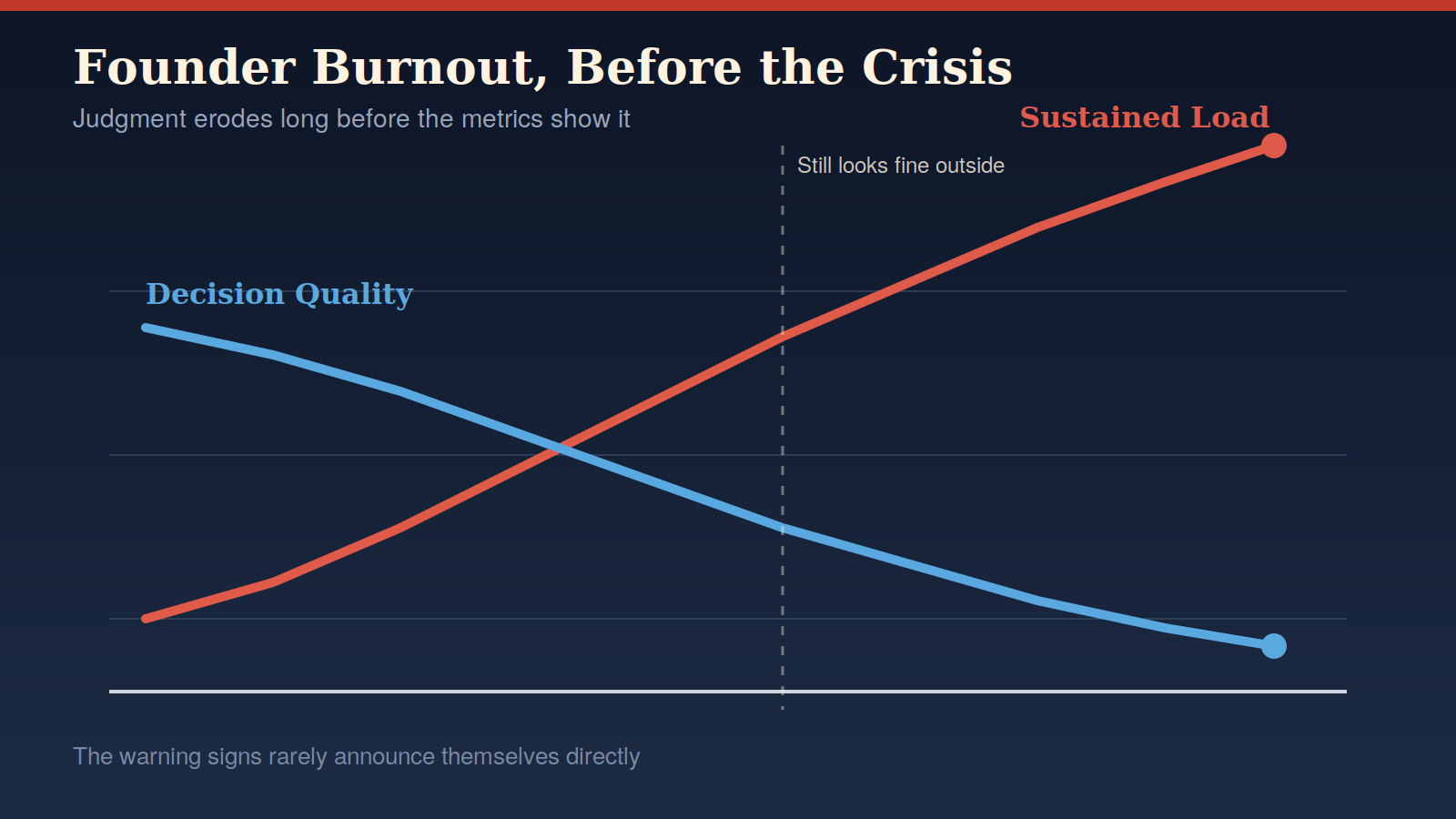
It would be easy to treat founder wellbeing as outside an investor’s job description. In practice, though, it’s directly tied to company outcomes. A burned-out founder makes worse decisions and avoids difficult conversations. They also lose the judgment that made them effective in the first place. Consequently, the company’s performance degrades well before any obvious crisis becomes visible from the outside.
Investors who only pay attention to metrics can miss this entirely until it’s already caused serious damage. By the time revenue numbers reflect the problem, the underlying exhaustion has often been building for months.
The Warning Signs That Are Easy to Miss
Burnout rarely announces itself directly. A founder experiencing it doesn’t usually say so outright. This happens partly from pride, and partly because they may not fully recognize it themselves. Instead, the signs tend to show up indirectly. Decisions that used to come quickly now take much longer. Communication becomes less frequent or more clipped. A founder who used to seem energized by the work starts describing it in flat, detached terms.
Notably, none of these signs alone proves anything. Together, though, they form a pattern worth taking seriously. This is especially true when they represent a real shift from how a founder normally operates.
What Adrian Vanzyl Believes Investors Can Actually Do
Investors aren’t therapists, and pretending otherwise helps no one. Instead, what investors can do is create genuine permission for founders to be honest about struggle. This beats performing constant confidence during every update call. A board member who only ever wants good news trains founders to hide exactly the information that matters most.
Beyond that, practical support matters more than sympathy alone. Consider helping a founder delegate a task they’ve been holding onto too tightly. Or, connect them with another founder who’s navigated something similar. Simply asking directly how they’re actually doing, rather than how the metrics are doing, can meaningfully shift the trajectory before things become severe.
Why the Physician’s Framework Applies Here
Medicine treats prevention as more valuable than crisis response. This framework applies directly to founder burnout. Waiting until a founder is in visible crisis carries real costs. In effect, it’s the equivalent of only treating a disease after it’s already advanced. Early, unglamorous intervention prevents most of the damage that a late-stage crisis eventually causes. That means checking in consistently and normalizing honest conversation, long before things reach a breaking point.
This preventive mindset doesn’t require clinical training to apply. It simply requires taking wellbeing seriously, as an ongoing input to company performance rather than an emergency to manage only once it’s unavoidable.
The Limits of What Investors Should Try to Fix Themselves
There’s an important boundary here. Investors can create space, ask better questions, and reduce unnecessary pressure. However, they shouldn’t try to serve as a founder’s actual mental health support. A founder showing signs of serious burnout deserves encouragement to seek real professional support. That’s different from simply getting a more understanding board member.
Recognizing this boundary isn’t a cop-out. Rather, it’s actually part of taking the problem seriously. After all, conflating genuine support with informal amateur intervention can leave a founder without the real help they actually need.
What This Means for Founders and Investors Alike
For founders, the practical takeaway is straightforward. Treat early signs of burnout as information worth acting on, not weakness to hide. For investors, the takeaway is just as direct. Build enough trust that founders feel safe sharing those signs in the first place, and take them seriously when they do.
That’s the standard Adrian Vanzyl holds himself to. It’s shaped as much by his medical training as by his years spent building and investing in technology companies.