Adrian Vanzyl

Why the Strongest Moats Are Built on More Than Technology

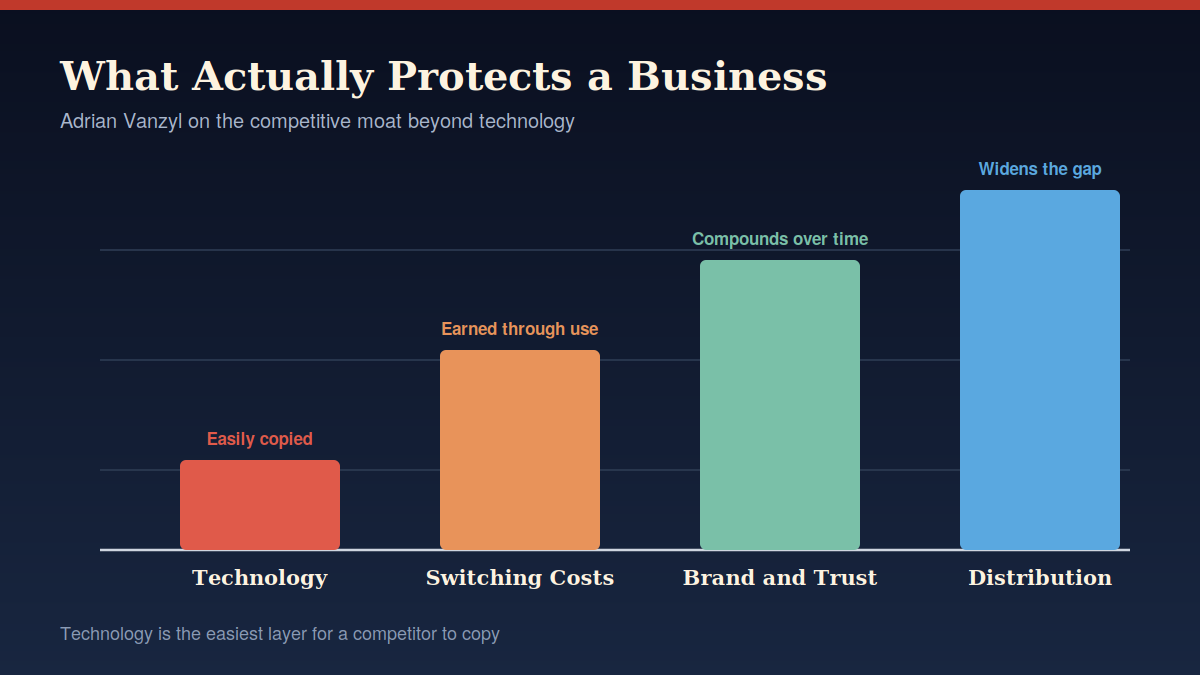
In fact, founders often describe their competitive moat in one word: technology. Adrian Vanzyl thinks that answer deserves more scrutiny than it usually gets. Technology matters, of course. However, it’s rarely the thing that keeps a company safe for long. Most technical advantages get copied faster than founders expect.

This isn’t a dismissal of engineering. Instead, it’s a reminder that durable protection usually comes from somewhere less obvious.

Why Technical Advantages Erode Faster Than Expected

A technical lead feels permanent while a company is building it. In practice, though, well-funded competitors can often replicate a feature in months. Open-source tools and shared talent pools speed this up even further. As a result, a lead measured purely in code tends to shrink quickly.

This matters because founders sometimes overinvest in the part of the business that’s easiest to copy. They polish the product while neglecting the assets competitors can’t simply download. Notably, the strongest companies tend to pair good technology with something far harder to replicate.

How Switching Costs Quietly Protect a Business

Some of the most durable moats come from the cost of leaving. When a customer has built workflows, trained staff, and stored years of data inside a product, switching becomes painful. That pain protects the company, even when a competitor offers something slightly better.

Importantly, this protection is earned through genuine usefulness, not through trapping customers. A product that becomes woven into daily work earns its place. By contrast, a product that relies on lock-in alone tends to breed resentment, and customers leave the moment a real alternative appears.

Why Brand and Trust Compound Over Time

Indeed, trust is slow to build and quick to lose. That asymmetry is exactly what makes it valuable. A company with a long record of reliability earns a kind of credit that new entrants can’t buy. Customers choose it partly because choosing something unfamiliar feels risky.

Consider a buyer comparing two similar products. One comes from a company they’ve trusted for years. The other comes from a newcomer with a slightly better feature set. In most cases, the trusted option wins. Therefore, reputation works as a real economic asset, even though it never appears on a balance sheet.

The Moat That Comes From Network Effects

For example, some products become more valuable as more people use them. Each new user adds something for everyone already there. This creates a self-reinforcing loop that’s very hard for a competitor to break into from the outside.

However, genuine network effects are rarer than founders assume. Many companies claim them without really having them. A larger user base alone doesn’t qualify. The product has to become measurably better for each person as the network grows. Founders should test this claim honestly before building a strategy around it.

Why Distribution Can Matter More Than the Product

Consequently, a good product with no way to reach customers loses to an average product with strong distribution. This is uncomfortable for engineers to accept. Even so, it’s a consistent pattern across industries. Access to customers, through partnerships, channels, or sheer familiarity, often decides the outcome.

Distribution advantages also compound. Established relationships make each new sale cheaper than the last. Meanwhile, a newcomer pays full price for every customer. Over time, that cost gap can become one of the widest barriers in the market.

What Adrian Vanzyl Believes Founders Should Ask About Their Own Moat

A useful exercise is to ask a blunt question. If a well-funded competitor copied the product tomorrow, what would still protect the business? The honest answer reveals whether the moat is real or imagined.

If the answer is only the technology, the moat is probably thinner than it looks. By contrast, if the answer includes customer relationships, switching costs, trust, or distribution, the position is much stronger. Founders who ask this question early can invest in the right assets before competition forces the issue.

Why the Competitive Moat Question Matters Even More for Investors

Investors face the same challenge from the other side. A pitch built entirely on technical superiority invites a hard follow-up. How long will that lead last? A thoughtful answer shows the founder understands where lasting value actually comes from.

Furthermore, a founder who can name several layers of protection tends to build a more resilient company. They’ve thought past the first product and considered how the business defends itself over years, not quarters.

What This Means for Founders Building Defensible Businesses

For founders thinking about defensibility, the practical takeaway is straightforward. Treat technology as a starting point rather than a finish line. Build switching costs through real usefulness, not artificial lock-in. Earn trust deliberately, since it compounds. And ask the blunt copycat question regularly, because the answer changes as the market does.

That’s the lens Adrian Vanzyl encourages every founder to apply, long before a competitor makes the question urgent.

Why Equity Education for Early Employees Isn’t Optional, According to Adrian Vanzyl

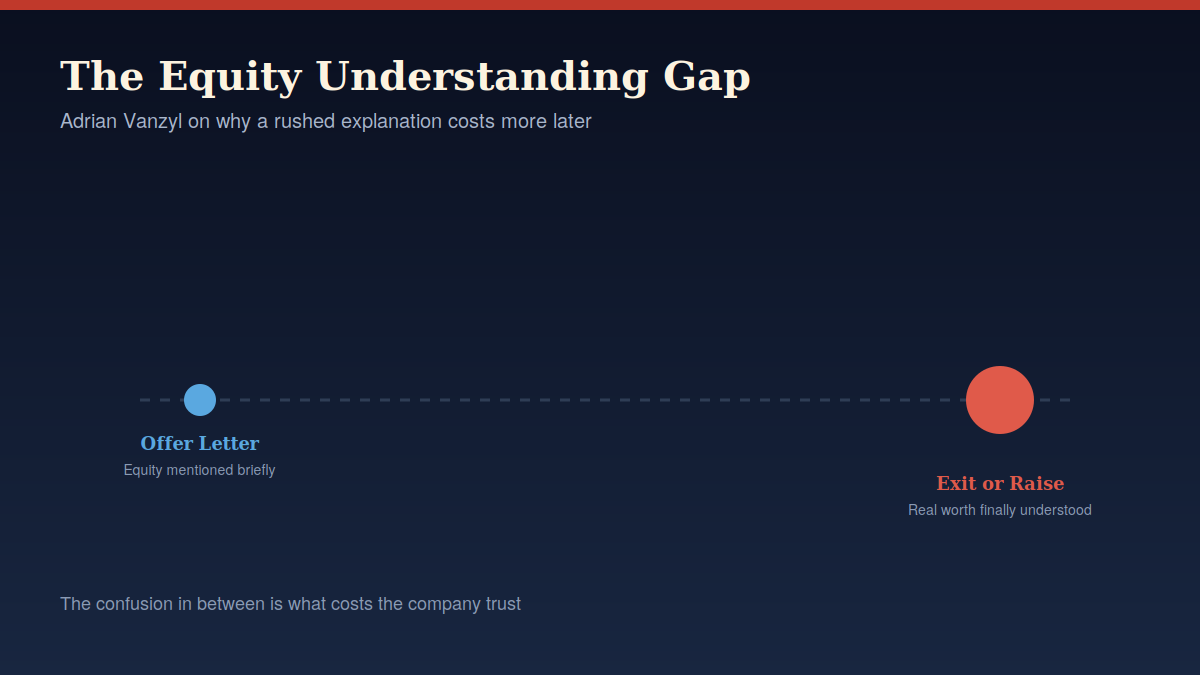
Founders spend real effort explaining the job, the mission, and the salary during a hire. Adrian Vanzyl has noticed a consistent gap right next to all of that effort. Equity is often the single largest part of an early employee’s compensation. However, it frequently gets explained in a few rushed minutes near the end of an offer conversation. That gap tends to resurface, usually at the worst possible moment.

This isn’t a legal compliance issue dressed up as a culture topic. Instead, it’s a reminder that confusion about equity quietly erodes trust long before anyone notices the cost.

Why Employees Rarely Ask the Questions That Matter Most

Notably, most early employees accept equity as a vague, exciting concept rather than something they fully understand. Asking detailed questions about strike price, vesting schedules, or dilution can feel awkward during a hiring conversation built around enthusiasm and momentum.

Consequently, employees often sign offer letters without truly grasping what they’re agreeing to. This isn’t because they don’t care. Rather, it’s because the social dynamics of a hiring conversation actively discourage the kind of detailed, skeptical questioning that equity actually deserves. A founder who doesn’t proactively close that gap is relying on employees to overcome a real social barrier on their own.

What Happens When Understanding Arrives Too Late

In fact, the real cost of this gap rarely shows up immediately. Instead, it shows up years later. This often happens during an exit or a new funding round. That’s when an employee finally confronts what their equity is actually worth, after taxes, dilution, and whatever specific terms applied to their grant.

That moment of delayed understanding frequently produces resentment, even when nothing was done maliciously. An employee who discovers their equity is worth far less than they’d assumed for years tends to feel misled, regardless of whether anyone actually misrepresented anything. The damage isn’t about dishonesty. It’s about an information gap nobody closed early enough to prevent disappointment later.

Why Vesting and Strike Price Deserve More Than a Passing Mention

Indeed, two details in particular tend to be glossed over, despite mattering enormously. The strike price determines what an employee actually pays to exercise their options. That cost can become a real financial burden if the company’s valuation has grown substantially by the time they leave.

Vesting schedules determine how much equity an employee actually owns at any given point. Leaving before a cliff or mid-vest can mean walking away with far less than expected. Explaining both of these clearly and early matters enormously. Employees who understand them make better decisions about when to exercise and when to leave. They also think more clearly about their own financial planning around the company’s trajectory.

The Cultural Signal Sent by Taking Equity Education Seriously

A founder who takes time to genuinely explain equity sends a clear signal. It shows how the company treats its people more broadly, rather than treating the topic as a formality to rush through. That signal compounds over time, shaping trust in ways that go beyond the specific topic of equity itself.

By contrast, a founder who rushes through equity explanations, or leaves them entirely to a generic legal document, signals something too, whether intentionally or not. Employees notice which parts of onboarding get genuine attention and which parts feel like boxes being checked quickly.

Why This Matters More as a Company Scales

Admittedly, in the earliest days, a founder might personally explain equity to every single hire. This at least creates the opportunity for real understanding, even if execution varies. As a company scales and HR processes take over onboarding, though, this personal touch often disappears entirely, replaced by a generic document nobody reads carefully.

This is exactly the stage where equity education needs to become more structured, not less personal in spirit, even if it can’t remain literally one-on-one. A scaling company benefits from formalizing equity education deliberately. Otherwise, it quietly erodes once the company grows past the size where a founder can explain it to everyone directly.

What Adrian Vanzyl Believes Good Equity Education Actually Looks Like

Ultimately, good equity education goes beyond a single conversation during the hiring process. Specifically, it includes accessible resources employees can revisit on their own time. Real examples illustrating what different outcomes might look like in dollar terms help too. Genuine encouragement to ask questions, without feeling like they’re slowing down the process, matters just as much.

Just as importantly, honesty about uncertainty matters too. Nobody can promise a specific outcome, and pretending otherwise sets up exactly the kind of disappointment this whole effort is meant to prevent. Honest uncertainty, explained clearly, builds far more trust than false confidence ever could.

What This Means for Founders Building Their Early Team

For founders building an early team, the practical takeaway is to treat equity education as seriously as any other part of onboarding, not as a quick addendum to the offer conversation. Explain strike price and vesting clearly and early. Create space for genuine questions, even uncomfortable ones. And build resources that scale as the company grows past the point where personal explanation alone is enough.

That’s the standard Adrian Vanzyl encourages every founder to hold themselves to, long before a departing employee’s confusion becomes a costly, avoidable surprise.

Why Pricing Is a Strategic Decision, Not a Math Problem, According to Adrian Vanzyl

Notably, founders often treat pricing as something to calculate once and revisit rarely. Adrian Vanzyl sees this as one of the most consistently underweighted decisions a company makes. Pricing isn’t simply cost plus margin. Instead, it shapes who buys the product, how they perceive it, and what kind of company gets built around it.

This isn’t a call to obsess over pricing endlessly. Rather, it’s a reminder that a number chosen quickly in the early days often sticks around far longer than it should.

Why Low Prices Don’t Always Win More Customers

Founders often default to low pricing, assuming it removes friction and speeds up adoption. In practice, though, this assumption doesn’t always hold. Price itself carries information. A price set too low can signal low quality or low confidence, even when the actual product is genuinely strong.

Consequently, some products sell better at a higher price point, not despite the price but partly because of it. Customers use price as a proxy for quality when they can’t fully evaluate the product upfront. A founder chasing volume through aggressive discounting can accidentally undermine the exact perception that would have made the product easier to sell.

The Trap of Pricing Based on Cost Alone

Cost-plus pricing feels safe and defensible, since it’s grounded in a number the founder can actually calculate. However, it ignores something important. It overlooks the value the product actually creates for the customer, which is frequently far higher than the cost of delivering it.

A product that saves a customer significant time or money can often command a price well above its production cost. That works as long as the value gets communicated clearly. Anchoring purely to cost leaves real revenue on the table. More importantly, it fails to position the product according to what it’s actually worth to the people buying it.

Why Changing Price Later Is Harder Than It Should Be

Indeed, a price set too low early on creates a specific kind of problem down the line. Existing customers expect the original price to hold. Raising it later often triggers churn, even when the increase is modest and reasonable relative to the value delivered.

This dynamic makes the initial pricing decision more consequential than most founders realize at the time. It’s far easier to start slightly higher and offer targeted discounts than to raise a price that customers have already anchored around. Notably, the first number chosen often becomes the baseline every future conversation gets measured against.

How Pricing Shapes the Type of Customer a Company Attracts

In fact, price doesn’t just determine revenue. It also filters who becomes a customer in the first place. A low price point tends to attract price-sensitive customers. These customers are more likely to churn when a cheaper alternative appears, and often demand disproportionate support relative to what they pay.

By contrast, a higher price point tends to attract customers who value the product on its actual merits rather than its cost. These customers are generally more stable, more profitable, and less prone to constant price comparison. This connects directly to the broader discipline of choosing the right customers in the first place, since pricing is one of the clearest levers founders have for shaping that mix.

Why Pricing Experiments Deserve More Rigor Than Founders Usually Give Them

Admittedly, many founders set a price once and leave it unexamined for years. They treat it as a fixed constant rather than a variable worth testing deliberately. This hesitation is understandable, since pricing changes feel riskier than most other experiments a company can run.

However, treating price as permanently fixed means missing something important. It means missing the chance to find a number that better reflects actual value delivered. Structured, careful experimentation, rather than guesswork or indefinite avoidance, tends to reveal pricing opportunities that founders significantly underestimate until they actually test them.

What Adrian Vanzyl Believes Founders Should Consider Before Setting a Price

Before settling on a price, founders benefit from asking a few specific questions. What alternative is the customer actually comparing this to, even if it’s not a direct competitor? Separately, what outcome does the customer actually value? How much is that outcome genuinely worth to them? And how will this price age as the product and company mature?

These questions shift pricing from a quick calculation into a genuine strategic decision. It becomes one that reflects the business the founder is actually trying to build, rather than simply covering costs with a reasonable margin on top.

What This Means for Founders Setting Their Price

For founders setting or reconsidering a price, the practical takeaway is to treat the decision with real deliberation. Don’t default to whatever feels safe or common in the category. Price according to value, not just cost. Start closer to where you want to end up, since raising later is harder than it looks. And revisit pricing periodically, rather than treating the first number as permanent.

That’s the discipline Adrian Vanzyl encourages every founder to bring to a decision too often made quickly and revisited too rarely.