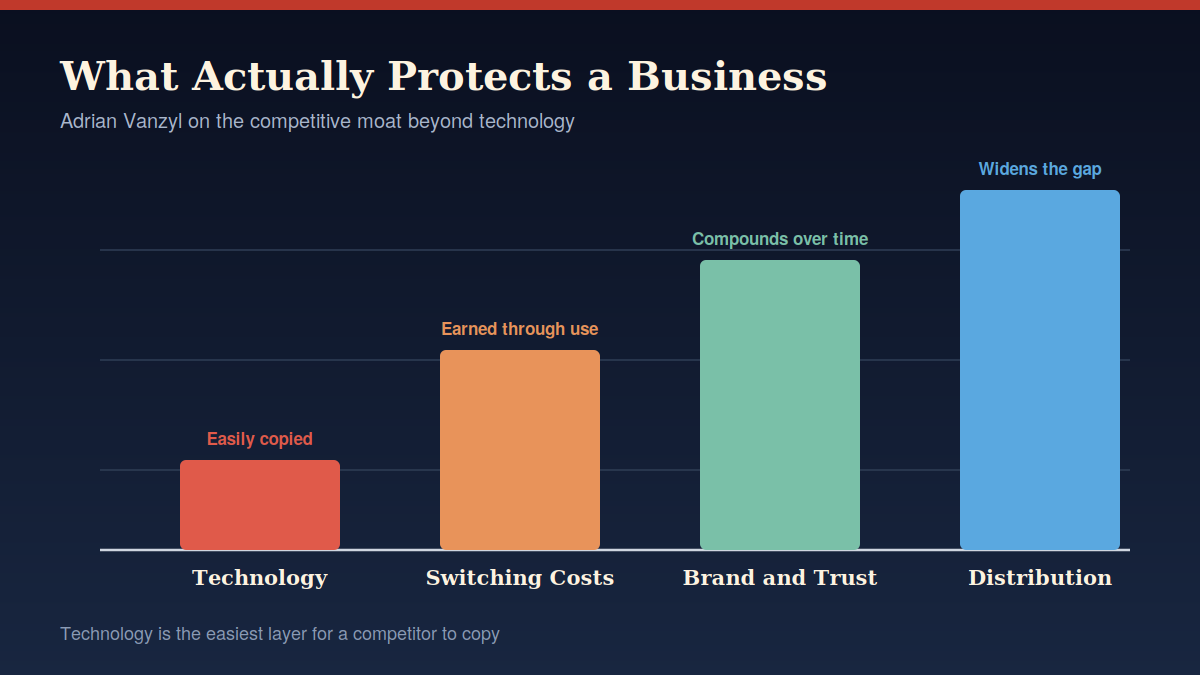
In fact, founders often describe their competitive moat in one word: technology. Adrian Vanzyl thinks that answer deserves more scrutiny than it usually gets. Technology matters, of course. However, it’s rarely the thing that keeps a company safe for long. Most technical advantages get copied faster than founders expect.
This isn’t a dismissal of engineering. Instead, it’s a reminder that durable protection usually comes from somewhere less obvious.
Why Technical Advantages Erode Faster Than Expected
A technical lead feels permanent while a company is building it. In practice, though, well-funded competitors can often replicate a feature in months. Open-source tools and shared talent pools speed this up even further. As a result, a lead measured purely in code tends to shrink quickly.
This matters because founders sometimes overinvest in the part of the business that’s easiest to copy. They polish the product while neglecting the assets competitors can’t simply download. Notably, the strongest companies tend to pair good technology with something far harder to replicate.
How Switching Costs Quietly Protect a Business
Some of the most durable moats come from the cost of leaving. When a customer has built workflows, trained staff, and stored years of data inside a product, switching becomes painful. That pain protects the company, even when a competitor offers something slightly better.
Importantly, this protection is earned through genuine usefulness, not through trapping customers. A product that becomes woven into daily work earns its place. By contrast, a product that relies on lock-in alone tends to breed resentment, and customers leave the moment a real alternative appears.
Why Brand and Trust Compound Over Time
Indeed, trust is slow to build and quick to lose. That asymmetry is exactly what makes it valuable. A company with a long record of reliability earns a kind of credit that new entrants can’t buy. Customers choose it partly because choosing something unfamiliar feels risky.
Consider a buyer comparing two similar products. One comes from a company they’ve trusted for years. The other comes from a newcomer with a slightly better feature set. In most cases, the trusted option wins. Therefore, reputation works as a real economic asset, even though it never appears on a balance sheet.
The Moat That Comes From Network Effects
For example, some products become more valuable as more people use them. Each new user adds something for everyone already there. This creates a self-reinforcing loop that’s very hard for a competitor to break into from the outside.
However, genuine network effects are rarer than founders assume. Many companies claim them without really having them. A larger user base alone doesn’t qualify. The product has to become measurably better for each person as the network grows. Founders should test this claim honestly before building a strategy around it.
Why Distribution Can Matter More Than the Product
Consequently, a good product with no way to reach customers loses to an average product with strong distribution. This is uncomfortable for engineers to accept. Even so, it’s a consistent pattern across industries. Access to customers, through partnerships, channels, or sheer familiarity, often decides the outcome.
Distribution advantages also compound. Established relationships make each new sale cheaper than the last. Meanwhile, a newcomer pays full price for every customer. Over time, that cost gap can become one of the widest barriers in the market.
What Adrian Vanzyl Believes Founders Should Ask About Their Own Moat
A useful exercise is to ask a blunt question. If a well-funded competitor copied the product tomorrow, what would still protect the business? The honest answer reveals whether the moat is real or imagined.
If the answer is only the technology, the moat is probably thinner than it looks. By contrast, if the answer includes customer relationships, switching costs, trust, or distribution, the position is much stronger. Founders who ask this question early can invest in the right assets before competition forces the issue.
Why the Competitive Moat Question Matters Even More for Investors
Investors face the same challenge from the other side. A pitch built entirely on technical superiority invites a hard follow-up. How long will that lead last? A thoughtful answer shows the founder understands where lasting value actually comes from.
Furthermore, a founder who can name several layers of protection tends to build a more resilient company. They’ve thought past the first product and considered how the business defends itself over years, not quarters.
What This Means for Founders Building Defensible Businesses
For founders thinking about defensibility, the practical takeaway is straightforward. Treat technology as a starting point rather than a finish line. Build switching costs through real usefulness, not artificial lock-in. Earn trust deliberately, since it compounds. And ask the blunt copycat question regularly, because the answer changes as the market does.
That’s the lens Adrian Vanzyl encourages every founder to apply, long before a competitor makes the question urgent.